
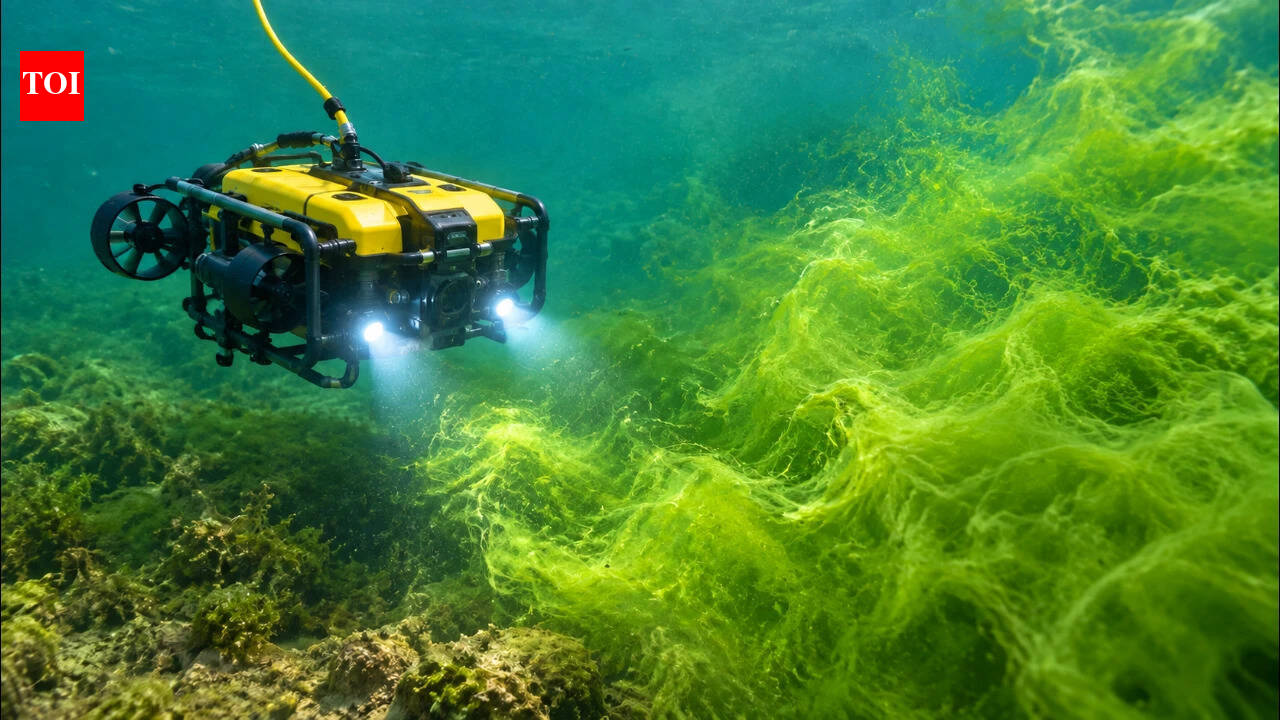
 AI Representation: NOAA sent a robot lab beneath Lake Erie’s toxic algae and got instant water-safety readings. Image credits: Chatgpt Lake Erie’s western basin turns green most summers as cyanobacteria bloom out of control, producing a liver toxin called microcystin that can shut down drinking water intakes and beaches. For decades, tracking that toxin meant sending a crew out by boat to collect water samples, then waiting a day or two for lab results, a delay that leaves water managers making decisions on outdated information. In the summer of 2021, NOAA and its research partners tested a different approach: an uncrewed underwater vehicle carrying its own compact toxin detection instrument, capable of producing a targeted microcystin measurement in under two hours without anyone hauling a sample back to shore.The main instrument in this operation was the Long-Range Autonomous Underwater Vehicle (LRAUV), equipped with what NOAA refers to as the 3rd generation Environmental Sample Processor, often abbreviated as 3G-ESP. It has been colloquially referred to as a lab-in-a-can, as it takes in water from the lake, processes and analyzes it for any toxic content right there in the vehicle. This experiment in 2021 was a continuation of the equivalence testing that had been conducted in previous years, showing that the robot’s measurements compared favorably to the manually collected samples.How the robot lab measured toxin levels in real timeThe 2021 deployment was documented in Underway measurement of cyanobacterial microcystins using a surface plasmon resonance sensor on an autonomous underwater vehicle, published in Limnology and Oceanography: Methods. This research group fitted a surface plasmon resonance sensor capable of detecting microcystin within the 3G-ESP platform and inserted it inside the LRAUV for field tests in western Lake Erie over that summer season. It took less than two hours for the system to produce one targeted toxin measurement compared to 24 to 48 hours required to conduct the same activity using shore-based laboratory analysis of manually collected samples.During the 14-day period of deployment, the vehicle remained inside the lake water without any recovery, and the results produced by the sensor included 16 measurements of particle-associated microcystin between 0.09 and 0.55 micrograms per liter of lake water. The researchers stressed the point that the system is meant to complement, rather than replace, current testing technologies; it works along with, rather than replacing, satellite data, aerial surveys, and manual sampling. In addition, because the sensor’s antibody cross-reacts with at least six different forms of microcystin found in western Lake Erie, the readings captured more of the toxin’s variants than a test tuned to a single form would, even though the result is reported as one combined total microcystin measurement rather than a breakdown by variant.Why earlier field trials found no significant gap across twelve measurementsThe confidence to trust an uncrewed vehicle’s onboard readings did not come from the 2021 season alone. It rests on equivalency testing described in Lake Erie field trials to advance autonomous monitoring of cyanobacterial harmful algal blooms, published in Frontiers in Marine Science, which compared the LRAUV-3G ESP system against manual sample collection during seasonal Microcystis blooms in western Lake Erie in 2018 and 2019. The comparison involved twelve different metrics, such as total counts for cyanobacteria via qPCR, microcystin toxin gene via qPCR, 16S amplicon sequencing, and metagenomic diversity measures, and it found no statistical difference between the results from the robotic system and the results that were collected manually.
A car ferry on Lake Erie. Image credits: Wikimedia Commons
This previous study is what gave the 2021 experiment its status as a true field test of the real-time system rather than an unproven prototype. The Frontiers study also showed that the robotic sampling tool was able to do something that manual sampling could not: obtain many more discrete samples across more days and sites than a manual crew would typically collect by boat, which in turn revealed differences in bacterial taxonomic composition and toxin gene concentrations that those same molecular assays had picked up.What the paired results mean for lake safety monitoringTaken together, these two papers highlight a technology which had already demonstrated its equivalence with traditional testing procedures prior to being tasked with measuring toxins in near-real time. The 2021 field season proved that an automated vehicle was capable of not just collecting a representative sample as had been shown in the previous equivalency tests, but analyzing that sample for a particular toxin in situ, reducing the turnaround time from days to hours. Cyanobacterial harmful algal blooms cost the United States more than $2 billion each year in terms of damage to drinking water supplies, recreation, and agriculture, according to the Limnology and Oceanography: Methods paper, and much of that cost is related to uncertainty regarding the current level of toxicity of any particular bloom.Researchers involved in the project reiterated that point, noting that no single method, whether robotic, satellite or crewed, captures everything the others can. Still, the shift toward on-the-fly toxin analysis marks a meaningful change for a lake where water treatment operators have historically had to make safety calls based on data that was already a day or two old by the time it reached them. As this technology moves from field trials toward routine use, it points toward a future where the gap between a bloom forming and a warning reaching the public shrinks from days to hours.