
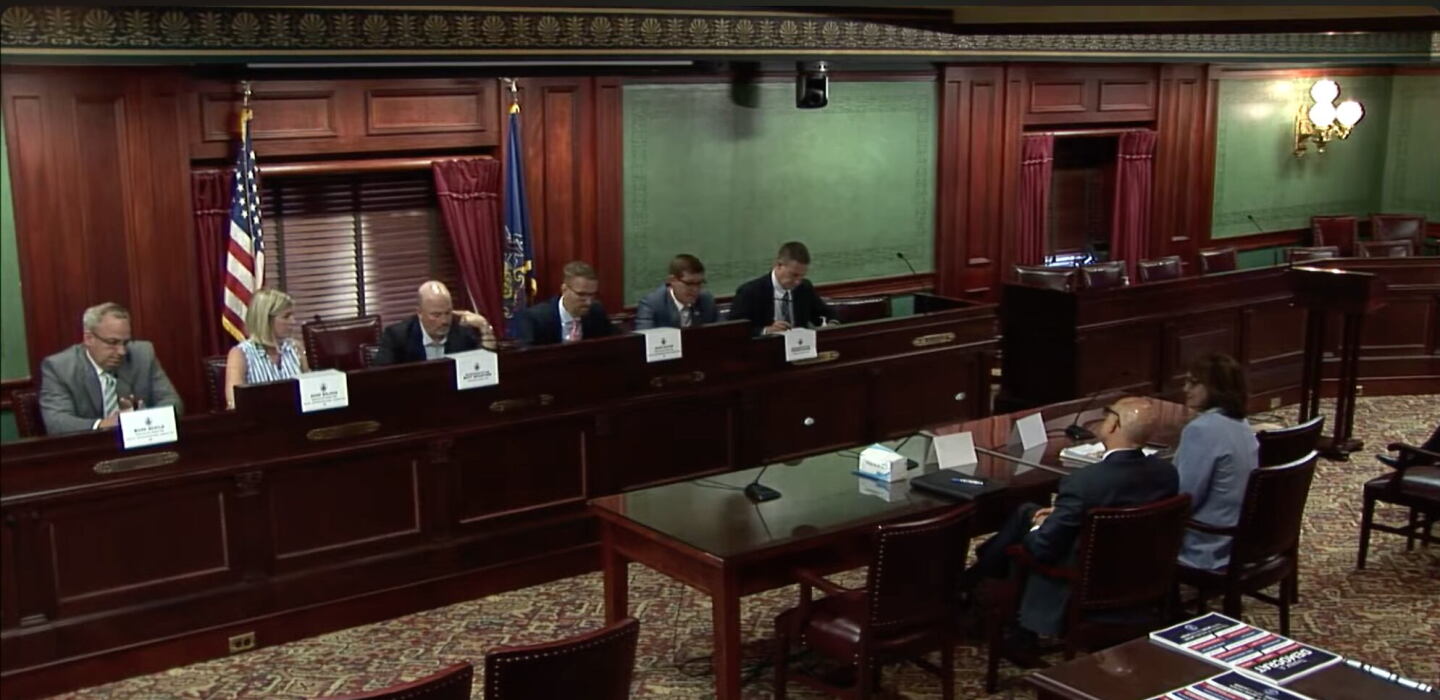
A Pennsylvania state board created to review billions of dollars in tax credits and government spending quietly stopped meeting three years ago and board members won’t say why.
The state’s widely touted first-of-its-kind Performance-Based Budget Board was formed by law in 2017 with bipartisan support and a simple purpose: to evaluate in public hearings how state departments and tax credits performed and fund them based on whether they met certain goals instead of just automatically updating previous years’ budget numbers, which is what Harrisburg lawmakers were doing at the time.
The budget secretary, who the governor appoints, was responsible for selecting which agencies to review in the first cycle. The Independent Fiscal Office (IFO), a nonpartisan fiscal watchdog agency, weighed in on the selections and conducted the reviews.
The game plan was to try this process and regroup every five years to see what could be improved.
But after a political spat over how the Department of Education’s spending was reviewed, where Democrats changed key facts in the analysis, the board ended its short run in 2023, before the first five-year cycle was completed, without notifying other lawmakers or the public.
Experts, former board members and advocacy groups called the sudden disappearance of the board concerning.
George Dunbar, an early advocate of performance-based budgeting and a former Republican House representative, was on the board before he left to lead the Gaming Control Board. He said the goal of the board was not necessarily to cut funding but to bring more transparency to the state budget process, which is mostly done behind closed doors.
“We used to take last year’s number, increase or decrease the percentage, and argue whether that’s right or wrong with no mention of the outcomes,” Dunbar said. “There’s so much money that goes through that budget that nobody knows where it even goes to.”
Gov. Josh Shapiro, a Democrat, took office in January 2023, and the board met three months later for the last time.
The Shapiro administration said he did not ask the board to stop meeting, and that his budget secretary was only responsible for scheduling which agencies and tax credits the IFO would review during the first incomplete cycle.
His office said the whole process was “very labor-intensive and time-consuming for agency staff and IFO staff.” They blamed the Legislature, saying that many recommendations from the IFO would require changes in the law but they haven’t “seen any movement.”
“Requiring agencies to continue spending time on reviews without clear direction from the board is not productive and takes away from providing other valuable services to Pennsylvanians,” a spokesperson added.
IFO Director Matt Knittel agreed it was a time-intensive task but added “it’s not clear if or how” the governor’s office uses performance-based metrics in the state budget process because neither the data or process is publicly disclosed.
“That is why legislators’ input is needed,” Knittel said, referring to the board.
Former Sen. Bob Mensch, R-Berks County, who championed the bill that created it, said the board was to “help departments justify why they’re asking for money.” But he said he wasn’t surprised by how things played out.
“The board can be more or less effective depending upon leadership,” Mensch told PennLive. “So the governor has to be behind it, has to understand it and has to really reinforce it and not just with rhetoric, but with actual action for it to work.”
Budget Secretary Zachary Reber declined an interview request and did not respond to questions on why the first cycle wasn’t completed.
“They’re actually just thwarting the law, just ignoring the law and not doing this and it could be laziness, but I’m more concerned that they just don’t want to be transparent and really don’t want to be held accountable,” said Nathan Benefield, chief analyst at the conservative Commonwealth Foundation.
Benefield also said his agency would look into filing a court order forcing the budget secretary to restart the board if “they don’t act quickly on this.”
Bernie Gallagher from the progressive Keystone Research Center said while performance-based budgeting isn’t a one-size-fits-all solution, there is “absolute value in having an independent public analysis on whether programs are performing and whether public dollars are accomplishing what policymakers intended.”
House Majority Leader Matt Bradford, D-Montgomery County, chaired the board right before it went dark. He did not respond to multiple interview requests for this story.
The Board Was ‘Really Important’
Five powerful public officials who have significant influence in the state budget make up the board: the Governor’s budget secretary and the four House and Senate appropriations chairs.
The IFO did a lot of the grunt work. It collected all kinds of data from agencies, analyzed costs and compared them with performance metrics, and synthesized all of it into a digestible report with recommendations for the board to approve or reject.
The approved reports were publicly posted on the IFO website, and shared with the governor and the Legislature to incorporate in the state budget process, involving tens of billions of dollars.
John Wetzel, who was secretary at the Department of Corrections until 2022, recalled a budget hearing where lawmakers used the performance-based budget report as “one of the better hearings I’ve ever had in my time at DOC.”
He said he was “a big proponent” of the board’s process, especially because the DOC historically had an “opaque kind of operation.”
“And so having this objective and transparent process where you have to quantify how you measure success in your operation, I thought that was really important and aligned with trying to invest more in treatment to improve incarcerated people’s lives,” Wetzel said.
In its five active years, the board made significant strides in identifying wasteful spending.
Three tax credits that cost taxpayers millions of dollars were flagged after the board found they were not benefiting the people they were intended to serve, Spotlight PA reported in 2020. A tax credit is a deduction on the amount of taxes an entity owes to the state.
The IFO found that:
A broadband tax credit, which was created to increase broadband access in rural areas, didn’t mandate companies to invest in those areas.Another credit to increase bone marrow donations hadn’t been used in five years.The Keystone Innovation tax credit was conceived to create jobs in the state but didn’t come with requirements to actually collect data on how many jobs were created.The board’s findings also facilitated changes in law.
The Education Tax Credit previously mandated its recipients to use 80% of funds for scholarships, allowing them to use 20% however they wanted. But after the board flagged it, the Legislature changed the law to reduce the discretionary portion to 10%.
Knittel, who leads the IFO, called the board’s sudden quitting “unfortunate.”
“Given the amount of money that’s being used for these incentive and tax credit programs, it’s appropriate that an analysis be done to see if the spending is having its intended outcomes,” Knittel said.
Stan Saylor, a former board member and representative from York County, said responsible spending of taxpayer dollars can’t happen “without holding people who fail accountable.”
“When you talk about performance, of course somebody’s ox is getting gored and certain people don’t like that,” Saylor said. “But it’s the people who are in charge now that don’t want to see it perform.”
The Beginning of the End
Like most things at the Capitol, the board wasn’t immune from politics. Because the governor appoints the budget secretary, Democrats held majority control of the board throughout its tenure.
And in 2022, a review of the Department of Education’s funding created controversy. Dunbar and Saylor, two former board members, said this hearing contributed to the board’s sudden inactivity.
The IFO calculated the cost per student in all traditional public schools and compared it with test scores to see how funding compared with student achievement. The report found “little to no correlation.”
The board tabled the report in January and asked the IFO to change its cost-per-student calculations to include the fair funding formula to provide a more accurate cost. It increases per-student costs for those in poverty and minority groups, who typically need more resources to educate.
But the board also asked the IFO to add charter school funding, which dramatically reduced the overall cost per student for school districts with low-income students.
However, this new analysis didn’t include charter school students’ test scores.
Instead, the board directed the IFO to compare this new lower cost per student to traditional public school test scores only, a methodological flaw that data experts said undermined the analysis.
The flawed method made it seem as if lower costs per student resulted in worse test scores.
Justin Ortagus, professor of higher education and public policy at the University of Texas, has worked with performance-based budgeting in higher education. He said the new calculation “does not make sense.”
“Whenever you look at the influence of input on output, you want to be sure that what you’re measuring for the input is similarly matched for what you’re measuring for the output,” Ortagus said.
“So if you are going to include charter and public school students, one would expect that that would be in the output, or you would do an apples-to-apples comparison between public school cost per student and public school test outcomes only,” he added.
The board also directed the IFO to remove the sentence from its original report which said there was “little or no correlation” between public school spending and test scores.
House Majority Leader Bradford, who chaired the board, did not respond to a detailed list of questions on why the IFO was directed to change its calculations or remove the sentence from its original report.
The IFO also only looked at one year’s worth of education data but for in-depth analyses, experts look at least a decade’s worth of data, which IFO Director Knittel acknowledged — but noted that’s not what the agency was asked to do.
In May of 2022, the board met to review the amended report. Less than a minute into the hearing, Bradford made a motion to approve the report. Former Democratic Budget Secretary Gregory Thall seconded it.
“All in favor, say aye,” Bradford, a Democrat, continued hastily, before being interrupted by former Republican Rep. Torren Ecker from Adams County.
Ecker expressed concern about the new analysis and asked the IFO to publish both analyses on its website.
The report was approved 3-2 with the Democratic lawmakers and the budget secretary voting yes, and the Republican lawmakers voting no.
Six months after this hearing, Democrats flipped the state House after 12 years of Republican control.
The board met in early 2023 for the final time to review and approve spending for the rest of the agencies in its first cycle.
Soon after, the IFO prepared a report on how to improve the performance-based budget process by surveying all the agencies that were reviewed in the first five years. This report was then sent to the board for review. But the board never met again and the IFO got no further information.
One year later, Shapiro came up with his own process to weed out wasteful spending: the Resource Evaluation and Mission Alignment (REMAP) initiative. But it’s an internal process where the governor’s office works with agencies with minimal public input. It’s also not required by law or subject to Pennsylvania’s public records law, unlike the Performance Based Budget board.
Shapiro’s office didn’t respond to a request from a reporter to see the data his office uses to come up with REMAP reports.
Karen Shastri, an accounting professor at the University of Pittsburgh who’s taught performance-based budgeting, said transparency is key.
“This is the kind of information that should be public so that people can assess what’s actually going on and make our own conclusions about whether or not we think it’s being done correctly,” Shastri said.
Dunbar, the former board member, said it comes down to being responsible with taxpayer dollars.
“Because sometimes when you know you’re being looked at, in a public setting, you put a little more effort, maybe do a better job with public dollars,” Dunbar said.
©2026 Advance Local Media LLC. Visit pennlive.com. Distributed by Tribune Content Agency, LLC.