
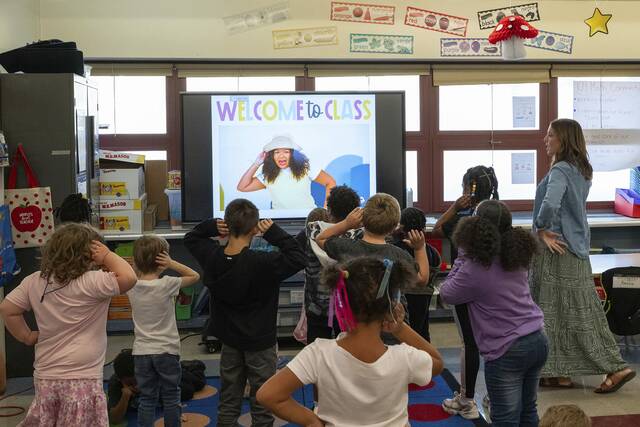
A normal school day at Pittsburgh Phillips PreK-5 in the South Side doesn’t look or sound anything like other schools, its teachers say.
“There’s not a quiet classroom in the building,” said Michael Russell, a project assistant at Phillips. “Everyone’s always doing something in terms of movement and interaction. The kids really need that throughout the day.”
The activities and culture at Phillips make it one of the healthiest schools in the nation, according to the Oregon-based Alliance for a Healthier Generation.
Phillips is one of 200 schools nationwide — and one of only two in Pennsylvania — to earn All-Star status on the Alliance’s America’s Healthiest Schools list.
Schools apply to be recognized. While nine other city schools made the list, Phillips achieved “All-Star” status, which means it implemented best practices across areas in: school health services, wellness policies for students and staff, nutrition and food access, physical and health education, social-emotional health and learning, being tobacco-free, and family engagement.
Curtisville Primary Center in the Deer Lakes School District is the other state All-Star school on the list.
“We really try to embed these things so it’s natural,” said Phillips Principal Dana Boesenberg. “Teachers weave it in with their curriculum, and it’s organic. We try to be in real time with things, and if there’s an issue in class, we try to make it meaningful. I think students respond well.”
The school has placed an emphasis on social-emotional learning, and uses the district’s curriculum teaching self-awareness, self-management, social awareness, relationship skills, and responsible decision-making, Boesenberg said. Phillips has spaces in the school where students can calm down if they are feeling overwhelmed or anxious.
Students are recognized for positive behavior through school announcements and prizes.
“The kids love nothing more than seeing their name in shout-outs,” Boesenberg said. “We showcase students’ positive behaviors and interactions, and it’s motivating.”
First grade student Gianna Gault, 6, said being recognized is special.
“It makes me feel happy,” Gianna said. “I was student of the month in kindergarten.”
Meeting students where they are
Phillips teachers encourage students to try new things. Students’ knowledge on health varies, said Jennifer Bichler, health and physical education teacher.
“There’s some kids who know jackfruits and dragon fruits, and others who think a potato is a fruit,” she said. “We run the gamut of what they understand.”
The school works with outside organizations to provide healthy food to families interested, Boesenberg said. Even something as simple as how breakfast and lunch food is placed and presented on a tray can make a student more open to trying something new and healthy, said Shannon Bender, food service manager.
“It’s trying to get them to try new things, expand their palate and provide a healthier lifestyle,” Bender said. “We make it more appealing to kids. The more appealing it is, the more likely they are to try it.”
Even physical education class at Phillips doesn’t look traditional. Bichler brings in professional guests to lead lessons like yoga, ballet or ballroom dancing. Class periods often give students options for activities, which Boesenberg complimented.
“The concept of student choice is sometimes missed, and why students disengage,” she said.
Over the years Bichler has been a teacher, students have become more fidgety, she said. She tries to keep students as active as possible in physical education class, and she plans a “walking classroom” this year. That initiative includes students walking indoors while listening to a podcast that matches the school curriculum.
“It’s good to get them to see lifelong fitness,” she said. “Walking and running help deescalate feelings, build friendships and take care of their body.”
‘Educate as much as I can’
A lot of the school’s health initiatives are geared toward students. But there’s still a focus on the adults in the building, too, said school nurse Colleen Schultz. She’s worked on leading blood pressure and weight loss for teachers.
Students are increasingly entering school with more complex medical needs than before — including feeding tubes, straight casts, severe seizure epilepsy and diabetes — Schultz said. While tending to daily needs, Schultz also works with students to help them become more independent. That could include working with a diabetic student to help them figure out their carbs for lunch.
“I try to educate as much as I can,” she said. “I like to have them get involved as much as possible. It helps them learn more, and they’re more engaged.” Phillips also met criteria for tobacco-free education.
Bichler said the school partners with UPMC and Adagio Health to provide age-appropriate lessons on that subject.
“An example would be how can we keep our lungs healthy, and what might make them unhealthy?” she said.
Families are the school’s strongest asset, principal says
Fifth grade student Jace Rutherford, 10, is one of Phillips’ “Student Envoy” leaders. He and his peers promote a positive, healthy culture to other students at the school through initiatives like lessons and posters.
“They say, ‘Be respectful and responsible,’ and ‘Don’t give up,’ ” Jace said. “They tell people not to do bad things.”
Families support the school projects, said Melissa Ott, first grade teacher and the school’s family and community engagement coordinator. Phillips’ student population is 242, and it is a partial magnet school, meaning it serves local neighborhood students while also accepting students from across the city through a lottery system.
More than 150 parents attended a recent math night at the school, Boesenberg said. Ott said staff plans an internet safety night with Pittsburgh Action Against Rape to help parents keep their children safe online.
“It’s a fine line to balance,” Boesenberg said of screen time. “The device is used every day for education and learning. When you think about what the world looks like now, if we aren’t teaching them how to use it, we’re not setting them up for the future.”
The staff’s wellbeing also plays a role in the school’s success. Boesenberg said, with different initiatives and goals teachers are saddled with, staff support for an initiative like Healthiest Schools could be a challenge. But it’s not at Phillips, she said.
“We all buy-in because we see it working,” Bichler said.
Social worker Stephanie Cohen said Boesenberg’s leadership makes staff feel supported at school.
“A lot of what happens here involves staff being happy and confident here,” Cohen said. “A lot of what happens makes the not-so-fun times, when they happen, easier.”