
Photo by Nathan Oun for The Lafayette
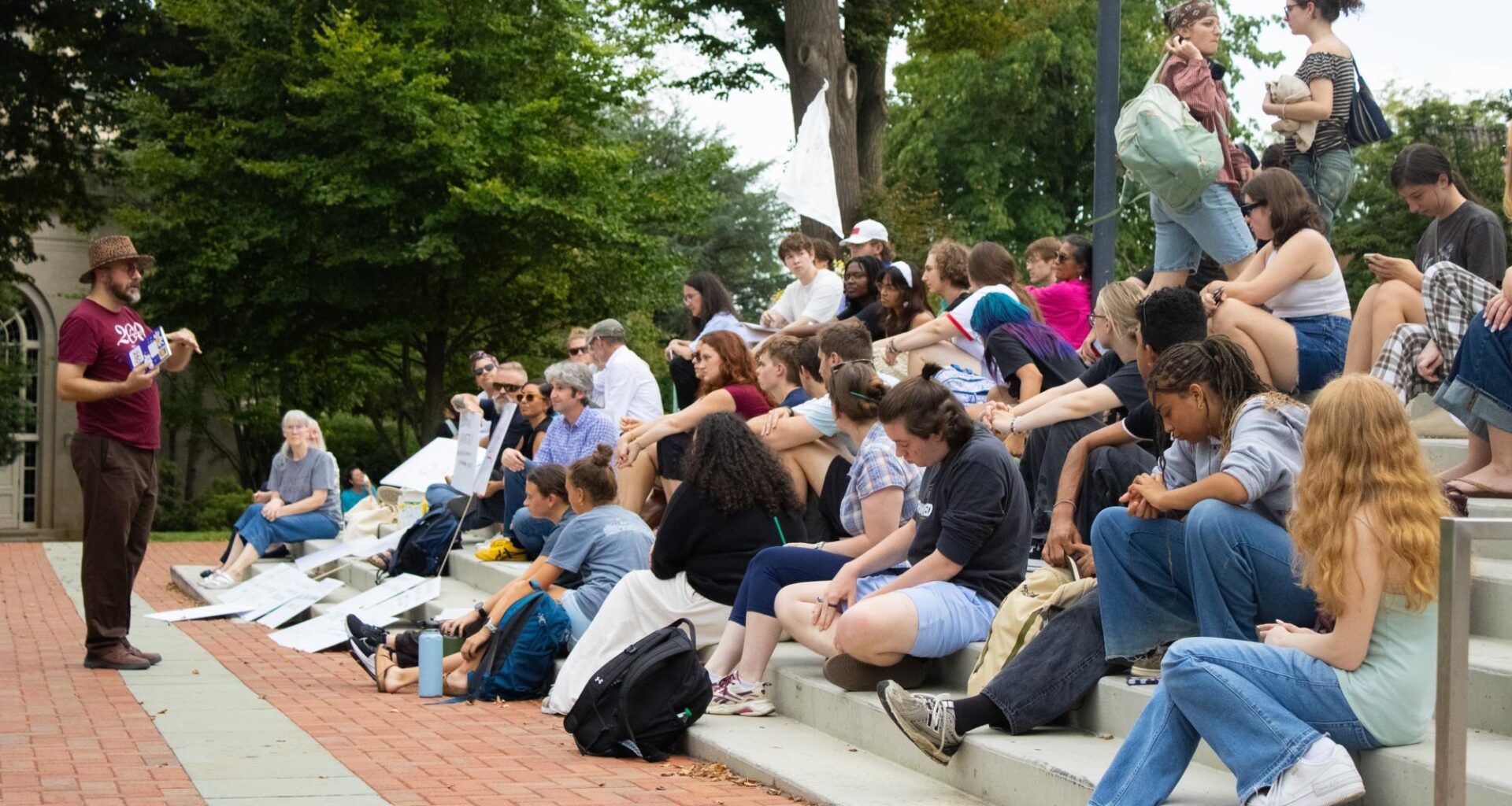
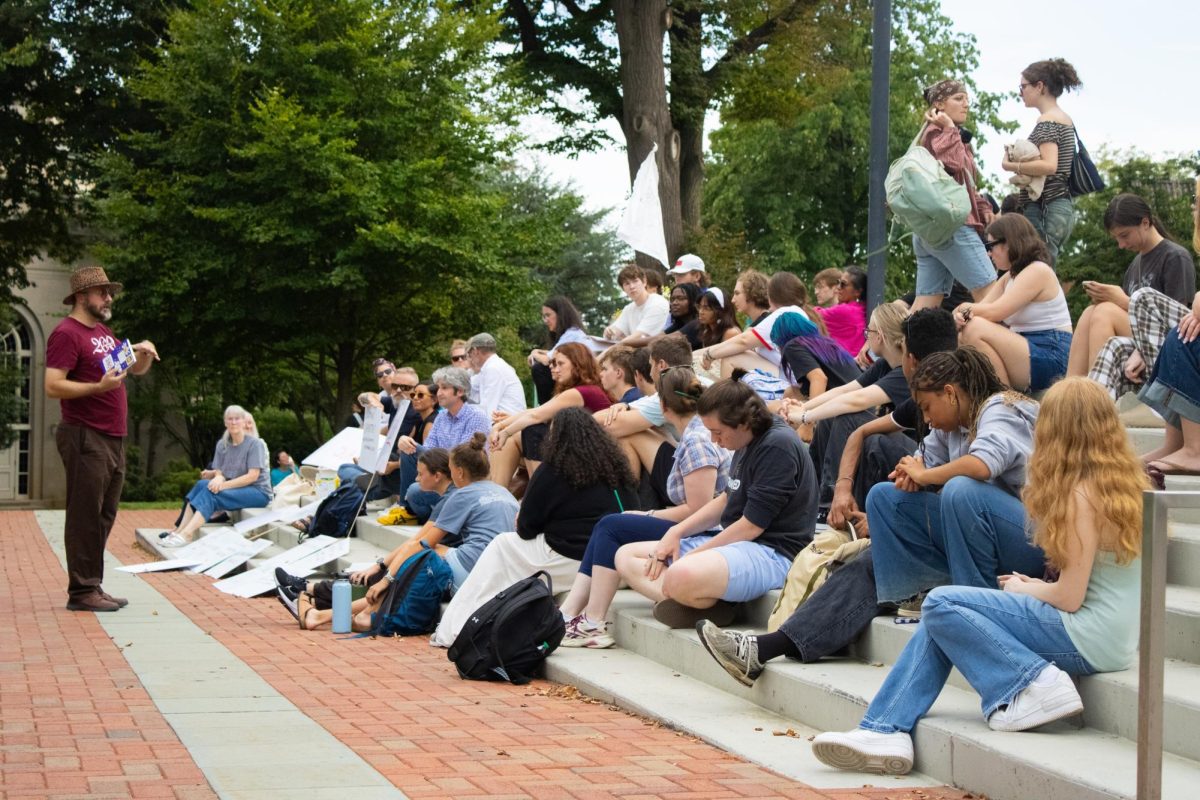
Students and faculty protested Lafayette College’s construction on the Quad in September.
Lafayette College received an overall F grade in campus free speech from the Foundation for Individual Rights and Expression, or FIRE. However, the rankings received criticism from some professors over its methodology and ideological intent.
FIRE is an independent organization that aims to protect free speech, primarily on college campuses. The organization releases an annual report grading institutions’ speech environment on an A-F scale based on data regarding institutional policies, alleged incidents of suppressed speech and student survey responses.
The college scored 53.9 out of 100 points, earning a ‘red’ in the foundation’s “stoplight rating” system and placing 235th among 261 colleges and universities. The college dropped three places despite a 1.6 point increase from the year prior.
Lafayette earned failing grades in two of six categories: “administrative support,” which measures students’ perception of college administrators’ support of free speech, and “political tolerance,” which measures students’ willingness to allow controversial speakers.
The college also earned a D in “comfort expressing ideas” and “self-censorship,” a C in “openness” and a B- in “disruptive conduct,” which measures how acceptable students think it is to disrupt a campus speaker.
“The rankings broadly have three components: policy, behavior and survey score,” FIRE data analyst Chapin Lenthall-Cleary said.
Policy-wise, the college’s lack of a Chicago statement, a policy report that strongly defends freedom of speech and open debate at colleges and universities, and an institutional neutrality policy contributed to the college’s lackluster rating.
A December social ban on Greek Life organizations following antisemitic and sexist comments docked one point from the college’s score, according to Lenthall-Cleary.
Student surveys, however, played the largest role in determining FIRE’s rankings.
FIRE surveyed 177 Lafayette students who were asked 43 questions across the six different grading categories regarding political climate and overall free speech on campus; Lenthall-Cleary said that while policy changes alone could substantially improve the ranking, student attitudes would need to improve to fully address the issue.
Trent Gaugler, a Lafayette professor of mathematics and data science who focuses on applied statistics problems, said the wording of questions and sampling methods could limit the survey’s efficacy.
“There’s a long history of poorly worded survey questions that, when redone, you get wildly different, wildly different results,” Gaugler said. He noted that voluntary sampling typically draws more opinionated students and more extreme results. He said it’s important to understand who participated in the student survey when interpreting results.
Anthropology and sociology professor Caroline Lee also questioned the foundation’s methods.
“Rankings and ratings (A+, B-, etc) themselves are typically pretty meaningless and do not follow best practices in social science methodology,” Lee wrote in an email.
“People like rankings because they take complicated concepts and reduce them to numbers that are comparable across cases,” Lee wrote, adding that advocacy organizations publicize rankings to pressure institutions to “change an institutional field to adopt their priorities.”
Chris Borick, a political science professor and the director of the Lehigh University Opinion Observatory, said he was looking for “consistency across institutions” when evaluating how surveys such as FIRE’s measure abstract concepts like free speech.
“To be honest, I’m not sometimes sold that that’s always a strong point,” he said, questioning the consistency of how FIRE applies its methodology, adding that he was “an enormous supporter of attempts to capture what concerns and needs our populations have.”
Lafayette’s Vice President of Communications Kristen Daily wrote in an email that the college’s statement on student rights and responsibilities “recognizes that students of the College community have a responsibility to exercise those freedoms in ways that preserve the freedom of others” in accordance with the student code of conduct and other college policies.
College President Nicole Hurd and Dean of Students Walter Snipes both deferred comment to Daily.
Director of Public Safety Jeff Troxell said Public Safety’s policy is not to interfere with on-campus protests, provided they are led by a campus organization and are continuing safely.
“We’d like individuals who certainly protest to do it safely, and we’re happy to sit down with any group that has questions regarding that,” Troxell said.