
For 21-year-old John Scull and his friend Joseph Hall, Philadelphia in the 1780s was a crowded place. They wanted to establish a newspaper. But at least since the colonial days of Ben Franklin, it had several, each of them rivaling with each other with varying political opinions and other kinds of information. It was where the action was. But you had to have a “backer” or a group of backers that would get a paper started.

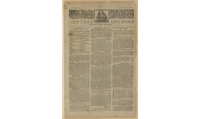
The General Advertiser newspaper, 1780
Library of Congress
It was at that moment that Hugh Henry Brackenridge walked into their lives. He was not an unknown commodity. He came to America with his parents as a child of five from Kintyre, a peninsula off the coast of Scotland. Many years later former Beatle Paul McCartney would write a song called the Mull of Kintyre about a property he had there.
Scull and Hall must have been familiar with many of the other details of Brackenridge’s life, as he was never shy of talking about them. He had tried publishing but that had failed. He had trained for the ministry but after several efforts he walked away from it. Looking back at Philadelphia he became frustrated. “I saw no chance,” he later wrote, “of being anything in that city, where there were such great men before me.”
Finally seeking another opportunity, he went west and in 1781 after a long journey found himself in what was then the frontier city of Pittsburgh. Using his legal training he was recognized as a lawyer. “I had a strong interest to offer myself to that place,” he wrote later, “the country and thereby myself.” Obviously, Mr. Brackenridge thought very well of himself.
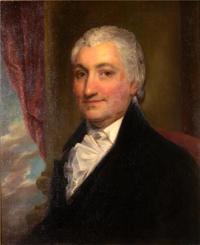
Hugh Henry Brackenridge (1748-1816)
Courtesy of Dickinson College Archives and Special Collections
The request that Brackenridge had for Scull and Hall was not a simple one. He wanted them to take themselves and their large wooden printing press on a wagon on the nearly impassable roads of the interior of the Keystone State, around, over or through the Allegheny Mountains to Pittsburgh. Once there they were to set themselves up as a newspaper free from the influence of the Philadelphia establishment and become the voice of the frontier people, and, not incidentally, of Hugh Henry Brackenridge.
Scull, a native of Berks County, was not unfamiliar with the large task that had been set before him and Hall. One of his relatives was Nicholas Scull who had been a surveyor for the old colonial government. He had been close to Allentown founder William Allen.
In a letter to Pennsylvania Proprietor Thomas Penn, son of William Penn, Penn’s agent James Logan noted that Allen was notorious for offering “gifts” (aka bribes) to surveyors to let him know where the best lands were before they went on the public record and the price went up. There is no evidence on the record that Nicholas Scull participated in Allen’s land deals, but that it was Allen’s practice was known.
But what may have been an even more daunting prospect was the physical challenge itself. Yet as they were young men looking for opportunity, perhaps the idea of opening the first newspaper in that part of Pennsylvania, an area attracting more settlers every day, appealed.
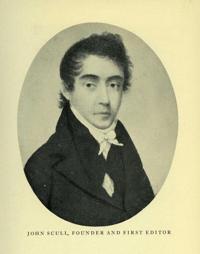
John Scull
Historical Society of Western Pennsylvania
Apparently Scull and Hall did not leave behind any written record of exactly what route they took. But the state of the roads in the central part of the state left a great deal to be desired. One historian writes of them in this way:
“The roads of that day across the mountains were the worst we can imagine-cut into deep gullies on one side by mountain rains while the other was filled with sands and stone… few of the emigrant wagons were provided with lock chains for the wheels and dragged along the ground. In other places, the road was so sliding that all the men that could be spared were required to pull at the side stays or short ropes attached to the upper sides of the wagons, to prevent them from upsetting.”
Most likely at least part of their route was on the old Forbes Road. The route was named for British Brigadier General John Forbes (1707-1759) who captured Fort Duquesne, the site of Pittsburgh that General Edward Braddock failed to capture at the start of French and Indian war in 1755. Forbes’ route differed from that of Braddock’s in that it crossed fewer streams.
Historian Reginald Briggs has this to say of Forbes Road: “Totaling only the most significant ascents and descents along the road, it was equivalent of overcoming a single irregular obstacle more than 8,000 feet high.”
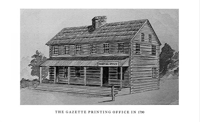
University of Pittsburgh Library System
Despite these obstacles, on July 29, 1786, John Scull and Joseph Hall released the first edition of the Pittsburgh Gazette. It was a four-page weekly, and it was the first newspaper published west of the Allegheny Mountains. Things were difficult at first. Supplies were not easily accessible. The mountainous terrain and poor road system made distribution difficult. Things improved in 1787 after Pittsburgh established weekly mail service with Alexandria, Virginia and the following year with Philadelphia.
Hall died a few months after the paper was formed. Although Scull was the printer, several sources agreed that it was Brackenridge who shaped the paper’s editorial policy. He was what would later be called a booster of the city. At Brackenridge’s advice Scull got involved with a short-lived partnership with John Boyd of Philadelphia in the creation of the Pittsburgh Almanac of 1787 and other publications.
A mercurial figure as always, in the 1790s Brackenridge got himself caught up in the Whiskey Rebellion. This attempt by the government to raise revenue by taxing whiskey sparked a rebellion of western Pennsylvania farmers, many of whom distilled whiskey, which was easier to ship and more profitable than grain. Eventually President Washington sent a military force in to arrest the ring leaders.
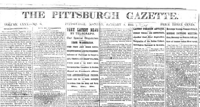
The Pittsburgh Gazette, January 8, 1866
Pennsylvania Newspaper Archive
Scull was a Federalist but Brackenridge, after much back and forth, spoke in support of the farmers. Scull blasted him for his stand in the Pittsburgh Gazette. In his final years Brackenridge left politics and got involved in writing a satiric novel titled Modern Chivalry. Using Cervantes’ Don Quixote as a model, he substituted political and cultural figures of his day. “Though it sold poorly in his own time,” writes one modern critic, “it has since been recognized as one of the first great American novels.”
In 1816, the year of Brackenridge’s death, Scull left the Pittsburgh Gazette. It had several owners until 1822 when Neville Craig took over and put it on a sound foundation. In 1928 it became the Pittsburgh Post Gazette. It is largely an online publication today.