
 Credit: IMAGN IMAGES via Reuters Connect
A game within a game within a game. The Pittsburgh Penguins were buried for the first half of the first period before wrestling momentum away from the Montreal Canadiens for at least 30 minutes, but then hung on as their jet-fueled push became a nosedive for much of the third period.
The Penguins’ 5-1 lead became a tenuous, tight 5-3 game and then … they needed overtime. The Montreal Canadiens scored four unanswered goals, including a trio in the third and two with the extra attacker in the final 68 seconds.
It was a laugher, and then it very much wasn’t, but the Penguins survived when Tommy Novak scored the OT winner.
“I think in any game you’re going to have things that you’re going to look back on … there are still things to clean up. There are more things to clean up after tonight, for sure. Even throughout the game, the chances that we’re giving up—there were some breakaways, (Arturs Silovs) They had to make some massive saves, you know, especially early in the game, and we got to clean it up. And so that’s something that we went into this year knowing that we have to. I think from an offensive standpoint, obviously, you know, generating some really quality looks on our end throughout the game. It’s a big positive. I still think we’re getting contributions throughout the lineup, which is a positive. I think the fact that we found a way to get the extra point in overtime, and especially with those last couple of minutes, you know, going into overtime with you know the best feeling, they stuck with it. We found a way.
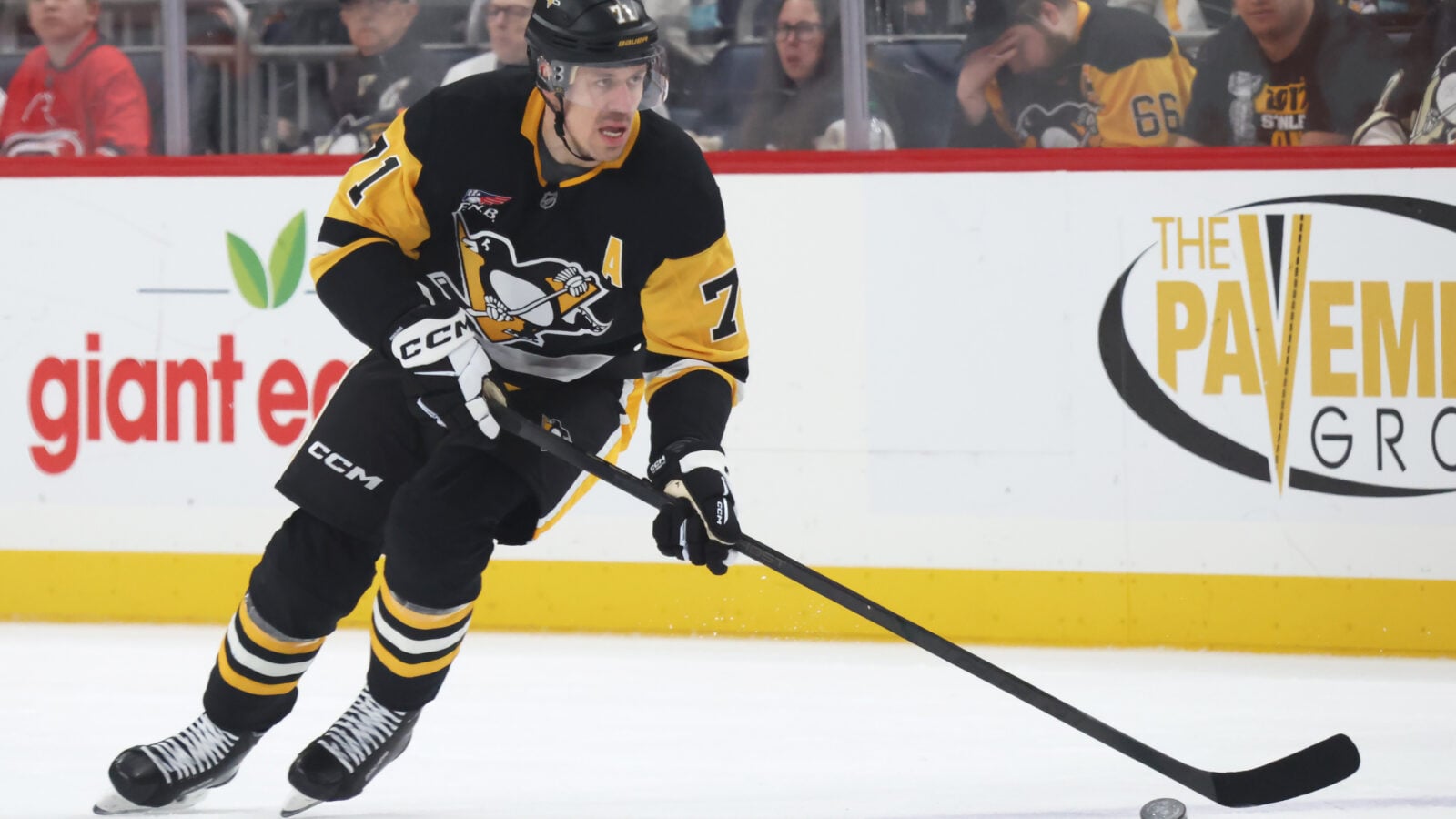
The game was nearly over in the middle of the third period. Shortly after Montreal crept to within 5-3, the Penguins answered. By the letter of the law, in fact, the goal should have counted, but after a coach’s challenge, referees deemed Erik Karlsson offside, despite his puck possession.
As Filip Hallander raced out of the offensive zone, Karlsson twisted so he entered the zone backward, thus delaying the puck’s entry and giving Hallander plenty of time to exit. He had full control, and he then wheeled around and made what he—and (he claimed) the referees admitted—was a pretty good seam pass. It would have been a different game had Egor Chinakhov’s goal stood to make it 6-3.
“The Offside Call”
For the record, NHL Rule 83 states: A puck-carrying player who crosses the blue line ahead of the puck is onside as long as they established possession and control of the puck with their stick prior to both skates completely crossing the leading edge of the blue line.
In fairness, Karlsson’s stick was not directly ON the puck, but he clearly had control, and no opponent touched it, deflected it, or was otherwise in contention to take it. Karlsson was able to laugh about the situation, and he had a good analogy to make his case.
“It’s like in basketball, when they inbound the ball, but the clock doesn’t start until he touches it,” said Karlsson with a big grin resulting from an exciting OT win. “He still has possession.”
Karlsson was all smiles after the game. He both conceded there was another side to the story but lightheartedly ripped the call, too. Here’s the full minute rundown from Karlsson himself, all the while smiling or laughing through it.
“I said, should I put my stick on the puck earlier for no reason? But I can understand the argument because it took a really long time. But I didn’t want to put it on because I was protecting it. But I’m in full control. It’s a little bit…I don’t agree with it necessarily, but I can understand their argument,” Karlsson said.
“I asked them who was in control, and they said no one. So I said, so no one was in control of the puck? I mean, I made a nasty seam play right after, just waiting, you know? And they’re like, ‘yeah, you did.’ I was like, ‘Yes, I was in control.’ Luckily we didn’t need it, so it’s all water under the bridge.
“At the end of the day, we won the game. It will be forgotten.”
Xs and Os
Transition. Puck pressure. Finishing.
The game was not the most tactical chess match the Penguins will play this season, and often times it was far from it. Instead, it was an entertaining game spent largely in transition from this end to that.
There isn’t a faster team in the NHL than the Montreal Canadiens. They’re not only a young, fast team, but they can move the puck with lightning crispness, and a nothing play becomes a high-event sequence.
The game didn’t devolve into pond hockey, but it was a track meet and a game of mistakes, and the Penguins made their share, including the Penguins defensemen who had some adventures with the puck.
A couple of things to note: Sam Girard has no fear about jumping deep into the offensive zone. He scored in the second period as the fourth Penguins player down low; he parked at the net front like he was Patric Hornqvist.
However, he and defense partner Kaedan Korczak had trouble getting out of their own zone. Korczak especially missed a few outlet passes that caused some trouble. Montreal’s third goal came after Korczak handcuffed a couple of forwards with passes. We’ll repeat this: defensemen can take a few months to settle in.
However, Kris Letang had a team-high three giveaways, including a ghastly turnover at his blue line that led to Josh Anderson’s breakaway.
Penguins Report Card
Team: C+
Undoubtedly, the Penguins have a lot to clean up. Their finishing ability changed the game, but the gaudy defensive breakdowns and flat-footed zone defense looked too much like the past. The Penguins yielded a few breakaways (continuing one of their fatal flaws from last season) and were too careless with the puck. But a win with six goals is indeed a win.
The empty-net struggles that plagued them were again a thing. It’s a separate issue from 5v5 play, but vitally important if they’re to preserve wins. Let’s table that issue.
Tommy Novak: Big Moments vs. Rest of the Game
It’s a big dichotomy for Novak, who lost puck battles quickly and decisively, and his first-period turnover almost led to a Montreal odd-man rush in a hastening sequence that eventually resulted in Montreal’s first goal. Compounding matters, there were some dangerous moments for the line around the Penguins’ net in which he didn’t body up his man. He’s a step behind the game right now.
However, he did score a beaut on a two-on-one that was set up by an Evgeni Malkin defensive stop and a beauty of an Egor Chinakhov pass. And Novak scored the game-winner in OT.
The Novak line was underwater in both Corsi (12-8) and scoring chances (5-3), largely against Montreal’s fourth line with grinders Josh Anderson and Zachary Bolduc. It wasn’t a good game.
Ben Kindel: B
Kindel didn’t earn a B for big moments; he earned it for the dozen little moments like stealing the puck from Noah Dobson on the power play for a contested breakaway, several hard backchecks that created changes of possession. He also scored a power-play goal and led the team with five shots.
Kindel’s line was also underwater in the advanced stat game, but he made more of an impact at 5v5 and on special teams.
Still, his line, no matter who is on it (it was Hendrix Lapierre and Andrei Kuzmenko on Saturday), will have to be more impactful as a unit. Don’t expect Muse to keep this line together.
Kaedan Korczak: Brief Moments
Korczak had the second-worst shot ratio on the team Saturday, at just 28%. While the chaotic game created plenty of instances in which the numbers and eyes disagreed, on this one, they were in harmony. Korczak struggled on the breakouts and was beaten to the net by Nick Suzuki on Suzuki’s second-period goal.
However, when he had the chances in the offensive zone, he took the space and created offensive zone pressure.
Dewar-Lizotte-Hallander: D
Just a pair of shot attempts against eight for the line. Is it possible to like Hallander’s game, but think Lizotte and Dewar were out of sorts? Dewar is a step off his game from last season, but let’s not pucker too much. It’s only the second game of the year.
Evgeni Malkin: A
His job is not to play defense. His job is not to backcheck hard and create defensive stops. As a scoring winger with 40-year-old legs, his job is to create offense. He did that, and he also showed some good speed in the process.
He set up Novak’s goal with a good defensive stop at center ice and deftly kicked the puck to Egor Chinakhov.
The line as a whole was mediocre, but Malkin was on his toes.
Arturs Silovs: B
None of the goals were softies. He stopped a few breakaways and some point-blank chances. He was solid despite the sketchy defending in front of him.
Tags:erik karlsson Penguins Postgame Pittsburgh Penguins
Categorized:Pittsburgh Penguins