
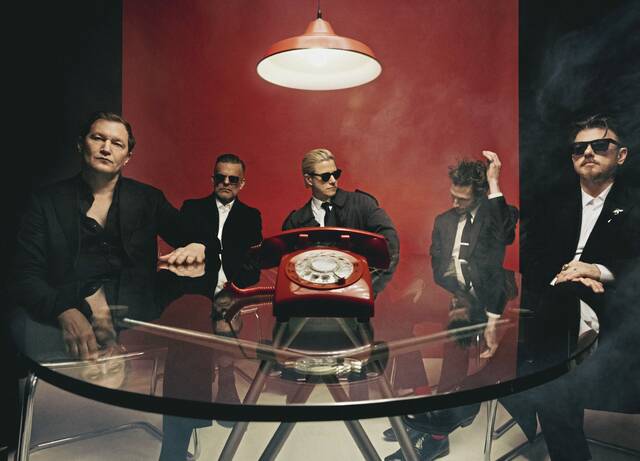
When Interpol arrives in Pittsburgh on Tuesday, they’ll be investigating how the crowd receives their latest breakthrough at Stage AE.
The band rose to prominence in a time of unbridled energy in the post-9/11 Manhattan garage rock revival scene alongside the likes of the Strokes, the Yeah Yeah Yeahs, TV on the Radio and The Walkmen.
Their tight, slow-grooving pulse is crafted primarily by lead guitarist and songwriter Daniel Kessler and bolstered by the full-bodied, vaguely deranged yet composed croon of singer and rhythm guitarist Paul Banks, who made his early career on setting up base camp for vocal passages in slightly discordant phrasing alleyways.
It’s a sound first exemplified in rawer and more minimal fashion than later works on tracks from 2002’s “Turn On the Bright Lights” like “Roland” and “Obstacle 1.”
“We were a band for like five years before we put out a first record. It felt very like, ‘Oh, this is probably not going to happen. We’re never going to get to release an album,’” remembers founding member and lead guitarist Daniel Kessler of those days. “It felt difficult and challenging, but at the same time was probably the best thing that could have happened because it gave us time to develop, kind of like being in the minor leagues, where you get comfortable with it. So when you do get some attention your way, you’re a bit more solidified in the writing process and in the performance process and what it means to be a band.”
But attention would come quickly upon their debut release. The quartet set about measuring their sound with grace on songs like “Evil” and “Slow Hands” from 2004’s “Antics.” They’d mature their signature style further sans the earlier critical acclaim on songs like “Rest My Chemistry” and “Pace Is The Trick” from 2007’s “Our Love to Admire” — a major label debut for which less universally positive reviews marked the beginning of a relative winter for critics’ public love affair with the group.
Kessler reflected on the insular scene that fostered them, with bands making the rounds between clubs like the Mercury Lounge and Brownies.
“It’s pre-social media, so bands can coexist in the same backyard, so to speak — like New York or any city — and not really know about each other. I didn’t really know about the the Strokes until all of the sudden they were playing a residency in the Mercury Lounge, and they’re playing like every Tuesday for a month,” said Kessler. “It was just unheard of back then. It’s like, ‘Who is this local band? How are they able to do this?’ It was really exciting to see.”
And instant communication had not yet become a driver of the night’s events.
“You would just go out, and then if you showed up at a certain place that turned out, (there’s a) great chance you can bump into people, like-minded, that you know or you kind of know. And then all of a sudden, a whole bunch of spontaneity would happen, and it would lead you to some shenanigans that were great,” said Kessler. “I feel like that’s healthy for humans just to not know what’s going to happen and be open to what happens next. So I do romanticize that, but I think it’s just like we’re very controlled and contained these days, and just always on our phones. I think just being in the moment like that is really good, especially when you’re of a certain age.”
Fast-forward to 2026 and Banks, Kessler and company have drawn critical acclaim once more with their eighth effort “This Mirror Weighs a Ton,” with the aid of layered harmonies and pervasive atmosphere, synths, keyboards and piano tactics that have defibrillated the band’s consistent sonic profile via songs like “See Out Loud,” “Iron City,” “Wings on Fire” and “Ever the Actor.”
“We are all striving for progression. It’s just more inherent of who we are, our makeup and who we are as people and artists,” said Kessler. “That’s why we’re still a band, because I think we can still grow and we feel this connection when we start writing music together. It’s never a laborious process as much as an exciting and inspiring one.”
Writing sessions were wedged over just a couple of weeks between two tours — one for their last album “The Other Side of Make-Believe” and an anniversary tour for “Antics.”
“I came in with a lot of songs, and then I think everyone just really vibed on them and then we just really grew them pretty organically,” said Kessler. “It’s just really great when you get a lot of green lights like that, not going down the wrong roads when you’re like, ‘Oh no, we want to go back this way.’ Everything felt very fluid.”
The band would record in NYC for the first time in more than a decade after concluding two and a half years of touring, enlisting New York producer and friend Andrew Wyatt and recording in his basement.
“He just really kind of fit right in and everything he brought into it as far as keyboards and atmospherics and orchestrations — this wasn’t even discussed, but it just expanded the songs, made them kind of wide and more (three)-dimensional,” said Kessler.
The results are being widely hailed as the band’s best work in years.
“Interpol is an albums band, and always has been an albums band. Even when times have maybe been more about individual songs as far as momentum and so forth, we’re always trying to tell a story,” said Kessler. “I love storytelling and I love giving the opportunity for escapism and hopefully trying to make something that is a cohesive record where every song leads to the other and is an answer to the other in maybe a slightly different direction.”
Interpol plays at Stage AE on Tuesday at 8 p.m. For tickets or more information, click here.