
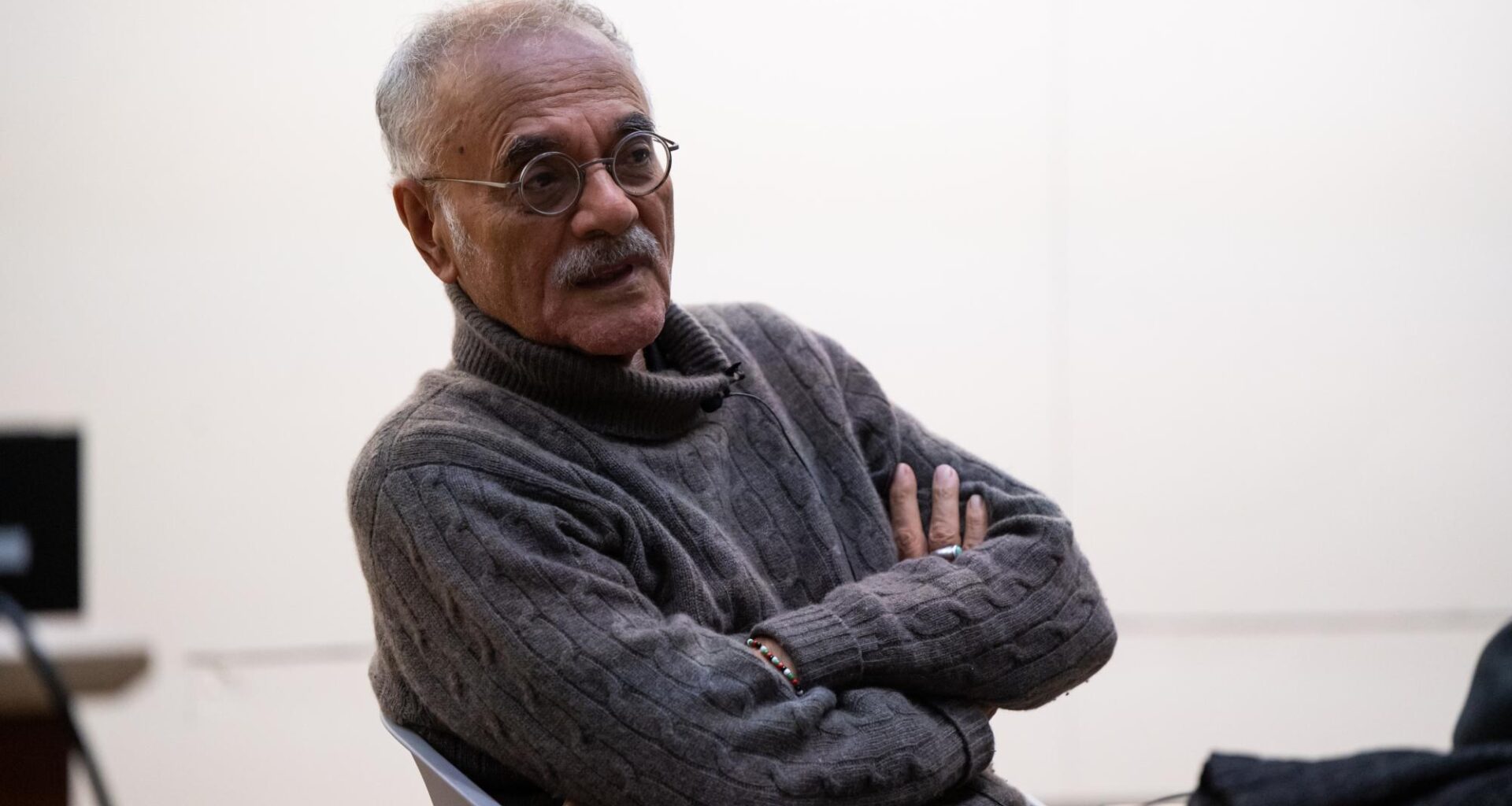
As a student at Pitt, Mahmood Mamdani, father of New York City mayor Zohran Mamdani, was introduced to a “new world” of activism.
Mamdani, currently the Herbert Lehman Professor of Government at Columbia University, spoke with Africana Studies professor Christel Temple in Lawrence Hall in a discussion organized by the World History Center. Mamdani explained how his interest in humanities and activism developed during his time at Pitt as an undergraduate international student during the 1960s Civil Rights Movement.
Raised in Kampala, the capital city of Uganda, Mamdani was one of several hundred students who came to the U.S. through the Kennedy Airlift program, which gave students from East Africa an opportunity to study in the U.S. Though he began his time at Pitt studying electrical engineering, Mamdani said he quickly became interested in social sciences.
“It was already clear to me that improvements needed to be made in the world, even then, and we had to change America,” Mamdani said. “I never took a course on Africa because I said, ‘I am not going to America to study Africa. I came to study America.’”
Mamdani said one of his first experiences with activism in the U.S. was with the Student Nonviolent Coordinating Committee in 1965. After meeting students in the organization, he immediately decided to hop on a bus to Montgomery, Alabama to join a civil rights march to fight for the “same struggles” he faced at home in Uganda.
“Colonial Kampala was a highly racialized society. It was arranged in[to] what the British called population groups — whites, browns, blacks,” Mamdani said. “[As] a kid who came out of that, [I] thought of the world in terms of races.”
At the protest, he listened to speeches from civil rights leaders including Martin Luther King Jr. and James Forman, and subsequently landed himself in jail for participating.
Mamdani said the warm welcome he experienced in Montgomery from Black community members gave him a new perspective, having come from the highly segregated society of Kampala under British colonial rule. In Montgomery, he was welcomed into the homes and churches of Black mothers and doctors.
“From then on, it was a new world. The racialized world could not withstand,” Mamdani said.
Shortly after returning to Pitt, Mamdani said he was greeted by two FBI agents at his dorm room door in Litchfield Towers. According to Mamdani, the agents questioned his political stance and thoughts on communist revolutionary Karl Marx, who Mamdani was then unfamiliar with.
“The FBI introduced me to Karl Marx,” Mamdani said. “[This] would mark my entry point into the Civil Rights Movement.”
Mamdani participated in a program for university students to be paired with and tutor high school students from Pittsburgh’s Hill District. Mamdani said, although he was the tutor, the student was able to educate him on real world experiences growing up in a minority community in Pittsburgh.
“He would tell me about his life, and I would ask questions,” Mamdani said. “I soon discovered that there was nothing I could do to help, and, actually, I had more to learn from him than he [did] from me.”
Mamdani shared another memory from a summer between semesters, when he traveled by bus exploring different states around the country. On one trip, he said the bus driver and his fellow passengers decided to pull over so he could step outside and pray — an experience he felt would not happen the same way today.
“What has happened between then and now has taught [people] how to think about the world. It taught them how to think about dangers in this world, and today I am one of the dangers in this world,” Mamdani said.
Amelya Pinami, a sophomore environmental studies major, said she saw a flyer for the event and was intrigued to meet the father of Zohran Mamdani, who she called “one of the most influential people of this time period.”
“It was really interesting to gain insight from a person who experienced the Civil Rights Movement in America and also civil rights issues in Africa at the same time, and was able to engage with both of them,” Pinami said.
Aashi Patel, a junior law, criminal justice and society major, said humanities and activism are very relevant within her field of study and was interested in Mamdani’s role in the field.
“I got a deeper understanding of what [Mamdani] meant as being a minority in his country [and] being a minority here, where he came to study,” Patel said. “I think that was a driving factor to the perspectives he had been forming about activism.”
Amyah Fish, a junior creative writing major, said as a member of a minority group on campus, she enjoyed gaining Mamdani’s insight.
“I really liked his answer to my question, ‘What advice would you give to minorities or other student groups on campus?’ He said, ‘Don’t consider yourself a minority,’” Fish said. “I really liked him talking about his experience as a brown person and as a Muslim because it’s not [like] stories that you hear a lot from Pitt students.”