
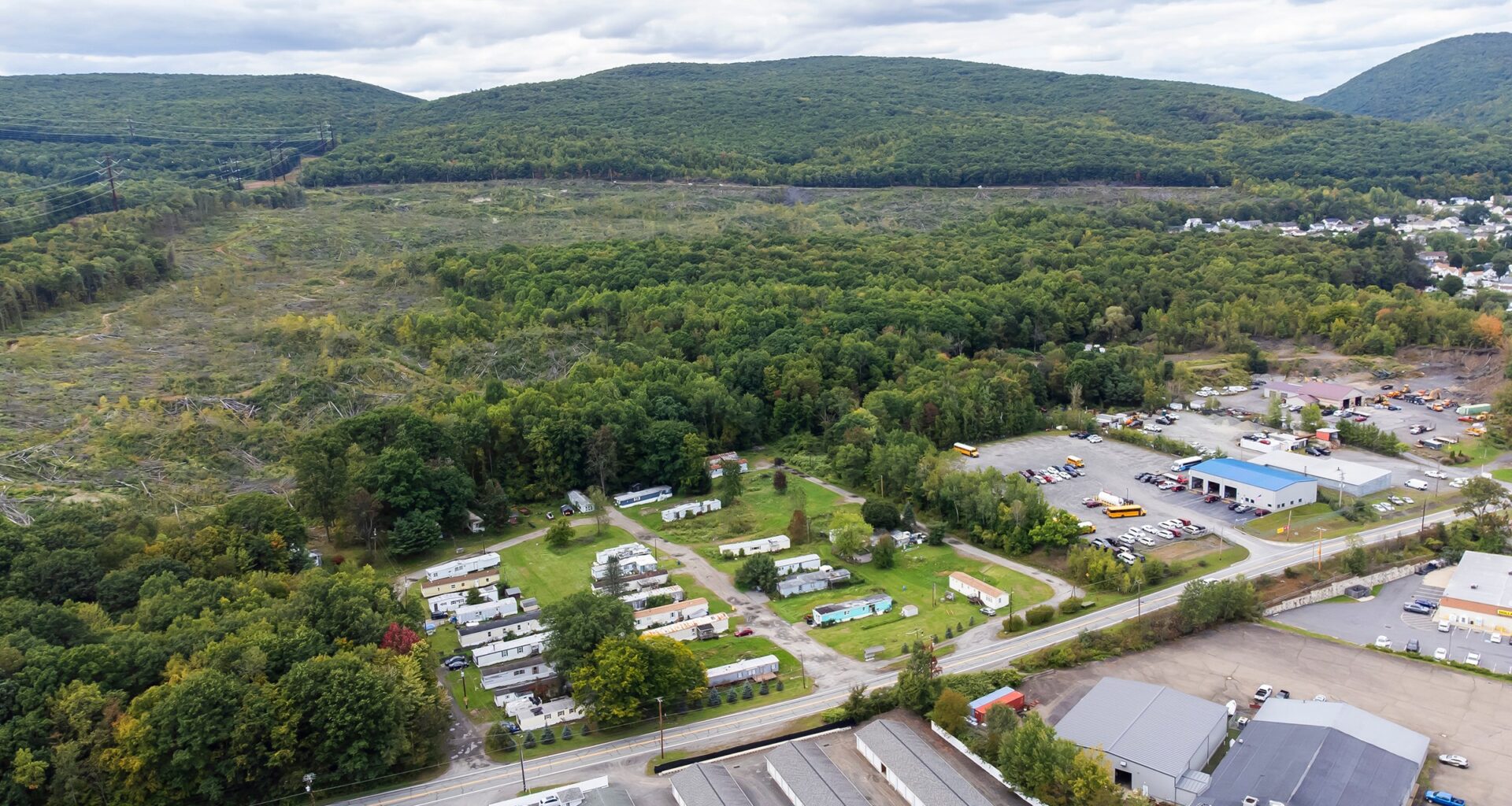
Project Gravity wants to build one of the largest battery storage sites in the United States to support its data center campus in Archbald, sparking fears among its closest neighbors even as the developer defends the safety of the batteries.
Operating as US Gravity Purchaser LLC of San Antonio, Texas, a partnership between Corscale Data Centers and Affinius Capital filed final land development plans in Archbald late last month depicting seven data centers with 430 megawatts of batteries across a 181-acre tract between Eynon Jermyn Road and Business Route 6. The nearest data centers would be 282 feet from the closest residential property line off Gibson Street in Archbald and Jermyn — including near Lackawanna County Housing Authority property — and 291 feet from the Valley View Estates mobile home park property line.
Proposed data centers in Lackawanna County largely plan to rely on backup diesel generators to provide power during outages. Project Gravity instead will rely on arrays of battery energy storage systems, or BESS, to keep its data centers online, replacing concerns about noise and air pollution from diesel generators with fears of difficult-to-extinguish battery fires.
In an emailed response to questions Tuesday, a Project Gravity representative said Project Gravity’s reduction in diesel generators means substantially lower emissions and noise than other projects in Archbald.
“BESS installations are no different than other battery technologies and we know how to operate them safely,” the spokesman wrote.
One of Project Gravity’s closest neighbors, Tina Verrastro, called it a nightmare. Verrastro, 41, has lived at the end of Gibson Street in Archbald since May 2019 with her fiancé and 16-year-old son.
“I can’t even put into words how upsetting this has all been,” she said. “It’s so inappropriate for a project of this size and scale to be behind somebody’s home — not just my home. I’m (the) closest one, but there’s other houses in our neighborhood.”
According to the U.S. Energy Information Administration’s preliminary monthly electric generator inventory for August — the latest month available — the largest operational BESS site in the country is a 500-megawatt facility linked to a California solar farm, followed by a 409-megawatt BESS site as part of a solar farm Florida. Thirteen planned BESS facilities across the country range from 475 megawatts to 1,200 megawatts, according to the inventory.
Project Gravity characterizes its layout as several smaller installations, not one single yard.
Representatives with Project Gravity will go before the Archbald Planning Commission at 6 p.m. Wednesday at the Borough Building, 400 Church St., to discuss their plans.
‘Reliability requirements’
Project Gravity became one of Lackawanna County’s earliest data center proposals in April 2025 when it submitted a sketch plan for a campus between Eynon Jermyn Road and Business Route 6 in Archbald. The majority of the campus falls into a general commercial zoning district that no longer permits data centers, but because Project Gravity’s application predates a November zoning amendment, the legacy zoning that principally permitted the industry in commercially zoned land applies.
As a principal permitted use, there is no public hearing requirement or conditional-use approval, giving Project Gravity a more direct path forward if it satisfies Archbald’s land development requirements.
The Valley View School District is challenging the legacy zoning in county court. The developer contends the district’s complaint is within Archbald’s purview.
District Solicitor Kyle Callejas of Joyce, Carmody & Moran P.C. subsequently sent Archbald and its planning commission three letters between Sept. 30 and Oct. 1 objecting to Project Gravity’s final land development submission, alleging deficiencies in its documents.
Project Gravity’s Sept. 24 final land development plan and accompanying documents depict seven data centers, each with 138,000-square-foot footprints, as well a 525-megawatt-capacity substation, stormwater basins, stormwater pumps and other infrastructure. Five of the data centers would be two-stories tall, and two would be one story.
The campus proposes 44 total generators at the site, with six backup generators per building and two generators for stormwater pumps, according to its sound study. Backup generators for data centers typically produce about 2.5 to 3 megawatts of electricity, requiring dozens to hundreds of diesel engines to power the facilities during an emergency, depending on a campus’s electricity needs.
However, Project Gravity’s sound study describes 430 megawatts of batteries, broken up into five 78-megawatt BESS yards for its two-story data centers, and two 20-megawatt BESS yards for the single-story buildings.
The spokesman cited Gov. Josh Shapiro’s encouragement for data centers to use batteries in his Governor’s Responsible Infrastructure Development standards for the industry. The BESS also meet their tenant’s reliability requirements from grid operator PJM and the North American Electric Reliability Corporation, the spokesman said.
“Utilizing BESS was driven by the tenant’s reliability requirements,” the spokesman said. “Grid operators and NERC are increasingly requiring data centers to stay online through grid disturbances, and batteries respond instantly in a way generators can’t. Batteries also smooth out rapid power swings.”
The spokesman declined to identify the tenant, explaining the tenant usually determines that announcement.
‘Safety concerns’
Although BESS incidents have decreased since 2020, the U.S. Environmental Protection Agency reports, “Lithium battery fires at some installations have raised legitimate safety concerns in many communities.”
BESS incidents can present unique challenges for host communities and first responders, according to the EPA. Those include:
Fire suppression: Lithium battery fires are extremely difficult to extinguish and may reignite hours or days later.
Emissions: Battery fires can release harmful gases that pose health risks to nearby residents and first responders.
Environmental impact: Proper cleanup and disposal of damaged batteries requires specialized procedures.
When responding to a large commercial BESS incident, the EPA advises first responders to create an isolation zone of at least 330 feet depending on the site, to position themselves upwind and uphill, and to evaluate the need for community shelter-in-place or evacuation plans, depending on the incident and site. Rather than focus on extinguishing a BESS fire, firefighters should let the fire burn itself out while focusing on preventing its spread, according to EPA.
‘Reduce that risk’
Among its installation considerations for BESS sites, the EPA recommends that developers “comply with state and local siting, zoning, marking, and permitting requirements to ensure site suitability.”
Archbald’s March 2023 zoning ordinance prohibits an “electricity grid storage battery facility” in commercial zones such as Project Gravity’s, limiting the battery facilities to industrial zones and mining districts as conditional uses, requiring public hearings and approval from council.
Project Gravity’s representatives contend that does not apply to their project because they’re building a data center campus as a permitted use; the BESS are accessory equipment, not a separate battery facility, the spokesman said.
The batteries would only support the data centers and would never discharge to the grid, nor would they sell electricity, the spokesman said. The spokesman noted that Project Gravity’s BESS layout is broken up into several smaller installations rather than a single yard, and they would be designed, tested and installed to meet current fire codes and national safety standards, with continuous monitoring and detection.
“BESS fires are extremely rare, and Project Gravity is designed to reduce that risk even further,” the spokesman said, pointing to separate outdoor enclosures, spacing and setbacks of 500-plus feet from the nearest property lines with round-the-clock monitoring from on-site staff. “Multiple layers of protection are designed to prevent a fire and, if one occurs, keep it contained on site. The emergency plan we are developing with Archbald’s fire officials and Lackawanna County Emergency Management will include clear response procedures.”
Project Gravity’s team has already met with Archbald’s Fire Department and other first responders, and they will support training specific to battery systems to ensure first responders are fully prepared, the spokesman said.
‘Such an outrage’
Lackawanna County Commissioner Bill Gaughan criticized Project Gravity’s proximity to residents, including those in the Lackawanna County Housing Authority’s Gibson Street housing complex.
“Those residents, I think, deserve the same protection, the same consideration, and the same right to a safe, healthy and peaceful neighborhood as anybody else in this area,” he said. “A person’s income or address does not make their health worth less, and I just think to basically put this on top of these people — it’s such an outrage, and it’s the definition of exploitation.”
Developments should be nowhere near residential areas or neighborhoods, Gaughan said.
“The fact that they’ve come forward with this plan should be an automatic disqualifier,” he said. “It’s not only bad for the people who live around it — it’s bad for the entire county because, again, when you combine this with every other development that is proposed, it is going to have generational consequences.”
Stop Archbald Data Centers attorney Justin Richards of Elliott Greenleaf P.C. said in a texted statement the group is dedicated to their goals when it comes to Project Gravity.
“We are working diligently to scrutinize the final land development plans and intend to exercise avenues that may be available under the law to hold the developer to account and to protect the health, safety, and welfare of the community,” he said.
As one of Project Gravity’s neighbors, Verrastro said she loves how quiet her neighborhood is, surrounding by woods and listening to birds chirping in the morning and katydids in the evening.
“It’s very peaceful, and I’m on the last house on the street, so I don’t have any neighbors to my right — until Gravity moves in,” she said.
The proximity to residents is unacceptable, Verrastro said. While she acknowledged the tax revenue a data center would generate, she asked, “If all of our quality of lives are in the garbage, what are we talking about?”
“I just feel like we’re being sacrificed,” Verrastro said.