
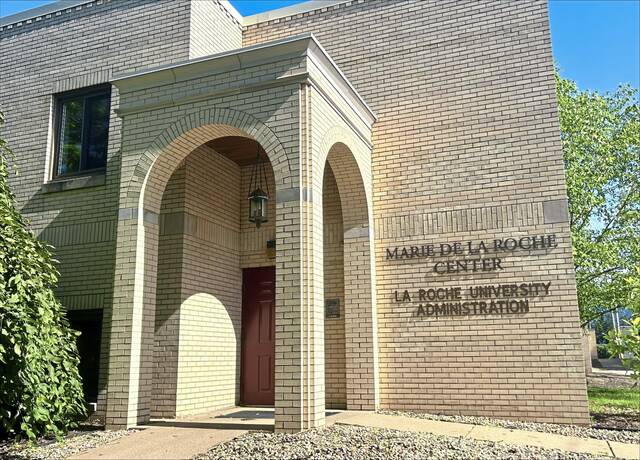
There are about 43 million people in America who attended college but left before earning a degree. That statistic is deeply troubling to La Roche University Provost Gregor Thuswaldner.
“That is a real problem,” Thuswaldner said. “Investing in things that help retention and persistence, and help students stay on track until graduation, is important.”
Many factors contribute to why people fail to complete college. For Thuswaldner the key factor is lack of college readiness among incoming students. Whether it is stigmatized, or they are unaware, students don’t often seek help or support for academic or mental health issues they experience on campus.
To address that, La Roche will use just under $3 million in federal funding to promote academic and career readiness efforts. The money will be spent on additional student-support staff, a library renovation, ANHD technology and faculty development.
“This will help us as an institution move the needle to have necessary means and support needed for students to be successful and graduate on time,” Thuswaldner said.
The money comes from the U.S. Department of Education’s Strengthening Institutions Program. Locally, Point Park University also received $3 million. Both are five-year projects.
Both universities say their initiatives will improve retention rates, the percentage of first-year undergraduate students returning to the same college for a second year.
La Roche, which has about 700 undergraduates this fall, has a retention rate of 69%. Point Park has around 2,080 full-time undergraduates — not counting online students — and has a retention rate of 76%.
The average national college retention rate is 69.1%, reports the National Student Clearinghouse Research Center.
“This is an incredible opportunity to develop and deploy a retention and completion strategy,” said Shari Payne, Point Park’s provost. “Because of this grant, we will have a workforce readiness model that can scale across all of Point Park’s programs.”
Thuswaldner said La Roche will hire a career readiness adviser, student success coordinator, retention specialist and grant coordinator — all new positions — to help provide more individualized academic and career goals for students.
Roughly 75 faculty members will be trained to redesign their courses to reinforce a focus on career readiness, he said.
“Nobody can rest on their laurels because things are changing drastically in the job market,” Thuswaldner said. “Having an additional career readiness specialist on campus and embedding it into the curriculum is important.”
La Roche officials say students will have more access to mentoring, job shadowing and mock interviews. Stipends will be offered for some internships and research opportunities.
La Roche’s Wright Library will be renovated to include more space for tutoring or instruction, Thuswaldner said. The university will also add new digital learning tools and data systems to help identify students who may need additional support.
“It’s really about reducing barriers for students to be successful. A lot of times, institutions are reactive — when it’s not going great, or it’s too late. By having software like the Early Alert System, we can intervene before it’s too late.”
While the money awarded to Point Park will support retention, graduation and career-readiness to all students, Provost Payne believes it will have the greatest impact on low-income students. About 40% of Point Park undergraduates are Pell eligible.
“Many Pell Eligible students are also first-generation students and it’s not obvious sometimes to navigate college,” Payne said.
Point Park’s initiatives include creating outlines that show students how courses, advising and careers connect, starting a professional mentoring network, and hiring counselors to proactively reach out to students struggling academically, financially or having difficulty finding a career placement.
“When students do high-impact experiential learning activities, not only do they expand learning, they also explore more obvious career pathways,” Payne said.