
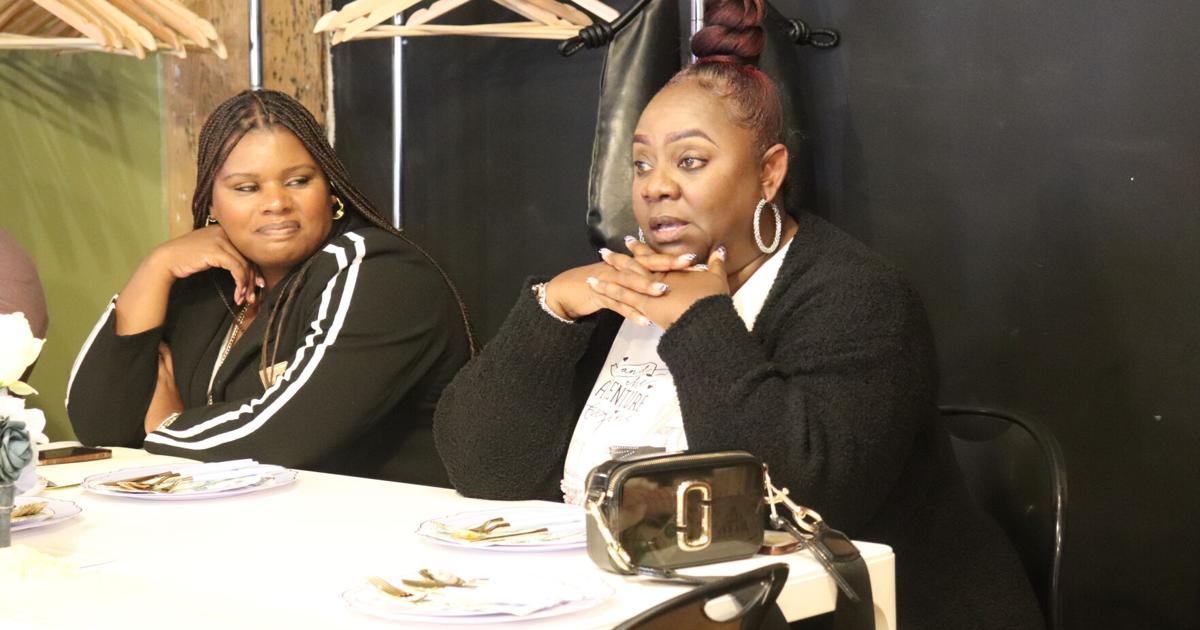
Renee Taylor cried as she talked about the last morning she had with her youngest son.
She drove Dayemen to school. They stopped at Dunkin’. He wanted his doughnut and coffee. She dropped him off around 8:30 a.m. Hours later, Taylor was at work when her sister called, screaming. “I couldn’t understand what she was saying,” Taylor recalled, fighting through tears. “She said, ‘He in the street.’ And I’m like, ‘Who is in the street?’”
Her 17-year-old son had been shot.
“My son got out of school at 3:30. My son was shot at 3:47. My son was pronounced (dead) at 3:53,” Taylor said. “I remember the times just like it was yesterday.”
More than two years after Dayemen Taylor was killed at an Ogontz Avenue bus stop, his mother still lives with the loss. At a recent gathering at the Anti-Violence Partnership of Philadelphia’s (AVP) Parkside office, she sat among others carrying their own memories of gunfire, frantic phone calls, hospital rooms and funerals.
AVP, led by Executive Director Natasha Danielá de Lima McGlynn, Deputy Director Johnathan Davis and Tone Barr, director of Victim and Witness Services, calls the gathering “Beyond the Pain,” a monthly program where people affected by homicide and other violence can eat together, talk, remember loved ones and spend time with others who understand that grief does not disappear when police tape comes down and everyone else goes home.
“After the lights go off, you still need someone to put their arm around you, listen to your story, pick that phone up, or just be somewhere to listen,” an AVP official told the families.
That need can last for years.
Emotional and crisis support
AVP has served Philadelphia victims and survivors of violence since 1983. Its Families of Murder Victims program offers free emotional and crisis support, information on police investigations and court proceedings, court accompaniment, assistance with victim compensation and referrals for other needs. The organization also provides professional counseling to adults and children affected by homicide and other violent crimes, without requiring insurance.
During a recent gathering, much of the afternoon was devoted to the families who hugged, shared stories, played Bingo and shared a meal.
Taylor described Dayemen as the baby of four children, separated from his older siblings by more than a decade. “He was the joy. He was the glue of everybody. He was love,” she said.
The words brought on more tears.
Dayemen was a junior at Imhotep Institute Charter High School when he was shot on March 4, 2024, as students boarded a SEPTA Route 6 bus near Ogontz and Godfrey avenues. Police said two gunmen opened fire on the crowd. Dayemen was struck multiple times and rushed to Einstein Medical Center, where he died. Four other people were wounded.
Taylor remembered racing toward the hospital after learning her son had been shot. She remembered the crowd outside the hospital. She remembered doctors finally walking toward the family. Deep down, she said, she already knew it.
When Taylor was allowed to see Dayemen, she hugged him. “He looked like he was asleep,” she recalled.
Police told her not to touch him because his body was evidence. “He’s dead,” Taylor remembered telling them. “Whatever evidence you need, go find it. He’s dead. I’m touching my child now. I’m talking to my child.”
Then she had to leave the hospital without him. “I’m going to my house, and my son’s not coming with me,” Taylor remembered.
The killing tore through more than one life, she lamented. She watched her parents grieve their grandson and her other children grieve their brother.
“A lot of times people don’t understand when there’s a murder, it don’t just affect the mom or the dad,” Taylor stated. “It affects whoever he was attached to.”
Public descriptions of Dayemen after his death caused another kind of pain.
“At one point, I felt embarrassed as a mom that my son was plastered on the news,” she said. “And they said ‘he was targeted. He was this, and he was that. He was none of that.’”

Tarik Ryant shares how he was affected by gun violence. —TRIBUNE PHOTO/KAYLA BROWN
Kayla Brown
TRIBUNE PHOTOGRAPHER
“I had to remove myself from watching and listening to what people said,” she said. “Because I know who I raised.”
She remembered a teenager who made people laugh, dreamed of owning a mobile barbershop, and talked about becoming an electrician. She remembered driving him to school each morning because that was their time together.
Dayemen never made it to his graduation.
His mother walked for him in 2025 and received his diploma.
Taylor also works with young people who have been arrested for gun-related offenses, mentoring them while they are monitored by the juvenile justice system. After her son’s killing, returning to that work forced her to confront emotions few people could see.
“I’m their mentor. I’m their advocate,” she said. “I encourage them to go right.”
For a time, she questioned whether she could continue.
“My son never had handcuffs on. My son was never in the police car. I never had to get up in the middle of the night to go find him,” Taylor said. “He was always home.”
She went back to work. “We can’t give up on them,” she said.
Taylor said she even tried to persuade authorities to intervene regarding one of the young men responsible for her son’s killing, before that young man was later killed himself.
“I did everything I could to save him,” Taylor said. “I called the DA. I called everybody to save the young man that I knew killed my son.”
Her losses did not end with Dayemen’s death.
‘I’m not being judged’
On June 6, 2026, Taylor said an arson fire that started at a neighboring property destroyed her home and many of the belongings she had kept for her son.
Her voice broke again as she talked about his coat. It was the coat she could still go into his room to smell when she missed him. Now it was gone.
Firefighters managed to save photographs, his yearbook and a Quran that belonged to him.
“When I come here, I feel a sense of release,” Taylor said of AVP. “I’m not tense anymore. I can tell my story. I’m not being judged.”
She looked around the room at people listening to her.
“When I’m here, I feel like I’m home,” Taylor said. “I feel like I can just talk about my baby. Can y’all listen? I feel like I need to talk about him.”
A mother’s grief still raw
Across the room sat another mother, her grief much newer.
Nakeisha Slappy’s son, 21-year-old Joseph Sumpter, was killed on May 23 at an after-prom gathering in the 500 block of North 11th Street. Four other people were wounded. Philadelphia police said Sumpter was not involved in the disturbance that preceded the gunfire.
Slappy cried as she talked about the son she called her “gentle giant.”
Sumpter stood about 6-foot-6, she said. He worked, helped care for his 2-year-old daughter and usually stayed home with his child rather than going out.
That night, his brother persuaded him to join.
“He had nothing to do with nothing,” Slappy said.
Video, she said, showed her son waiting outside for his brother as they prepared to leave.
“Five minutes more, my son probably would have been home,” she said.
The words were hard to get through.
Sumpter had come home early from work that day to help his family prepare for the prom. Slappy had taken him to work that morning. Hours later, her family was waiting for word on whether he was alive.
“I never thought I would get that type of phone call,” she said.
Sumpter left behind a daughter who recently turned 2 years old.
Tone Barr of Anti-Violence Partnership of Philadelphia hosts a lunch on Thursday where families affected by gun violence come together and share their stories. —TRIBUNE PHOTO/KAYLA BROWN
Kayla Brown
TRIBUNE PHOTOGRAPHER
“I was mad at him for having a baby, but now I’m glad he did have a baby because he left something for us to have,” Slappy said.
She cried as she spoke about the child her son left behind and the other children and grandchildren who still need her care.
“This hurt so bad,” she said.
For Slappy, the killing is still close enough that anger and thoughts of revenge can surface.
She did not try to hide it. “Right now it’s still fresh,” she said.
Confronting the rage
Ryant told the room he was shot four times at his Southwest Philadelphia restaurant. He survived without a broken bone or a damaged artery and walked out of Penn Presbyterian Medical Center hours later.
The physical wounds were only part of what he carried away.
“I just kept thinking about revenge,” Ryant said.
He had built a life as a restaurant owner, real estate developer, licensed realtor, and contractor, and had earned three degrees. After the shooting, he found himself thinking about throwing it all away to retaliate against the man who shot him.
Ryant spoke candidly about something he had once resisted. Therapy.
“I looked so forward to talking to this therapist every Wednesday,” he said. “I used to be on time, like half an hour early, wanting to just release.”
Being able to express what he was feeling helped him manage the rage without acting on it.
“I’m learning how to heal people,” Ryant said, whether through the meals he prepares, speaking to others, or “just being a good dad to my kids and my boys.”
He knows there could come a day when he meets the man who shot him.
His voice carried the uncertainty that lingers.
“I still don’t know what that interaction is going to look like,” Ryant said. “And that scares the s*** out of me.”
People around him knew that surviving violence and recovering from it are two different things.
When the calls stop
Tone Barr told the families there is no single timetable or method for living with violent loss. AVP offers individual and group counseling, victim advocacy, and other support, but Beyond the Pain grew out of what staff members repeatedly witnessed.
Immediately after a killing, families can be surrounded by others.
Relatives arrive. Friends call. Reporters ask questions. Detectives investigate. Neighbors bring food. People attend the funeral.
“Everyone’s paying attention to you,” Barr noted. “And as time goes by, that attention starts to leave. And then all of a sudden, it becomes quiet. And then you sit in your grief.”
Beyond the Pain was created to interrupt some of that isolation. AVP’s work with homicide families includes relatives whose cases remain unsolved and families whose cases have moved through the criminal justice system. Its Families of Murder Victims program assists relatives regardless of the status of the homicide investigation.
For Taylor, an arrest or prosecution could never answer the question she must confront each morning.
How does a mother live the rest of her life without her child?
She visits Dayemen’s grave.
Sometimes she laughs with him. Sometimes she talks to him. Sometimes she cries. Sometimes she screams.
She has also learned not to expect her surviving children to fill the space their younger brother once occupied because they are grieving him, too.
As Taylor spoke to the other families, she did not tell them that their pain would disappear.
She told them the opposite.
“I hate when people say, ‘Oh, it gets better,’” Taylor said. “It don’t. It don’t.”
The room was quiet as she went on.
“You just got to go through it.”
Taylor urged the families to hold on to the lives their loved ones lived rather than allow the violence that killed them to define their entire story.
“Think of all the good memories,” she said, tears still coming as she talked about her son. “Because I have a whole lot of good memories with my son.”
Stay informed and connected — subscribe to The Philadelphia Tribune NOW! Click Here