
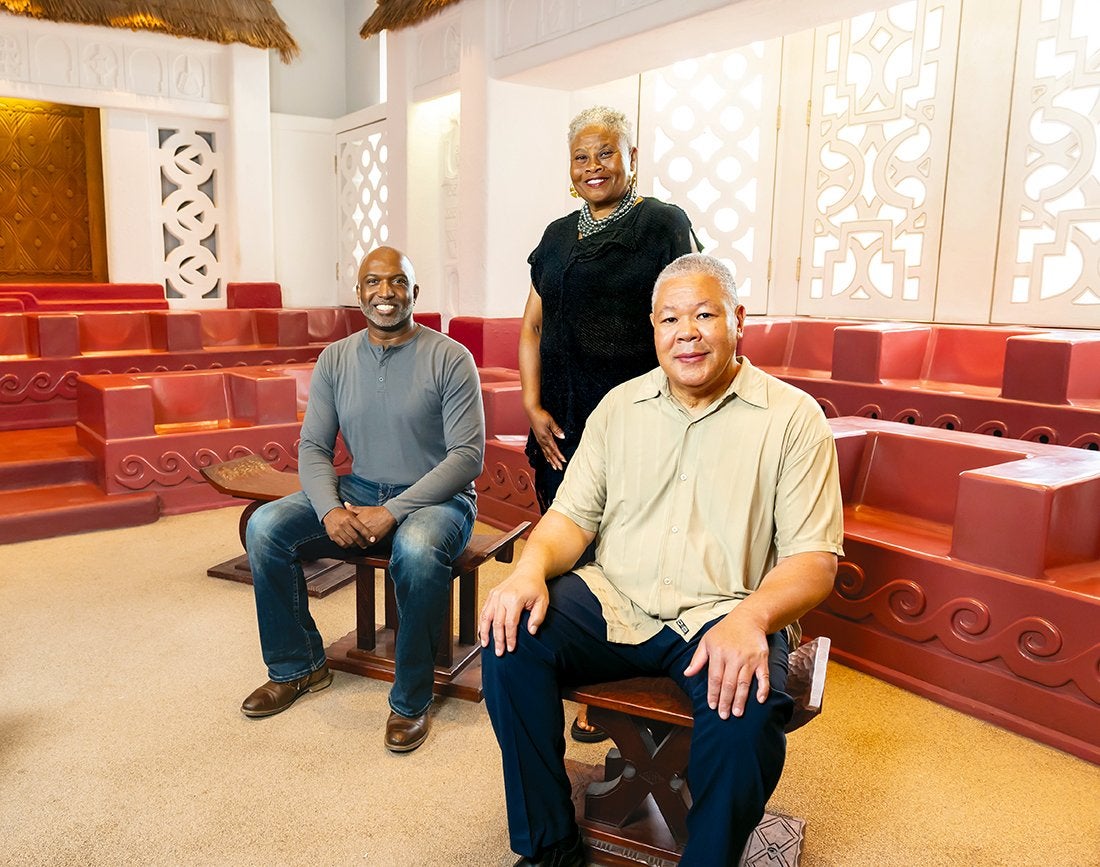
From left, chair Carlton Scott is joined in the African Heritage Room by committee members and past chairs Donna Alexander, a retired longtime Pitt staff member, and Richard Coleman (A&S ’79, ’02G). Dedicated in 1989, the room is Pan-African in concept, Drawing on Asante temple forms and centering on the concept of a courtyard.
Carrying it forward
As a junior at Pitt, Jenna Baron was sitting in the computer lab in David Lawrence Hall, searching online for study abroad scholarships when her phone rang.
“It was the Nationality Rooms,” says Baron (A&S ’13), who majored in anthropology in the Dietrich School while earning certificates in African studies and global studies. “They wanted to let me know I was their winner. That phone call changed my life.”
The scholarship was for $5,000 from the African Heritage Room Committee. Baron had been studying Swahili for three years and tutoring Somali Bantu refugee youths in Pittsburgh through a student-led group called Keep It Real.
The scholarship sent her to East Africa for 12 weeks. She divided her time between a Salvation Army school for the blind in Kenya and a Pitt-sponsored summer program in Tanzania that paired Swahili language study with East African culture and public health.
At the school, Baron, then 21, lived in a building next to the dormitory for the girls who studied there. After dinner most nights, she walked to their dormitory and sat with them. They asked her questions, often about things they couldn’t ask anyone else. It felt like a gift to be trusted.
Jenna Baron
Baron would later return to Kenya as part of a Fulbright research grant through which she conducted oral histories with disability rights activists across the country.
After that trip, Baron came back to Pittsburgh and continued the same sort of work. She and a group of Pitt friends who also tutored Somali Bantu refugees started a summer camp for the immigrant youths they’d been working with. By 2017, the work outgrew a single summer program, and Baron and her colleagues created an additional year-round nonprofit organization.
Baron’s cross-cultural experience and her goal to use her learning to support local African diaspora communities embodies much of what the African Heritage Room symbolizes.
The room “represents memory, resilience, continuity and possibility,” says Carlton Scott, who chairs the room’s committee and serves as associate director of academic advising within the Dietrich School.
The room, he adds, “stands as a living testament to the greatness of African civilizations, the endurance of African descendants and the responsibility we have to preserve and pass on that legacy to future generations.”
Dedicated in 1989, the room was designed by William Bates, a nationally recognized African American architect from Pittsburgh, with carvings by Yoruba master carver Lamidi Fakeye. Pan-African in concept, the room draws prominently on Asante temple forms from Ghana. At its center is a courtyard.
Founding member Laurence Glasco, professor emeritus of history at Pitt, recruited African students to help guide the design. They proposed the courtyard, which Glasco says plays a large role in the lives of many Africans.
“It’s where kids play when they’re young, where parents sit around in the evening and talk, where they entertain guests. It holds weddings, holds funerals — everything,” he says.
As the students described their own home courtyards, Glasco recalls, one of them welled up with tears. “I knew this was the real thing,” Glasco says.
The courtyard was where the work started, not where it stopped.
“Heritage is not something static or ceremonial,” Scott says. “It is something we must actively protect, teach, embody and extend.”