
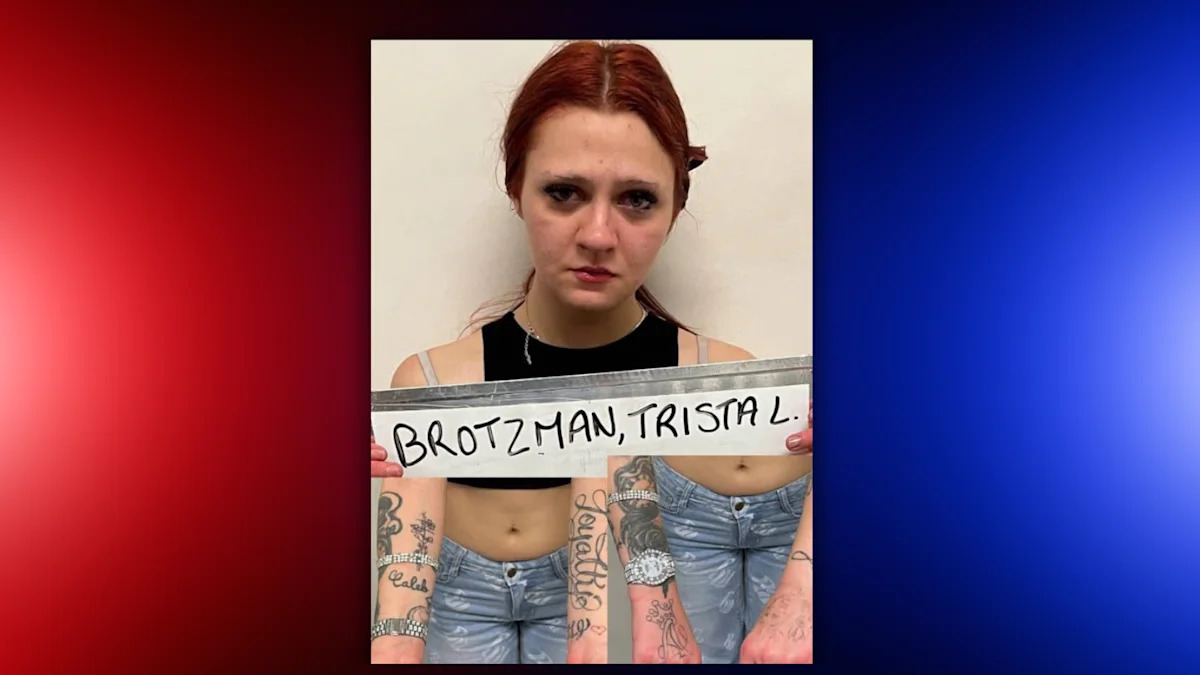
Police arrested a Pennsylvania woman accused of stealing merchandise from JCPenney after she left the Wyoming Valley Mall and headed toward neighboring businesses.
Wilkes-Barre Township police said loss prevention reported that 22-year-old Trista Lynn Brotzman concealed merchandise in her purse and left without paying on Sept. 21. Officers located her shortly after.
A search following the arrest turned up drug paraphernalia and five bills police described as “fake U.S. currency.” Police took Brotzman to headquarters for processing.
The retail theft was graded as a third-degree felony because of Brotzman’s prior convictions, but something else in those photographs quickly became the focus of the comments.
The Bills Get a Second Look
Embedded media follows; please allow a moment for it to load.
Across the five bills are the words “FOR MOTION PICTURE PURPOSES.”
“That’s not counterfeit money,” one commenter wrote. Others made the same point in different ways, arguing that possessing movie money is different from trying to spend it.
The Pennsylvania court record lists two charges against Brotzman: third-degree felony retail theft and misdemeanor possession of drug paraphernalia. There is no forgery, counterfeiting, or other charge involving the bills.
A Cashier Takes the Bill
A 2024 Virginia Court of Appeals case shows how strange the line between prop money, forgery, and fraud can become.
Jeffrey Reeves Joyce Jr. bought a six-pack of beer at a convenience store using a movie-prop $20 bill. The cashier noticed that it felt thicker and lighter than genuine currency, but accepted it and gave Joyce real change.
The bill was not hiding what it was. Its front said, “This note is for motion picture purposes, it is not legal tender.” “Motion Picture Purposes” appeared several more times, while the back substituted “In Props We Trust” for “In God We Trust.” The name and website of the prop-money company were printed on it as well.
Joyce was convicted of obtaining property by false pretenses and felony uttering of a forged bank note.
The appeals court reversed the uttering conviction. It found that the prop bill was invalid on its face and therefore did not qualify as the forged bank note required by Virginia’s statute. The cashier having accepted it did not change what the bill was.
Joyce’s false-pretenses conviction remained in place. He had not challenged that conviction on appeal.
The Paper Has to Qualify
Federal law also distinguishes between the object itself and what someone does with it.
Under 18 U.S.C. § 472, passing, attempting to pass, or possessing a falsely made, forged, counterfeited, or altered U.S. obligation can be a federal crime when it is done with intent to defraud.
The object still has to qualify as the kind of counterfeit or forged obligation covered by the law.
The Virginia appeals court pointed to a 1963 federal case involving supposed $10 bills whose printing was faint, backwards, and crude. The Fourth Circuit reversed the counterfeiting conviction because the papers were “just too crude to mislead” and lacked sufficient resemblance to genuine currency.
Pennsylvania’s forgery statute separately covers making, altering, transferring, or uttering certain writings with intent to defraud or injure another person. Pennsylvania includes money within its definition of a “writing.”
The Virginia case shows how those categories can separate. Joyce used worthless paper to obtain beer and real change, yet the appeals court still concluded that the bill itself did not satisfy the forged-bank-note statute.
A Similar Bill Turns Up Nearby
Brotzman’s arrest had an unusual same-day counterpart elsewhere in Luzerne County.
On Sept. 21, Pennsylvania State Police said someone at Mohegan Pennsylvania Casino in Plains Township tried to pass what appeared to be a $100 bill.
That bill also had “motion picture purposes” written on it.
Wilkes-Barre Township police said they found five prop bills while searching Brotzman following the JCPenney arrest, and her case contains no currency charge. At Mohegan, state police said someone tried to use the similarly marked $100 bill as money.
There is no indication the two incidents were connected.
Another Kind of Fake Cash
Nearby Dallas Township police provided a different example after businesses began receiving counterfeit $50 bills.
Police described older-style $50 notes bearing identical serial numbers, with suspects allegedly using them at businesses while rushing employees through the transactions.
Officers later said three suspects had used the matching bills at Grain & Berry, and one man arrested in the investigation was charged with forgery and theft.
Those notes were not openly labeled as props. Police described them as older-style $50 bills carrying matching serial numbers, the sort of physical clue that points toward an imitation of genuine currency rather than novelty money announcing what it is.
The five bills in the Wilkes-Barre Township photograph are much less coy. They say what they are for in large print.
All parties are presumed innocent unless and until proven guilty in a court of law.