
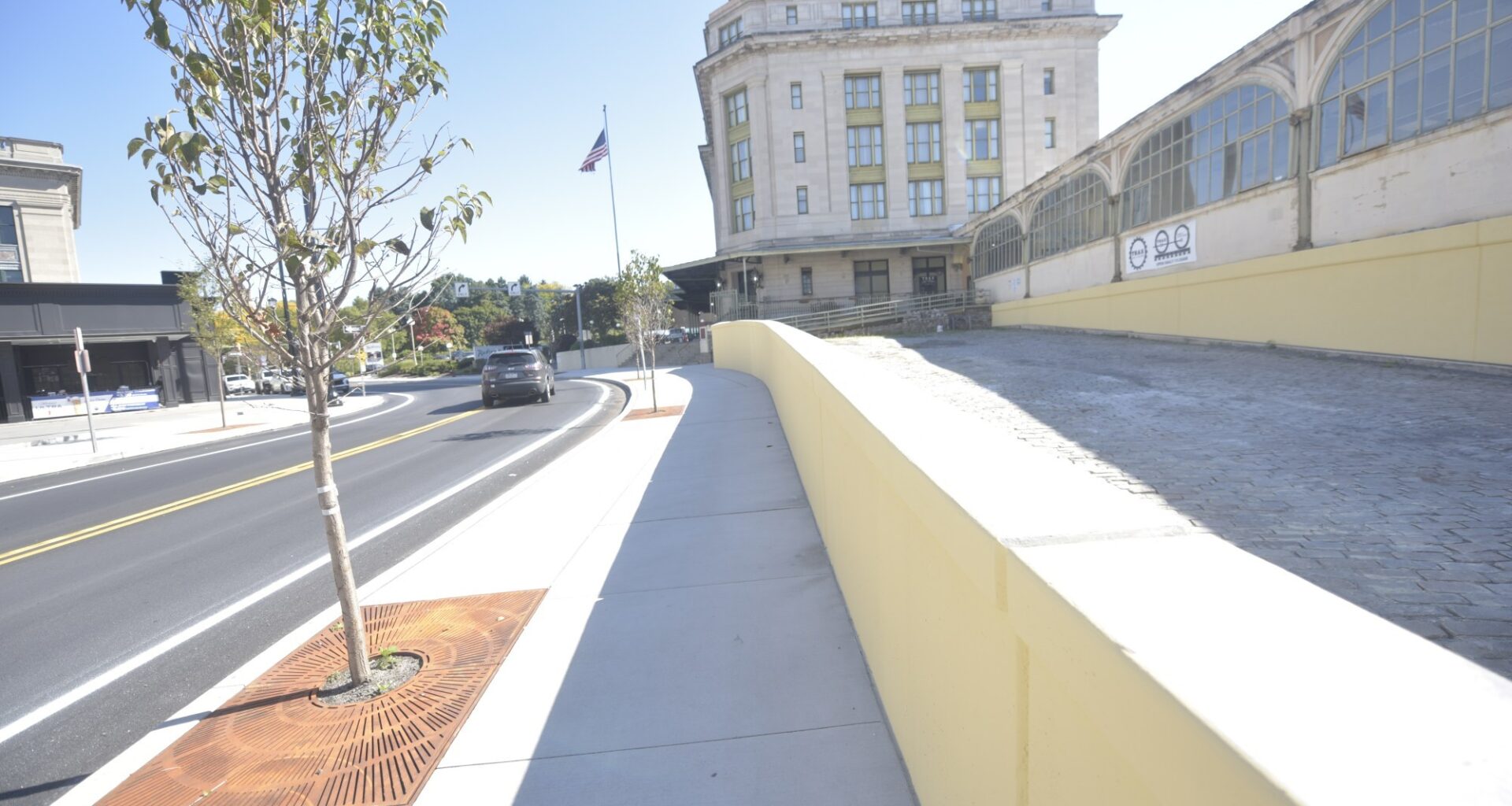
SCRANTON — A $2.2 million streetscape upgrade at a major gateway of the downtown near a historic former train station has removed blight, and improved traffic and pedestrian safety and transit bus accessibility, officials said.
People now can safely walk on new sidewalks in the 600 block of Lackawanna Avenue and bus riders can board and disembark safely at a relocated bus stop there. A block-long, 15-foot-tall and nearly 120-year-old railroad retaining wall that was cracked, crumbling, unsafe and unsightly has been repaired and restored.
The project also installed new curbs and period lampposts and planted trees. Work occurred on most of both sides of Lackawanna and Jefferson avenues, between Cedar/Adams avenues and Biden Street/Expressway. The Biden/Jefferson/Lackawanna nexus sees about 10,000 vehicles a day.
The project created a much safer — and much more inviting — streetscape between the city’s two major hotels, the Radisson at Lackawanna Station and the Hilton Scranton and Conference Center, Mayor Paige Cognetti said during a ribbon-cutting ceremony held Wednesday to celebrate the recent completion of the work.
“Having this look good again is important because it’s right between the Radisson and the Hilton. This is where people come for conferences, this is where they come and stay for weddings, for their parents’ weekend” at colleges, Cognetti said. “We want to make sure that people’s gateway to Scranton right where they’re staying is looking nice.
 Scranton Mayor Paige Cognetti addresses members of the press after the completion of a streetscape upgrade at a main entry point of the downtown near the Radisson at Lackawanna Station hotel in the 600 block of Lackawanna Avenue and part of Jefferson Avenue on Wednesday, Oct. 7, 2026. Among other work, the project included repairs to a 15-feet-high, 120-feet-long and nearly 120-year-old railroad retaining wall that was cracked, crumbling and unsafe. (CHAD SEBRING/STAFF PHOTO)
Facelift for 118-year-old wall
A visually striking aspect of the project is the restoration of the long, large, curved retaining wall, as well as a smaller, shorter companion retaining wall at the bend in the road where Lackawanna Avenue becomes Jefferson Avenue.
The larger wall between the Radisson and the Station Center building at Lackawanna and Cedar avenues likely dates to 1908. Based on historical postcard images, this large retaining wall probably is original to the 1908 Delaware, Lackawanna & Western Railroad station that is now the Radisson, Lackawanna Historical Society Assistant Director Sarah Piccini said in an August 2025 article in The Times-Tribune.
A plaque at the Radisson from 1951 commemorating the 100th anniversary of the Delaware, Lackawanna & Western Railroad Co. says in part: “Here in Scranton, Pennsylvania, was conceived and brought to successful completion the first segment of what is now the Delaware, Lackawanna and Western Railroad, on which the first train was operated October 15, 1851.”
The spiffy, repaired wall gives that block a fresh look.
“I think when people look at a wall like this, that they’re used to seeing on parade day and have it be crumbling, and when it gets fixed, it really boosts people’s morale. It boosts their pride in the city, whether they even know it or not. It also boosts the private investment” occurring downtown, Cognetti said.
The large wall likely will become a canvas for future murals, the mayor said, noting she anticipates the city working with the nonprofit Scranton Tomorrow and its Mural Arts Program on raising funds to adorn the structure with murals.
“I’m sure that we’ll have lots of ideas for these murals,” Cognetti said. “It’s such a large wall that I imagine there would be different ones, but you’ve got to raise the money first.”
Previously, the sidewalk along the Radisson ended at a small bus shelter spot and didn’t pick up again until some distance down Lackawanna Avenue, along the large retaining wall. A smaller retaining wall near the former bus shelter was so badly deteriorated and crumbling it had to be cordoned off from the road with concrete barriers. Now, a new, wide sidewalk and small retaining wall replace the formerly blighted, disjointed gap in the streetscape and allow pedestrians to stay out of the road there.
The project also relocated the bus shelter down the block, to a spot where passengers can stay out of the street when boarding or disembarking.
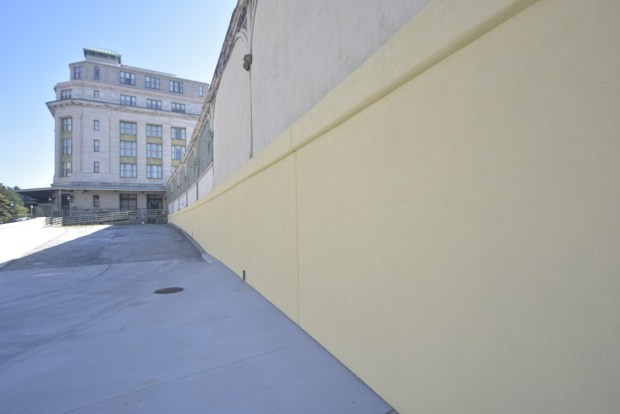 The city celebrated the completion of a streetscape upgrade at a main entry point of the downtown near the Radisson at Lackawanna Station hotel in the 600 block of Lackawanna Avenue and part of Jefferson Avenue on Wednesday, Oct. 7, 2026. Among other work, the project included repairs to a 15-feet-high, 120-feet-long and nearly 120-year-old railroad retaining wall that was cracked, crumbling and unsafe. (CHAD SEBRING/STAFF PHOTO)
Project went back years
The 600 block of Lackawanna streetscape project initially started as a county project several years ago. The city later took it over as the lead agency and it became a key component of the ambitious, sweeping overhaul of many streets downtown approved in 2025 by Cognetti and Scranton City Council.
The larger, overarching streetscape plan stemmed from a 2023 connectivity study, which has also been called a walkability study, and that proposed numerous ways to improve pedestrian safety and traffic flow throughout the downtown.
Set in motion in summer 2025, this Lackawanna Avenue streetscape project was the first of many streetscape infrastructure projects throughout the downtown to get off the ground.
“We were able to work with the county to make sure we got it done,” Cognetti said of the 600 block of Lackawanna Avenue.
In October 2025, council adopted three ordinances from Cognetti’s administration underlying the various downtown streetscape changes under the connectivity/walkability plan. Those called for replacing some traffic lights with stop signs and reverting some one-way streets to two-way; narrowing some vehicle travel lanes and adding curb bump-outs at intersections to improve pedestrian safety; and in certain spots adding bike lanes and parking spaces.
Most of the downtown streetscape projects, which total $20.4 million, have been completed. Some of the remaining ones will get done before winter and the rest will be completed in the spring, she said.
“We’re doing it corner-by-corner and block-by-block,” and also filling in old vaults under sidewalks, Cognetti said.
Plans for traffic changes involving replacing some stoplights with four-way stop signs and reverting some one-way streets back to two-ways remain in development for implementation soon, she said.
Bigger picture
The downtown streetscape upgrades, coupled with numerous parks-and-recreation and stormwater improvements throughout the city in recent years, represent some of the largest public works projects undertaken in the city, and generally around the same time, in many years.
“Our goal with all of this public infrastructure investment throughout the whole city — stormwater projects included, parks included, but very much so the streetscapes work downtown — is to have public investment alongside the private investment,” Cognetti said. “We want the city to not just look nice, we want it to be safe.”
Curt Camoni, the executive director at the Lackawanna County Convention and Visitors Bureau, said the impact of all of the downtown projects combined will benefit the city greatly for years to come.
“There’s economic-impact studies galore that will show you a 20-40% increase in economic impact after smart walkability and streetscaping projects,” Camoni said. “It not only benefits tourism, but it also benefits quality of life, increases property values, is more welcoming, people have a higher perception of safety. Across the board, this is a great idea.”
And while the construction work has created traffic headaches downtown, Camoni expects that the overall project will be appreciated more by the public after it’s finally all completed.
“It’s like renovating a house while you’re living in it — it’s going to create some headaches, some frustrations,” Camoni said. “It’s just going to be much more appreciated after the fact, than when you’re driving through construction on your daily commute. When the whole downtown is done, it will be a drastic improvement.”