
How did a country as small and poor as Albania in the 1940s emerge from the Holocaust with a larger Jewish population than before the war, a statistic no other European country matched? The country’s resident population of Jews swelled from 200 at the start of World War II to 1,800 to 3,000 by the war’s end.
At a Sept. 29 event to posthumously honor Albania’s own Oskar Schindler and Albania’s relationship with Israel at the Weitzman National Museum of American Jewish History, attendees who had never before heard this fact learned the answer.
The family of Kadri Cakrani (pronounced SOCK-rani), an Albanian immigrant with an Oskar Schindler-like history who lived on North Second Street in Philadelphia, knew nothing of their father’s past.
“It was just Dad,” Hope Cakrani Vrato, his daughter, said. But she did remember asking him why, if he was such an important person, her friends didn’t even know who he was.
“Your friends will read this story. Don’t worry, your friends will read my story in the history book. You’ll see,” Hope quoted him as saying.
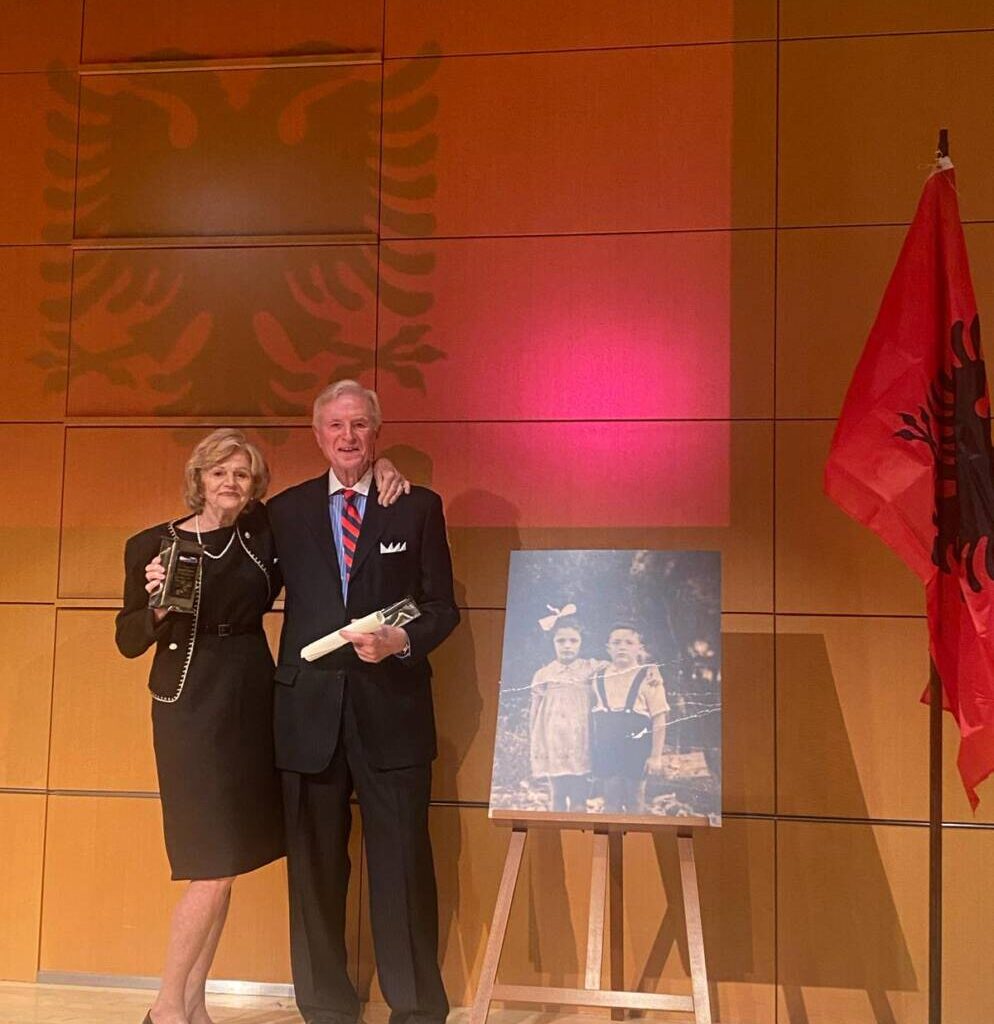
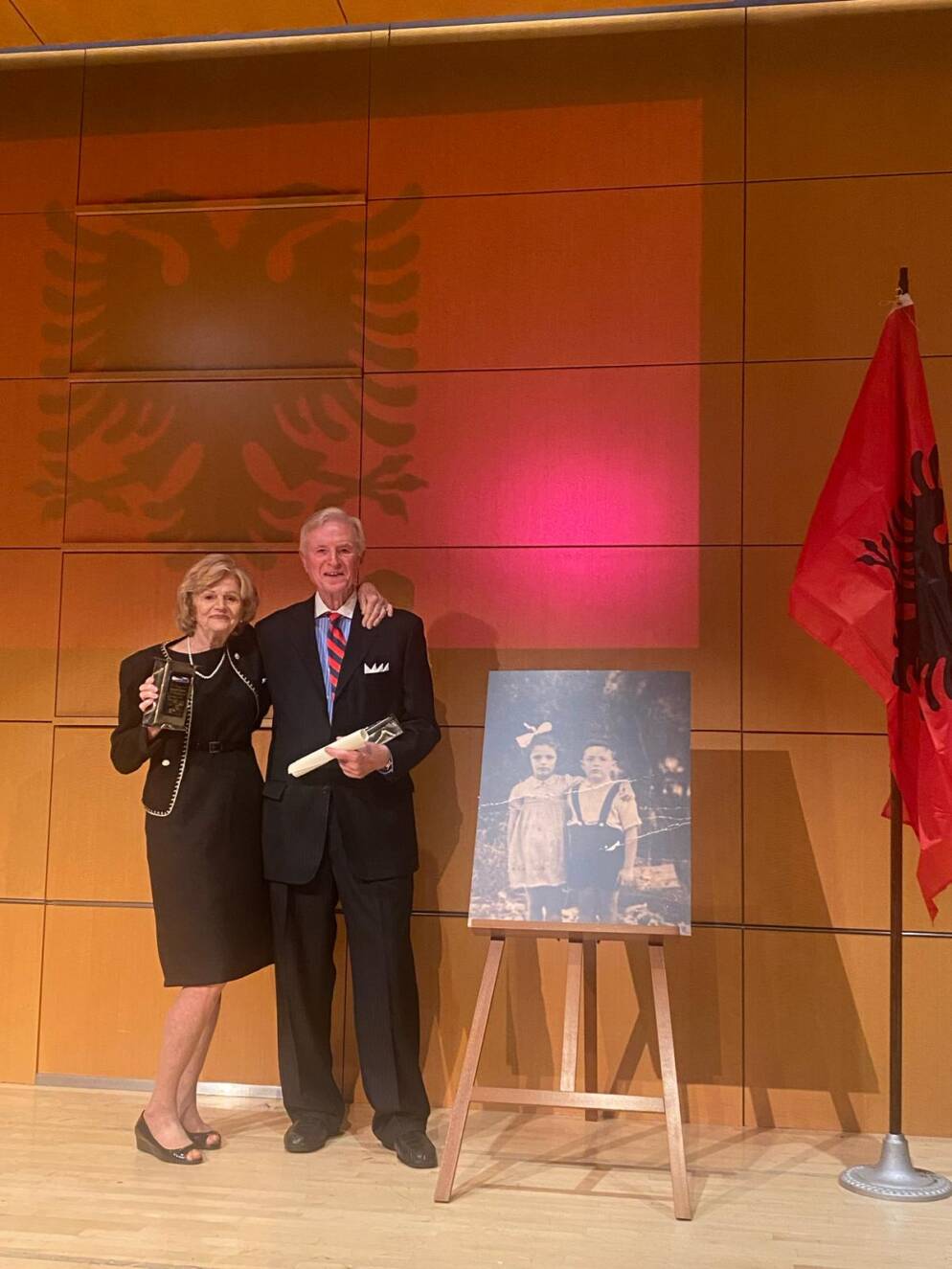 Hope Cakrani Vrato and Iz Cakrane, the children of Kadri Cakrani, pose next to a photo of themselves as children, holding the tzedakah boxes they received in commemoration of the work done by their father to save Albania’s Jews from the Nazis. (Photo credit: Lisa Vrato)
That prediction is unfolding as the Cakrani family, with efforts spearheaded by his granddaughter Lisa (Elizabeth) Vrato, shares their discovery with the world. It began when his son, Iz Cakrane (pronounced KAHK-rin), began researching his great-uncle after finding nothing about his father. That’s when he found a letter that an Albanian had posted online written by his father and addressed to his uncle that, he said, he could not believe was real at first.
“We need to urgently transport a big number of people from Berat,” Cakrani, commandant of the Albanian city, wrote. “I am talking about the Jews who are in the hundreds here, and if they are found, they will all be put under the bullet … They shouldn’t fall into the hands of the Nazi army that is on its way here, because we know what the Nazis will do to them … Send someone back immediately with my courier.”
Cakrane said that he sent the letter to 25 family members across five states and they were all just as “floored” as he was; none of them had known anything about it.
“I read it, and I thought, how is this possible?” he told Philadelphia Jewish Exponent. “How can this be true?”
The letter sparked research into the family history undertaken by Lisa, who flew to Albania to discover whatever she could. Ultimately, the family pieced together a story of an Oskar Schindler-like figure, who, because of his fluency in German and his position as a military commander, succeeded in keeping hundreds of Jews (about 600 and possibly more) hidden as he stayed one step ahead of the Nazis. When they conducted a sweep of one area, he moved them to another area, his rapport with the SS officers enabling him to keep them fooled.
Cakrani died in 1972, but the letter wasn’t discovered until 2018, raising the question: Why the secrecy?
Cakrani did not act alone. The government refused to hand over lists of Jews to the Nazis, and ordinary Albanians, Christian and Muslim alike, sheltered Jews in their homes, as did Cakrani himself.
Albanian Ambassador to the United States Ervin Bushati told Philadelphia Jewish Exponent that what made Albanians different was an ancient moral code known as besa.
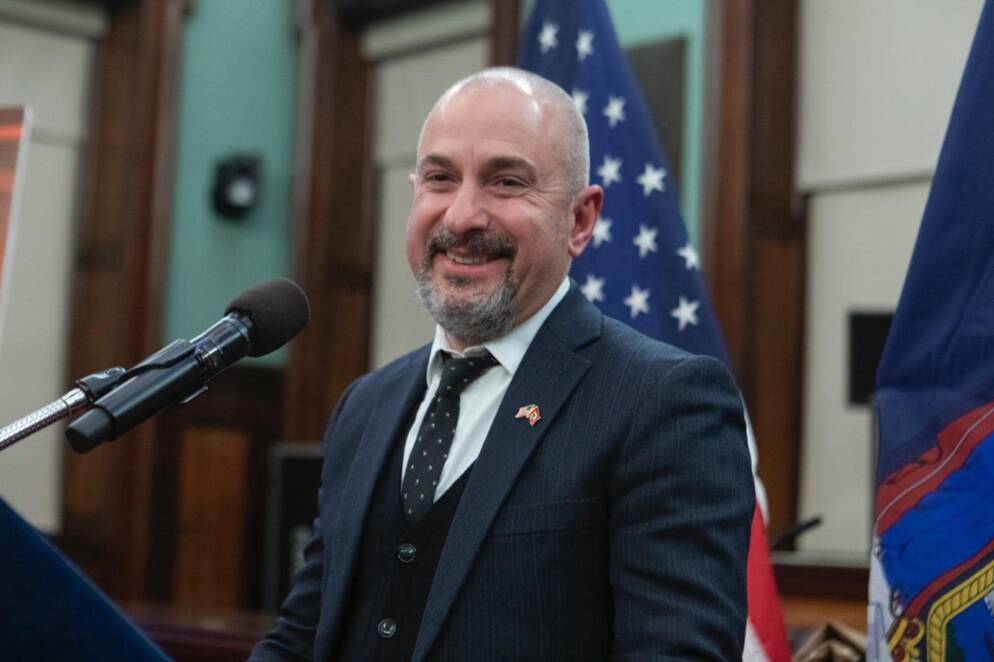 Albanian Ambassador to the United States Ervin Bushati. (Photo credit: EuropaUlqini/wikimediacommons)
“Besa is like a covenant … It’s keeping your word, keeping your covenant,” he said, adding that hospitality is embedded in that code.
“That’s why we try to treat our guests as if they were family,” he added. “So everyone that seeks refuge or safety in Albania … we try to do our best and even sacrifice from ourselves or our families to keep that covenant.”
Albania has maintained its friendliness toward Jews once diplomatic ties with Israel resumed after the fall of communism. Bushati said Albania has become a tourist hot spot for Israelis, with tourism from Israel increasing by more than 700%.
Highlighting this development, one of the hosts of the event, Gil Kapen, executive director of AJIRI-B’nai B’rith International, said in his talk that Jewish and Israeli tourists “can visit Albania safely” without worrying “about being attacked or accosted.”
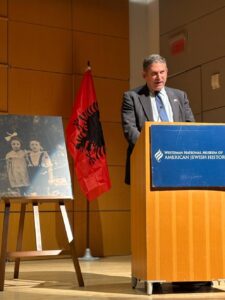 Gil Kapen, executive director of AJIRI-B’nai B’rith International and cohost, delivers remarks. (Photo credit: Lisa Vrato)
For its strong ties to Israel and warmth toward the Jewish community, Albania was honored by B’nai B’rith at the event, which the Albanian diplomat accepted on its behalf.
Eventually, Cakrani’s family learned the reason for his secrecy, a secrecy so strict that his daughter assumed he knew nothing of Jews. After receiving a Star of David from her grandfather as a little girl, Lisa asked her mother, “Does Baba think I’m Jewish? Because look, he gave me this necklace.” Her mother replied, “He doesn’t know what that is. He got that for you because he thinks it’s pretty,” Lisa said.
When communist dictator Enver Hoxha took the reins of power, Cakrani, who opposed him, was forced into exile, fleeing to the United States with nothing more than $7 in his pocket. The man who was born into wealth and privilege to one of Albania’s founding families found himself selling snow cones for a nickel apiece; he rose through the ranks to restaurant owner, and he also worked for the CIA, providing intelligence as part of his work to resist the communist government in Albania.
Fearing for the lives of the soldiers, relatives and friends back home who might suffer if the government learned of their involvement in his wartime activities, he kept quiet until his death.
The story about the heroism of ordinary Albanians during the Holocaust is slowly emerging only now for a similar reason, according to Lisa.
“It was suppressed,” she said, adding that after the war, Albania’s Jews immigrated to Israel.
“Albania became closed off from the world,” she explained. “These stories were not able to be told because of the safety of the people in Albania who they would have been taken to jail as enemies, class enemies.”
Indeed, many of the attendees at the event had never heard the story of Albania’s Jews during the Holocaust, using some variation of the term “mind-blowing” to describe their reaction.
Jessica Shapiro, associate deputy mayor for Mayor Cherelle Parker, who attended the event in the mayor’s place, said she had previously known little about Albania’s role during the war. “I’ve been doing a deep dive on the Yad Vashem website and lots of places, and I was blown away,” she said.
Karen Uslin, who played music at the event by postwar Jewish composers with ties to Philadelphia, said this fact “blows my mind,” especially given that Albania was a small country without “a huge amount of resources and a massive army.”
Robin Schatz, director of government affairs at the Jewish Community Relations Council of the Jewish Federation of Greater Philadelphia, is now inspired to visit Albania.
“I did not know the history, and it blew me away,” she said. “I would love to go to Albania now.”
Why is the story of an Albanian who saved Jews during the Holocaust more than 80 years ago still relevant today?
“Because to roll back and then defeat the antisemites, we need friends and allies,” Daniel S. Mariaschin, honorary CEO of and senior adviser to B’nai B’rith International and co-host of the event with Kapen, who emceed the event, said. “This is a reminder of what people who are not Jewish, who have no reason generally for stepping in, can do … This story can serve as a guidepost to what we can do to fight back against antisemitism today.”
“No matter when you live, there are always opportunities to see God’s image and likeness in another human being, and to stand up against injustice in favor of that person, and that, in doing so, you become a better person,” said Father Nick Dellerman, rector of Saints Peter and Paul Orthodox Church in Philadelphia, who delivered the interfaith invocation. “There’s always a point where you need to stand up for somebody.”
Lisa’s husband Tom Volz said that a story like his wife’s grandfather’s “gives you hope.”
“I think people just need to be inspired. People need to know that what they do matters,” he said.
Cakrani’s children had different views on how their father, whose hallmark was humility, would feel if he knew about the recognition he received that night.
“I think he would be a bit embarrassed, you know, because [of] besa,” Cakrane said. “There’s a moral code that goes behind it, and the moral code is that you will help those in need, regardless of the circumstances.”
But Hope said he would have reacted “with pride and joy.”
“I don’t know about embarrassment,” she added, when asked about her brother’s perspective. “I think he would be so proud.”
“I wish I could [tell him] you were right. You were right, and this is bigger than what you even thought,” she said.
Lisa said she wished she could tell her grandfather, grandfather, a war hero, “that a family is a chain, and that the legacy is being restored, and that we do for each other, we do for our ancestors, and we do for our descendants. And I’m pleased to be able to just be this vessel in between and try to make both things happen.”
Dinah Bucholz is a freelance writer.