
Iftekhar Ansari owns about a dozen convenience stores under his A1 brand. But now, he expects some may have to close.
That’s because the skill games in his stores, which he said brought in additional revenue over the years, become illegal as of Wednesday.
“It will be [a] bad impact on these stores,” he said. “And a lot of stores will be closed, and without skill machines, it’s very hard to survive [for] the small convenience stores.”
As the deadline approaches for Pennsylvania businesses to remove unlicensed skill game machines, some in the Lehigh Valley said they fear how the loss will affect them, both in decreased revenue and potential closures.
The Pennsylvania Supreme Court ruled in June that the skill game machines often found in restaurants, social clubs and convenience stores are slot machines as defined in the Gaming Act. That makes it a crime to own, operate or maintain skill games without a Pennsylvania Gaming Control Board license.
The state police and attorney general’s office said the last day to remove skill games located outside of PGCB-licensed businesses before potential law enforcement is Tuesday. After that, the games can be seized.
A state police news release encouraged businesses with skill machines to discuss their removal with any distributors or vendors, or to reach out to the state police for help. Resources and contact information are available at pa.gov/psp/skillgames.
“We do not want to see searches and seizures at storefronts or bar, social club and restaurant establishments — we would much rather business owners and social clubs comply with the law and take steps to get these illegal devices out of their places of business,” Attorney General Dave Sunday said in a release. “Collaborating with our law enforcement partners, my office will act in accordance with the law which prohibits these machines outside of licensed gaming facilities.”
Several Lehigh Valley businesses told The Morning Call they intended to remove their skill game machines before the deadline, but they are not happy with the requirement.
Sumeet Singh has about 10 convenience stores with his family in the Lehigh Valley and beyond, under brands including 7-Eleven and Sunoco.
They installed skill games at those stores, he said, because of customer demand. They improved merchandise sales, helped prevent layoffs during the COVID-19 pandemic and subsidized rising costs.
Given the expected loss of customers who visit for the skill games, Singh said it was “very upsetting” to have to remove the machines and that “it seems like everyone just feels helpless.”
Puneet Lodia, manager of the Jack’s gas stations in Bethlehem, said, “End of the day, it helps promote our store sales. That was key for us. And helps, obviously, our business stay afloat. There’s slow times throughout the year … sometimes around wintertime. Stores peak out and it definitely helps us [with] keeping our employees and everything taken care of.”
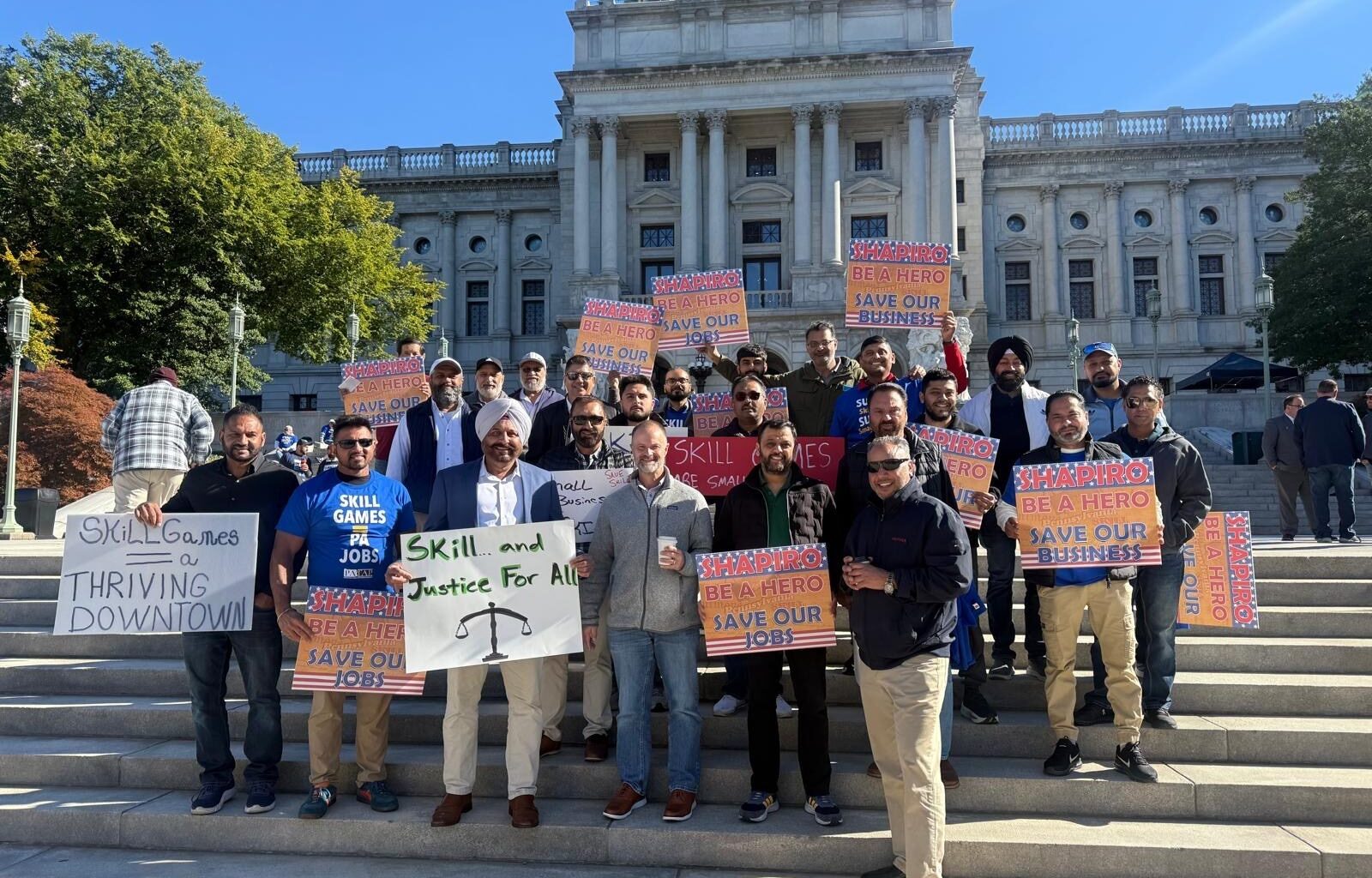
The Pennsylvania Taverns and Players Association organized a rally Tuesday at the state Capitol in Harrisburg in support of skill games.
“Skill games don’t just impact the businesses that have them,” the association said in a September social media post. “Their revenue helps small businesses manage rising costs, support employees and keep prices affordable for their customers. When small businesses lose this revenue, the impact doesn’t stop at the machine. It reaches employees, customers and entire communities.”
There are about 70,000 skills games machines in Pennsylvania. Legislation to regulate them has included Senate Bill 1079 sponsored by Sens. Gene Yaw and Anthony Williams, companion legislation House Bill 2213 sponsored by Reps. Danilo Burgos and Jonathan Fritz, and House Bills 2801 and 2802 introduced by Rep. Russ Diamond.
Some businesses offered to replace the lost skill game machines, such as the arcade machine provider RoboVending and the vending machine provider LVP Vending.
“Let’s fill that space where your skill games used to be and continue making you passive income!” RoboVending said online.
LVP Vending owner Matt Karmazyn said he was concerned for businesses with skill game machines that may not be aware of the deadline, the potential consequences for not complying and even how to properly comply.
The state police news release explained that enforcement can include seizing the machines and the proceeds associated with operating them as well as filing criminal charges. Powering off or unplugging skill game machines is not enough.
“I just feel like there’s a lot of machines out there, and I’m kind of not confident that everyone’s going to get them removed in time,” Karmazyn said.
He added that his work to replace removed skill game machines is “probably not going to replace the amount of revenue that a skill game was bringing in, but it’s something.”