
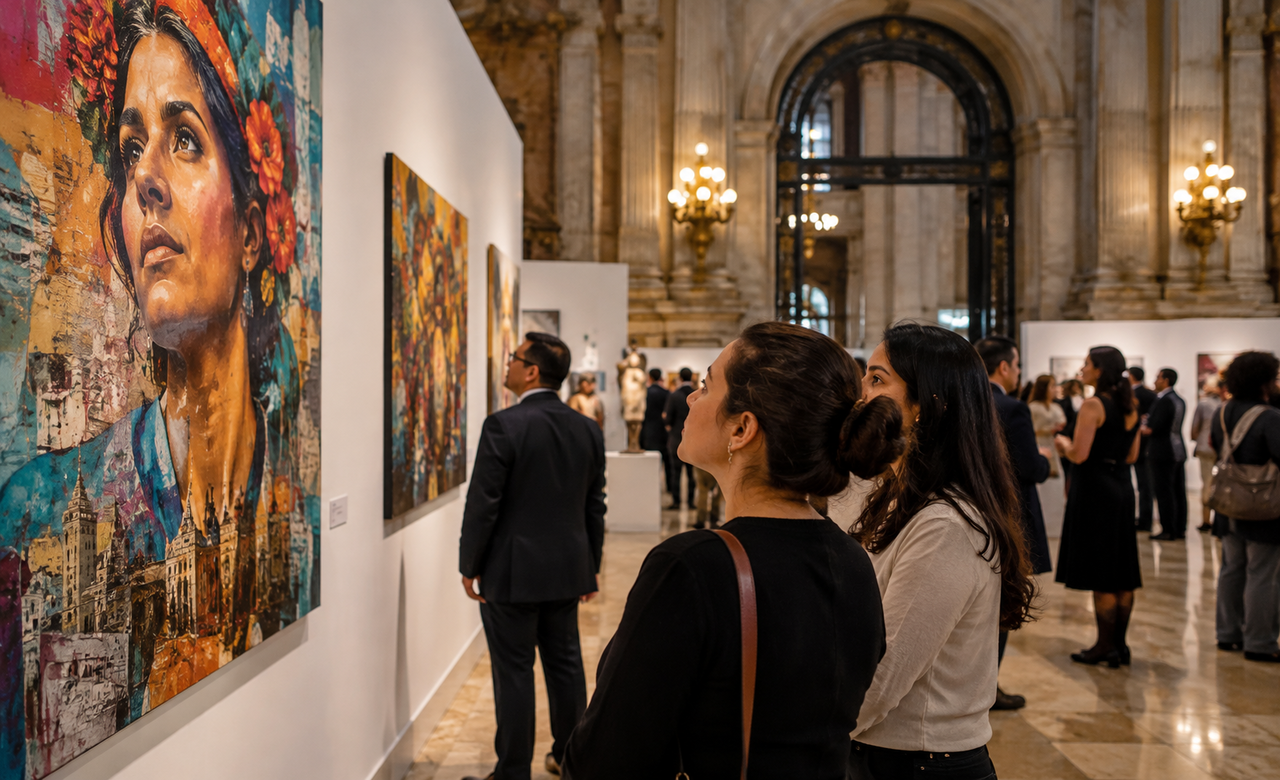
Philadelphia City Hall will open its doors this Friday, October 9, to a conversation that extends beyond the walls of a gallery. The exhibition Philadelphia at the Semiquincentennial will bring together artistic expressions connected to the Hispanic experience in a city preparing to commemorate the 250th anniversary of American independence. The initiative is part of Hispanic Heritage Month and raises a particularly relevant question as the national anniversary approaches: What does it mean to be Hispanic and build a life in the United States?
The opening reception, scheduled from 5 to 6:30 p.m., will feature Creative Philadelphia, City Council President Kenyatta Johnson, and Councilmember Quetcy Lozada, who represents the 7th District. The reception will take place in City Council Room 400A, while the exhibition itself is housed in the municipal building’s art gallery. The exhibition is scheduled to remain on view through November 4, with access Monday through Friday, from 9 a.m. to 5 p.m.
More than a celebration on the cultural calendar, the initiative seeks to place Hispanic experiences within an American history often told through its founding institutions, major political events, and historical figures. Art offers another perspective: that of people who have arrived from other countries, built lives in the city, and helped transform its identity without necessarily abandoning the traditions of their places of origin.
A National History Seen Through Different Roots
The timing is no coincidence. In 2026, the United States commemorates the 250th anniversary of its independence, a milestone that invites a reassessment of both the nation’s founding principles and the diverse experiences that have shaped its society. For Hispanic artists, that reflection can also explore migration, belonging, family memory, and the coexistence of cultures.
According to the exhibition description published by InLiquid, artists were invited to interpret the meaning of America’s 250 years through their experiences as Hispanic residents of Philadelphia. The exhibition encourages them to explore cultural heritage, personal legacies, contemporary social issues, and individual stories.
Among the publicly identified participants are David Enriquez, a Mexican-born figurative painter, sculptor, and educator based in Philadelphia, and Jacqueline Unanue, an abstract artist and designer born in Chile who also lives and works in the city. Unanue’s career offers an example of how the immigrant experience can become both artistic material and a subject of public reflection.
The artist has described her work for this initiative as a convergence of her Chilean traditions and her life experience in the United States. She has also connected her approach to issues of immigration, justice, and cultural recognition. Her perspective points to a reality that does not always fit neatly into simple categories of origin or nationality: identity can preserve its roots while evolving through encounters with other contexts.
From Symbolic Recognition to Public Representation
The exhibition comes at a time when Philadelphia is officially recognizing the importance of its Hispanic and Latino communities. On September 17, City Council adopted a resolution declaring September 15 through October 15 Hispanic Heritage Month in the city. The document highlights these communities’ historical, cultural, and social contributions, including the Puerto Rican presence, which is deeply rooted in local life.
However, recognizing a community does not necessarily guarantee that its stories will hold a permanent place in public spaces. That is what makes initiatives that bring cultural expression into buildings where decisions are made and residents are formally represented particularly significant. City Hall is not a conventional gallery: it is one of the main centers of municipal power. Bringing the work of Hispanic artists into that setting creates an opportunity for their stories to engage with the city’s institutional history.
The Art in City Hall program, administered by the city’s arts, culture, and creative economy office, seeks precisely to transform public spaces within the building into platforms for artistic expression, community voices, and dialogue. The initiative recognizes that art can contribute to civic discourse, not merely provide entertainment or decoration.
That purpose carries particular weight in a city shaped by successive waves of immigration and by communities that have developed their own institutions, businesses, organizations, and cultural networks. For many Hispanic residents, Philadelphia is both a place to put down roots and a space where questions of identity, representation, and belonging remain unresolved.
The Challenge of Keeping the Conversation Alive
Hispanic Heritage Month offers an opportunity to celebrate diversity, but it also raises a more demanding question: how can recognition be prevented from becoming limited to a few weeks of activities? Exhibitions, festivals, and ceremonies can increase artists’ visibility and introduce audiences to different cultural experiences. Their impact, however, also depends on whether sustained opportunities exist to exhibit, produce, and share this work throughout the rest of the year.
Philadelphia at the Semiquincentennial proposes viewing national history through a plurality of experiences. Rather than presenting American identity as a closed narrative, it creates space for artists with Latin American roots to examine its contradictions, legacies, and possibilities.
The 250th anniversary of independence invites Americans to remember the past, but also to ask who gets to participate in shaping the future. In that debate, Hispanic art is not a marginal presence. It offers perspectives on migration, justice, memory, and coexistence that help illuminate a city and a country in constant transformation.