
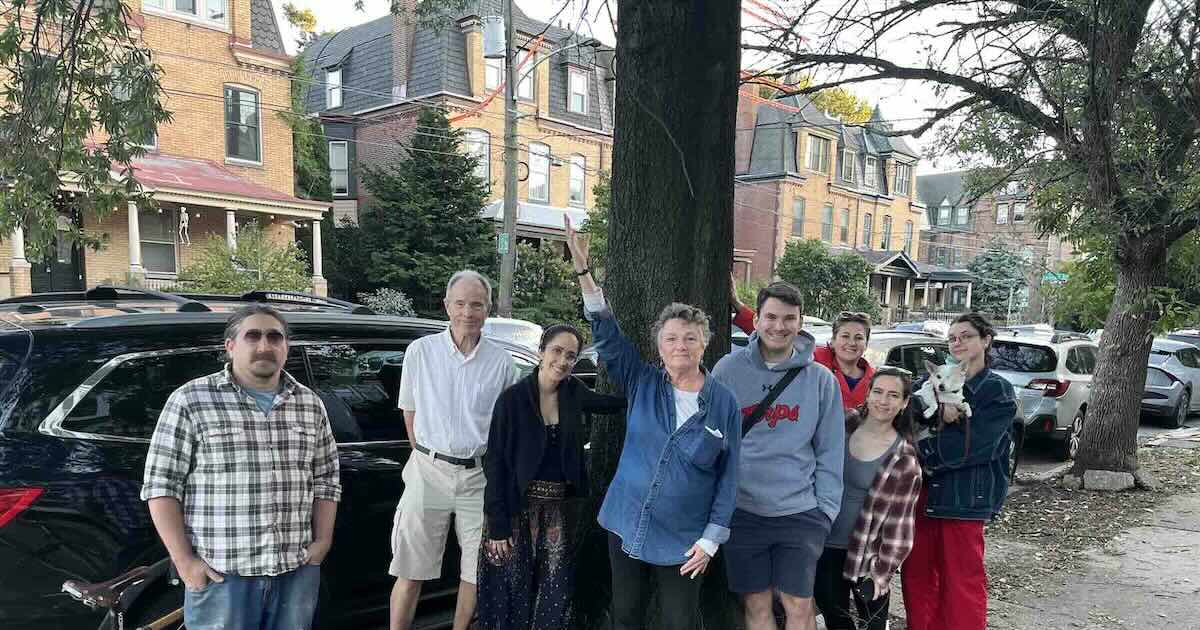
What do you do if you want to get workers to stop cutting down a tree? If you’re Beth Duddy, you block their way.
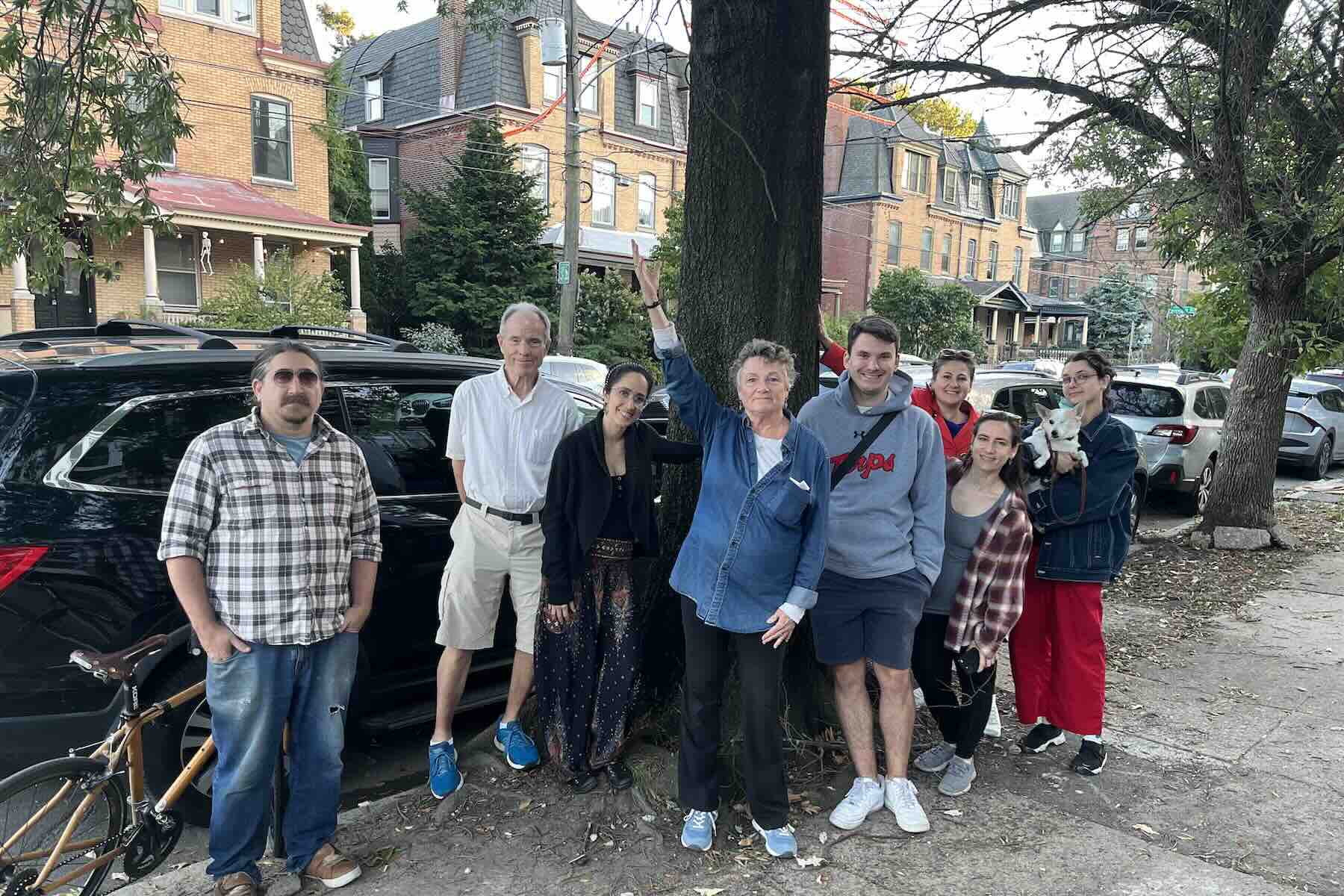
Beth Duddy and concerned neighbors in front of the West Philadelphia tree threatened with removal (photo provided)
Listen to the audio edition here:
Two Mondays ago, Beth Duddy was enjoying the early fall weather, relaxing on her second floor porch of the apartment she rents near the corner of 46th and Springfield in West Philadelphia. She was taking in the sunshine and ample birdsong when her peace was suddenly interrupted by the sound of loud machinery. She peered down the street and saw a crew removing large branches from a lovely willow oak tree in front of 4601 Springfield Avenue. One of the workers had climbed up the tree and two others stood below.
Duddy, a retired copyeditor, walked outside to speak to the workers. She asked what they were doing and they told her they’d been hired to cut the tree down and remove the stump. “I asked them if they had a permit, and they said no,” Duddy says. So Duddy stood next to the tree, making it impossible for them to continue their work, in a move reminiscent of 1970s activists who chained themselves to trees. Alas, Duddy didn’t have a chain at the ready.
One of the workers called the Delaware-based developer behind the ongoing renovation of the house, Tremaine Johnson, and explained the situation at hand. The worker gave the phone to Duddy, who told Johnson he couldn’t remove the tree without a permit. Duddy describes the call as “confrontational.” “I spoke to him,” she says. “Or he spoke at me is more precise.” The two had a brief conversation, which ended after Duddy told Johnson she was staying put.
An hour or so later, Johnson showed up. By that time, a couple of Duddy’s neighbors joined her in her protest. “Everybody was alarmed and excited and angered,” Duddy recalls. “There was anger on both sides.” Police were eventually called to the scene but left soon after arriving because, says Duddy, they were called to a more urgent matter. The workers left, as did Johnson, and Duddy returned to her apartment. (Coincidentally, Johnson was standing near the tree on Wednesday when we showed up to measure the tree and talk to Duddy; the two shook hands, and Johnson apologized for “coming in heated” on that Monday afternoon.)
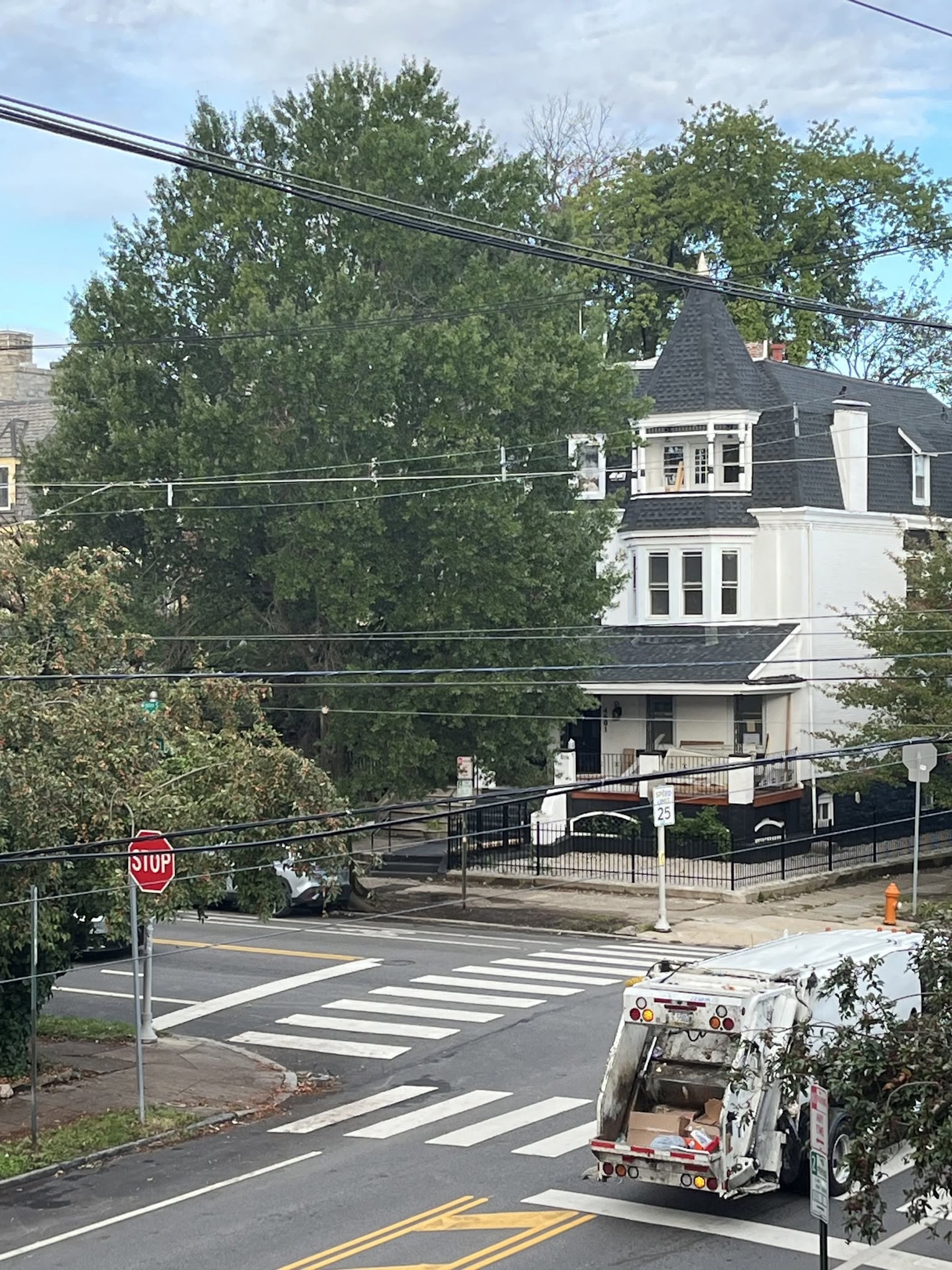
A view of the tree threatened with removal, from Beth Duddy’s second-floor porch in West Philadelphia (photo courtesy Beth Duddy)
Johnson tells Philly Mag that he wants to remove the tree because he is concerned about its massive root system damaging the property he’s developing and possibly leading to water in the basement. He says he’s trying to be proactive. “Nobody just spends thousands of dollars to take a tree down for no reason,” he insists. To people who say he shouldn’t remove the tree, he has this to say: “Well, what about this property? What if there’s a tree growing towards your house [that might cause] possible water issues and sewer issues and cost you thousands of dollars?”
Immediately after the confrontation in front of 4601 Springfield, Duddy started a Facebook campaign in neighborhood groups to let the community know of her mission to save the tree. She heard from residents of Powelton Village and Fairmount who had dealt with similar issues: longstanding trees being ripped out by developers. She started emailing and calling everyone she could think of, from the office of Councilperson Jamie Gauthier to the non-profit Philly Tree Coalition to the city’s forester.
The tree in question is what is known as a street tree. Unlike trees that are in a front or backyard, a street tree is one that has grown between the curb and the sidewalk. “Yard trees are private property trees,” explains Kiasha Huling of the Philly Tree Coalition, an organization dedicated to making neighborhoods greener. “But our street trees are shared-responsibility trees. They are primarily the property of the homeowner but they are also informed by utilities and the city itself and line-of-sight for transportation.”
According to Huling, it’s difficult to know how many street trees there are in Philadelphia, simply because people remove trees and people plant trees, and there’s no effective way to track that on a regular basis. But according to the Philadelphia Parks & Recreation’s 2018 tree canopy survey, the city lost 6 percent of its tree coverage between 2008 and 2018 — about 100 football fields of trees every year — thanks to storms, pests, and, yes, developers. The next tree survey is scheduled to take place in 2028.
Duddy, who says she’s never considered herself an activist, says her primary motivation for wanting to save the tree is quite simply that it’s beautiful, and she loves looking at it. But there are many reasons why trees are important in the city: they clean the air, they cool the blocks, they can help reduce stormwater runoff, they provide homes for wildlife, they can increase housing values.
“We also know that being in green spaces and being close to nature improve moods,” offers Huling. “Stress can be managed through spending time and nature in green spaces and in nature before it becomes clinical anxiety. Street trees are our biggest opportunity to grow our canopy and recover from our tree loss. Street trees are our biggest asset in terms of trees.”
So this isn’t just about this one tree. It’s about the tree canopy as a whole, a citywide problem.
A property owner does, in fact, need a permit to remove a street tree in Philadelphia. You can’t just call a crew to rip the thing out. The owner of 4601 Springfield Avenue is Johnson’s BAL Educational Athletics Foundation, a New Castle, Delaware-based non-profit whose mission is to pair sports with academic mentorship. (During our interview with Johnson, he declined to discuss the non-profit, explaining that he wanted to focus on the tree dispute; similarly, he declined to tell us, for the purposes of this story, if he had developed any properties before.)
Johnson did not obtain a permit to remove the tree and, according to city records, his foundation was previously found in violation and fined by the Department of Licenses & Inspections for doing work on the property without the proper permitting required by law — long before the matter at hand.
But getting a permit to remove the tree in front of the property should be an easy task for him. If a street tree is unhealthy, the city will remove it at no expense to the property owner. But if the tree is healthy, as is the case with the one here, the property owner must pay for the cost, after receiving a permit. This is more or less a rubber stamp, says Huling.
Getting said permit gets trickier if the tree is protected as a heritage tree, which means it has to be on the city’s list of protected species (this one is), it has to meet a size requirement with a diameter of at least 24 inches at chest height (this one does), and the lot on which it sits must be at least 5,000 square feet (4601 Springfield is on a 3,50o-square-foot lot). Once Johnson obtains a permit, he also has to hire a certified arborist recognized by the city to do the work.
Duddy has been keeping the heat on, continuing to make phone calls and send emails, and she held a small rally in front of the tree on Monday, a week after the initial confrontation with Johnson. Abby Heller-Burnham, an artist who lives nearby on 49th Street and heard about the tree drama on social media, showed up at the rally to meet Duddy and show support. “I love it in West Philly, particularly because of the tree canopy,” says Heller-Burnham. “I’d hate to see a tree be removed for no reason — or at all for that matter. We recently had a terrible storm that knocked down a bunch of trees, so I’m particularly alerted to that, because it was really awful to lose those trees.”
Duddy says this has been a learning process for her, understanding all the ins and outs of street trees, city permitting, bureaucracy navigation and the like, and now concedes that Johnson is well within his rights to remove the tree she loves so much — as long as he does it the right way. She and Heller-Burnham agree that the next step is to get the city to change the laws as they relate to street trees, so that a property owner must prove just cause before the city will issue a permit for removal, and they are beginning to focus their energies in that direction. Duddy says she hopes to meet with City Councilmember-at-Large Katherine Gilmore-Richardson, who has been working on a bill to improve the city’s tree canopy, as well as with Gauthier, who represents Duddy’s neighborhood.
“The city needs to get serious about managing our trees,” Gauthier told Philly Mag in a statement. “My office regularly hears from residents who are confused by how hands-off the city’s approach is. The consequences can be dangerous and even deadly. A rotting tree in Fairmount Park was left standing until it fell and injured my uncle and three others while they were playing dominoes. They were lucky. I’ve had other constituents die after being hit by a tree. At the same time, healthy, safe trees that make up our essential tree canopy have no legal protection. Together, these gaps create a dangerous mix. Residents don’t trust the City to protect safe trees or remove unhealthy ones, so some feel they have to take matters into their own hands.”
Until the laws change, the best hope that residents like Duddy have to save a street tree in their neighborhood is to make a nuisance out of themselves. And in the case of the tree at 4601 Springfield Avenue, it seems like Duddy’s tireless efforts to make life more difficult for Johnson might just be paying off.
“It’s costly, and I don’t really want any more headaches in the neighborhood,” says Johnson. “At this point, I’m not really sure what my next steps would be. I’ve been getting a lot of grief.”
For now, the tree lives to see another day.