

Matt Doyle talks about his “extraordinary ability to shape shift.” His career proves his point.
In 2007, at age 19, Doyle took a chance by going to an open call for Broadway’s buzz-provoking hit at the time, “Spring Awakening.”
The song he sang was Paul McCartney’s “Let It Be.” It led to him understudying two roles. He eventually graduated to full-time casting as the confident Hanschen and went on to play the complex lead, Melchior.
“I was fortunate,” Doyle, coming Oct. 19 to the Broadway Cabaret in the Warwick Hotel’s Rittenhouse Grill, says by telephone from his Jersey City home. “‘Spring Awakening’ changed my life exponentially.”
Over the next few seasons, Doyle would play a series of Broadway leads — Hugo Peabody in “Bye Bye Birdie,” Billy in “War Horse,” Elder Price in “The Book of Mormon” — before going on to more unusual roles off-Broadway, including Anthony in an immersive “Sweeney Todd” and one of the droogs in an intense staging of “A Clockwork Orange.”
Obviously, Doyle avoided being typecast, and all of the shows expanded his sensibility about theater along with expanding his range.
“I am most proud of this earlier part of my career when none of the characters were similar let alone the same. The characters were not only different from each other. They were different from me. I had to learn about other people’s lives. I also went back and forth from leads to character roles.
“The shows were also different. They from off-center to conventional, from serious to comic. It was quite the learning experience. I became known among people on Broadway, established a career, and worked constantly even if the public might not recognize me.”
Anonymity ended when Doyle took stage in 2021 as Jamie, the neurotically unsure gay co-groom in Marianne Elliott’s gender-bending revival of Stephen Sondheim’s “Company.” Doyle’s version of the hilarious lightning-fast “Getting Married Today” earned him oodles of attention along with a 2022 Tony Award as Best Supporting Actor in a Musical. His life was changed again, just as Jonathan Bailey’s was after he played Jamie in Elliott’s 2018 London production of “Company.”
“Best of all was playing the character that came closest to who I am. Jamie is a nervous gay guy who is going over the edge as he anticipates what this wedding might mean to him and his partner. I am a nervous gay guy who has a tendency to go over the edge. I am used to having panic attacks.
“There was a lot to be on edge about with ‘Company.’ It had two runs. We began performances in March 2020. Five shows in, we had to close because everything was closed by the pandemic. It was almost two years later that we finally began our run.”
The pandemic also gave Doyle, maybe everyone, additional perspective. After working eight shows a week for an entire decade, he says he had to learn to take life day-to-day. Among things he found himself doing was inventing cabaret or concert acts in his living room, the same one from which he’s speaking to me. Songs and composers chosen revealed preferences as broad and eclectic as the roles Doyle’s played.
For his set at the Rittenhouse Grill, Doyle will be combining songs from his theater appearances with music from pop singer-songwriters such as Bob Dylan, Joni Mitchell and Sara Bareilles. The two songs that proved so significant to Doyle’s career, “Let It Be” and “Getting Married Today,” are included.
“I’m drawn to songs of growth, hope and beauty, songs that speak to being an individual,” he said.
The soothing quality of “Let It Be” and franticness of ‘Getting Married Today” figure into Doyle’s life story.
“I talk about panic attacks and going over the edge with experience,” Doyle says. “For my whole life, I’ve coped with being manic-depressive. Mental health is an important topic to me, and I will be talking about it throughout my set.”
Doyle says he dealt with bouts of depression while performing but in general, he found his time in front of audiences “healing.”
“I found safety on stage, identity on stage, and escape on stage. Performing was wonderfully cathartic. Whatever I might be handling off-stage, the focus and purpose involved in playing a character kept me disciplined and level.”
Doyle also talks about people who influenced him in his life and career. One is Marianne Elliott, to my mind one of the two best theater directors working today. (The other is Ivo van Hove.) She chose Doyle to play the lead in “War Horse” and gave him the role of Jamie in “Company.”
“It is a gift the way she talks to actors and makes everything so clear,” Doyle says.
Another is the late Gavin Creel, a fellow Tony recipient and fellow Elder Price,” who Doyle mentioned several times, describing him as a friend and mentor as well as an example of a versatile performer.
‘Misery’ on stage
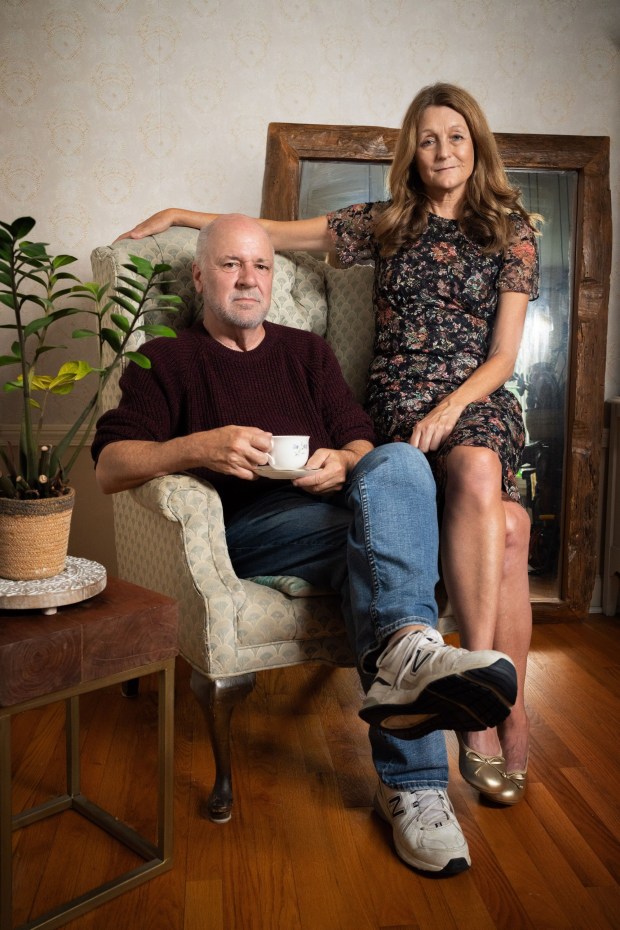 Performers Bruce Graham, left, and Emma Gibson, right, are featured in “Misery,” set to run at Hedgerow Theater in Rose Valley, from Wednesday, Oct. 14 to Sunday, Nov. 1, with 14 performances. (COURTESY OF JAMES KERN PHOTOGRAPHY)
Bruce Graham emphasizes that people who come to Hedgerow Theatre’s production of “Misery” should not expect to see Rob Reiner’s 1990 movie re-enacted.
“This a different ‘Misery,”’ Graham says by telephone from his South Philadelphia home. “Emma Gibson and I are not trying to bring on memories of Kathy Bates and James Caan. We’re working with William Goldman’s adaptation of Stephen King’s novel and basing our performances on what the characters say and do, not what Bates and Caan chose to do.”
Graham says that during rehearsal he and Gibson practically race each other to see who’ll arrive to work first because they are each so eager to begin honing scenes for the show, which opens Wednesday and runs through Nov. 1.
Graham made his reputation as a playwright but says he laid off from writing about 20 years ago. About 10 years later, he decided to fulfill a long-withheld ambition to act.
“I went on an audition. I was scared to death. I’m still a little nervous when I try out for a play,” he said. “I always wanted to be a character actor. Even at age 22, I didn’t see many leading man roles coming my way. Not even with a toupée. I grew up wanting to be Burgess Meredith. People hearing I’m in ‘Misery’ might think I’m playing the sheriff, but I am the writer, Paul Sheldon.
“So far, rehearsals have been great, but as much fun as I’m having with Emma and our director, Catharine Slusar, I can’t wait until there’s someone besides us in the room.”
Before talking to Graham, I noticed on Hedgerow’s site that he and Gibson were acting in the piece while Slusar was directing. It read like a game of theatrical musical chairs. Graham, who’s amassed some fine acting credits, usually is the writer, Gibson is best known as a director, and Slusar is regarded primarily as an actress. With “Misery,” they’re going against the expected. Just like Graham says he and Gibson are doing with their parts.
“It’s a little schizophrenic, but we’re doing well in our assigned roles,” Graham quips.
One refreshing element of all Bruce Graham plays — “Burkie,” “Minor Demons,” “Coyote on a Fence,” “Any Given Monday,” “The Outgoing Tide,” “White Guy on the Bus,” etc. — is its use of naturalistic dialogue. His characters speak as if they didn’t have dialogue written for them. They don’t always finish sentences. They use slang. They might say “don’t” instead of “doesn’t” or mispronounce a $50 word. So the question is whether Graham can stick to the text given him or has an urge to rewrite or bring the dialogue down to earth.
“I have a careful strategy. I allow myself to stray here and there, but I know when I do, so I go back to the script, cut my edits, and practice scenes so I’ll perform them as Goldman wrote them. I don’t want any nasty letters from The Writers Guild,” he said.
Graham’s character is a writer, but he says except for a trait here and there, they have nothing in common, adding: “We are alike in one important way. I can’t write if someone else is in the room.”
One challenge is how physical “Misery” becomes.
“There I am with two broken legs and my ankles crushed, and I have to move, maybe to fight,” Graham said. “We have a great fight coordinator who keeps everything safe, but violence is part of the story. At least I’m the only character who is not thoroughly doused in blood.
“Catharine is an actor-friendly director, so she makes things easier. Also, I’ve been to clown school, and I learned how to fall. I know the parts of a fall and how to handle them so I can take a spill without getting hurt.”
Graham taught at Drexel until two years ago. In spite of giving up playwriting, he’s a bit “compulsive,” and had two fledgling pieces read, one at Malvern’s People’s Light Theatre, the other at a theater in Chicago. He says his mainoccupation these days is being a grandfather.
‘Yale’ in Philadelphia
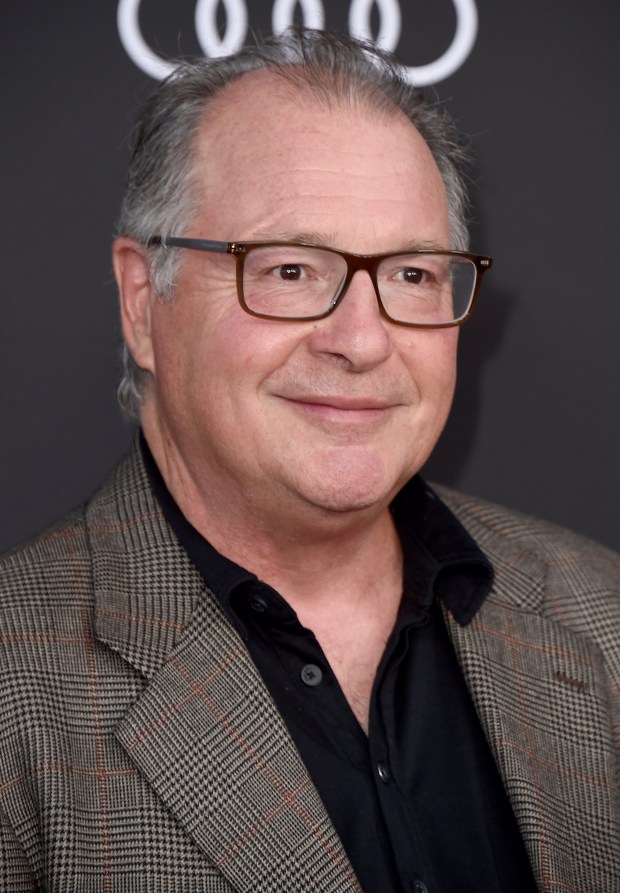 Kevin Dunn stars in “Yale.” (Photo by Jordan Strauss/Invision for the Television Academy/AP Images)
Van Billet’s wife and children were concerned to the point of wanting him to see a psychiatrist when he retired at age 52 from investment banking and decided to pursue a lifelong dream and become a screenwriter.
He found success with his first venture but is getting more traction with his newest movie, “Yale,” a story from his family archives that he’s been sitting on for about 50 years.
“Yale” is about Billet’s roguish grandfather and has nothing to do with the university. It earned acclaim at film festivals in Los Angeles and Florida Florida and will be played at the Philadelphia Film Festival at 7:30 p.m. Friday at PFS East (125 S. Second St.) and at 5:15 p.m. Oct. 24 at Philadelphia Film Society Center (1412 Chestnut St.).
Billet is not the only one enjoying later-life kudos from “Yale.” Its star Kevin Dunn has the role of his life as a charming cad tracked down by an abandoned daughter during a crisis in her life. Her child is dying and she needs an organ donor to save him. She has to see if her absentee father is a match.
Dunn is one of those prolific character actors who has seen time after time for more than 40 years. Everyone knows his face and remembers parts he played when they see him, but few could remember his name.
“Yale” could change that. It might replace Dunn’s six seasons as Ben Cafferty, the White House chief of staff on the television series “Veep.” He is also in Delaware County shooting his second season as Vince Runyon, the straight-shooting FBI chief on HBO’s “Task.”
“Guess so,” Dunn says modestly when asked if having a lead role like Yale could propel him from being a recognized actor with many credits to one whose name people know.
“I just found the film to be a great opportunity. I was surprised and honored to be offered it. It’s a fascinating story. I could hardly believe it when (director) Jay Silverman told me it was real.
“An honest, delicate piece like ‘Yale’ is a rare thing. When I read Van’s script, I didn’t like the guy, but I had to make the audience interested, so I worked at making him not too mean and not too charming. He’s a sociopath. He wanted to be loved by all the people he could make love him, only to hurt or disappoint them.
“Working on it every day was a challenge but a pleasure because ‘Yale’ is written so well, and Jay and Van were on set everyday to discuss and take the temperature of what we were doing. It gave me a chance to flex my acting muscles. I liked hearing, ‘You’re OK’ after we shot scenes.”
Those scenes take place in Philadelphia and its suburbs, where the actual story of Yale Parker unfolded. Billet says he insisted Philadelphia be prominent in “Yale.” Exteriors were shot throughout the Delaware Valley while interior scenes were shot in L.A.
The story is one that has been on Billet’s mind since he first heard it 50 years ago.
“I was already in my twenties when my mother came clean and told me about my grandfather, who was a bigamist that deserted my family and most of the others he spawned,” he said. “I wanted to be a film writer, but that career wasn’t starting. With my future and own family to consider, I did a 180. I went to La Salle University, went on to get a law degree and found a career in investment banking.
“All the while this story my mother told me about Yale remained in my head, always as a movie. While I always thought about the story, it took a long time to turn it into a script.
“The writing took about five years. It took another three years to find Jay Silverman, who agreed to direct it and more time to find a distributor, The hope is the attention we’ve gotten at film festivals will get us the distributor we need.
“My grandfather was a narcissist, a taker, not a giver, a heartbreaker but charming and funny. One of the children he’s abandoned has been as feckless as he is. She is a drug user who has been to jail, but she, now sober, has a child who needs an organ to live, and she’s forced by concern for her son to seek the father that vanished in case he is the right donor to save her son.”
Caitlin McGee plays Yale’s daughter. Billet says she is the focal point of “Yale,” but the title character became so compelling, she spends a lot of time listening and reacting to him.
“Caitlin and Kevin nailed their parts,” Billet says. “Kevin is so authentic while being someone to whom the audience could be drawn in spite of themselves. Caitlin resists any form of exaggeration. Her facial expressions tell stories.”
Dunn was effusive in his praise of McGee: “She was the perfect person to act with. We bonded on the first day of shooting. After that, it was off to the races.”
Yale will continue in the festival route through 2026. Billet says producers are looking toward a larger launch in January.