
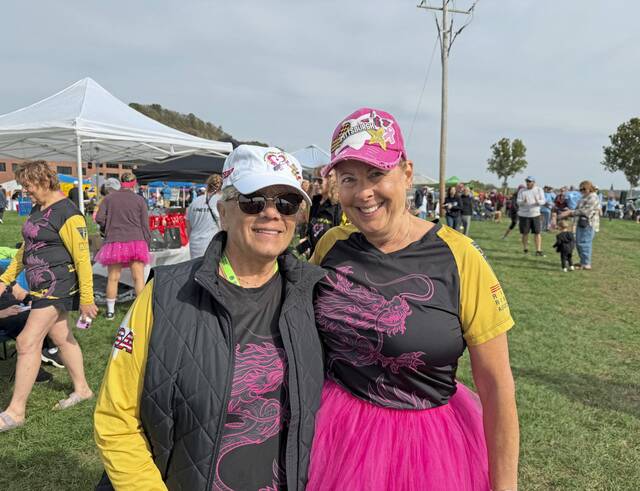
Drum beats reverberated as paddles sliced through the sparkling water of the Allegheny River in East Deer on Saturday morning.
Raising money and support for those diagnosed with breast cancer and breast cancer survivors, the eighth annual Pittsburgh Dragon Boat Festival drew 38 teams to compete — a new record.
The festival outgrew its previous venue of North Park Lake, said founder Darlene Goldfinch, with Saturday’s festivities taking over the larger Pittsburgh Brewing Co. grounds in East Deer.
Goldfinch, 71, of Penn Hills said seeing so many supporters at the festival Saturday gave her the chills.
“I got goosebumps on my arms right now — it’s so exciting,” she said.
Goldfinch has been a breast cancer survivor for 29 years, and she began dragon boating in 2008. She and Janice Bagnato co-founded their own dragon boating team, Pittsburgh Hearts of Steel, in 2017.
“This is going to make me cry … my heart is full,” Bagnato, 63, of Gibsonia said of the festival’s turnout. “We love the hard work and the sense of community, and it raises awareness for breast cancer at all stages.
“I just think it’s so important to have everyone here know how much this sport means to us in our survivorship.”
All of the money raised through the festival stays in Western Pennsylvania, she said, either with the team or given to breast cancer organizations in the area.
“We raise money to offset the costs, so (there) would never be a reason for someone not to join us,” Bagnato said. “Shirts, paddles, stipends to help offset the costs of travel.”
About 20% of the earnings is given back to people who help support breast cancer survivors, she said, with over $18,000 given in the last nine years.
Goldfinch said the money raised at the festival has grown every year, but last year’s festival raised about $30,000.
Dragon boating has “saved many of our lives,” said Bagnato, who is a 23-year breast cancer survivor after being diagnosed three times, at age 40, 49 and 60. She’s currently metastatic.
The women on their team consider dragon boating a “treatment program” as part of their individual health journeys, Bagnato said.
“We thrive through this,” she said. “We have a sisterhood we didn’t know we needed, and it’s part of our family.”
What is dragon boat racing?
Dragon boating is an old Chinese water sport from about 2,500 years ago, where teams of 20 competitors paddle in long, canoe-like boats.
Each boat has a dragon’s head attached to the front and a dragon’s tail attached to the back.
“It really is taking off in the whole world, actually,” Goldfinch said. “We race in about three or four races a year, and every four years there’s an international dragon boat festival just for breast cancer survivors.”
The most recent one was this year, so the Hearts of Steel team went to the French Alps to compete against about 150 other teams from all over the world — and coming in 15th place. Previously, the team has competed in New Zealand and Florence, Italy.
Goldfinch is both the coach and steersperson for the team, meaning she trains people to paddle and steers from the back of the boat.
“If you look at the back of the dragon boats, someone has to be able to steer them in a straight line,” she said. “And then we have a drummer in the front.”
The drummer follows the strokes of the person who’s in the front left seat, making drum beats each time their paddle hits the water, said Goldfinch.
“If you’re a really good drummer, you can command the boat,” she said.
The connection between dragon boating and breast cancer came from a physician in Vancouver, British Columbia, Goldfinch said.
“He was thinking about how women are always told with breast cancer not to pick anything up heavy, not to do strenuous activity,” she said. But he wanted to experiment and had women try dragon boating.
“After, they were like, ‘We’re still going to do it.’ ”
That was around 1997, she said. Dragon boating came to Pittsburgh breast cancer survivors around 2005.
“Everybody on our team is (a breast cancer survivor), and our board is, too,” Goldfinch said. “We wanted to have an all-inclusive team — we have accountants, we have doctors, we have nurses — anyone you could think of on our team.”
Saturday marked George Banky’s first time racing in a dragon boat. He and his wife have been training with the Pink Steel team.
“I just think this is a blast,” said Banky, 62, of Mt. Lebanon, who is the lone male breast cancer survivor on the team. “It’s fantastic — it’s just a great group of women. (A) very grateful group, very fun group … very supportive people.”
Completing a race in under a minute is a good time for Pink Steel, he said, and one of their runs Saturday was 59 seconds.
“We’re real happy with it,” Banky said. “Being a cancer survivor, I’m grateful for every day, and I’m really happy to be here today.”
Bob Randolph, who has been paddling with the Steel City Dragons Club in Pittsburgh for 23 years, said watching a dragon boat competition is like going to a Pittsburgh Steelers game — “but it’s free.”
“It’s one of the most exciting sports you can watch because you can see people of all shapes and sizes coming from everywhere. But then you see them get in the boats, and they’re all paddling in unison,” said Randolph, 68, of the South Side.
It’s hard to participate in dragon boating, and he said it takes a lot to compete at the highest levels. Steel City Dragons Club has members who try out for Team USA and go to world competitions, which he said are like the Olympics.
“We practice three days a week and work out on the off days,” Randolph said, as well as working out over the winter while the rivers are frozen. “For fun, for socializing, for exercise — it’s everything all in one.”
A friend of his found dragon boating advertised in an outdoor activity newsletter, which is how he got involved.
“We came down for an orientation. We thought we’d be just watching a video, (but) they said, ‘No, get in the boat,’ so 20 of us piled into the boat,” Randolph said. “We paddled up and down the river, and I’ve been hooked ever since.”
Being at dragon boating festivals is energizing for him, and this one was close to home. The Steel City Dragons Club practices just downstream on the Allegheny, he said.
“It’s just an awesome day to be out on the beautiful river,” Randolph said. “We love being out on the water all the time … the community of dragon boaters is what keeps me going.”
Paddling, not rowing
Leslie Caplan, one of the coaches of the GoPink!DC dragon boat team out of the Anacostia Community Boathouse in Washington, D.C., explained that when rowing, the boat travels backward.
But that’s not the case in dragon boating.
“We see things before we almost hit them because we’re going forward,” she joked. “It’s related to canoeing, kayaking and other paddling sports, but the trick is, a full boat is 20 paddlers.
“You have to be in sync and coordinated, and that’s one of the hardest things to learn.”
Caplan, 71, of Chevy Chase, Md., is a breast cancer survivor, and from her point of view, dragon boating is “a really special experience.”
“When you’ve spent months and months and months having people do things to you — I mean, you’ve given consent, but you don’t really feel like you’re participating — this is something you do,” she said. “You do it for yourself, and it makes you healthy, and it makes you happy, and you make friends.
“And it’s a totally different thing from what it feels like going through treatment.”
Faye Stark, a two-time breast cancer survivor, joined the GoPink!DC team after seeing a flyer about dragon boating.
“All of us are supporting one another as we fight through this journey,” said Stark, 68, of Manassas, Va. “At this race, it’s just great to see other survivors here and supporters here racing on the water.”
As a survivor, Stark said the dragon boating community was what she needed.
“Knowing that there’s other people out there like me in this journey, I appreciate them, and I love them all,” she said. “I don’t want to start getting teary-eyed, but it’s a great cause.
“And we want people to know that there is fun in getting through this journey.”