
There are fairly few places that students from all 12 Penn schools would call iconic, from the trails near the Biopond, to the spreads of College Green and high rise field, and to the arboretum I still need to visit. Beyond Ivy League acclaim and its preprofessional culture, Penn’s campus distinguishes itself from most others through its highly integrated greenery. With the recent launch of the Department of Landscape Architecture’s Penn’s Sylvania: The Campus as Landscape (each chapter written by a Penn professor or professional affiliate), we get a unique look into the campus’ storied history of natural preservation. Since the campus’ inception, it has continually worked as a prototype for the idea of the “American Campus.”
The idea for the book came about from continued talks between co–editors Ignacio Bunster–Ossa and Dean of the Stuart Weitzman School of Design and professor Frederick Steiner. Steiner acted as a logistical lead of sorts, spearheading efforts to bring on authors and collaborators, while Bunster–Ossa’s continued fascination with the campus and its relationship with time, space, and color—exhibited primarily through his black–and–white photography taken over the years—dictated the visual language behind the book. His included portfolio adds a striking edge to the textually–dominated memento.
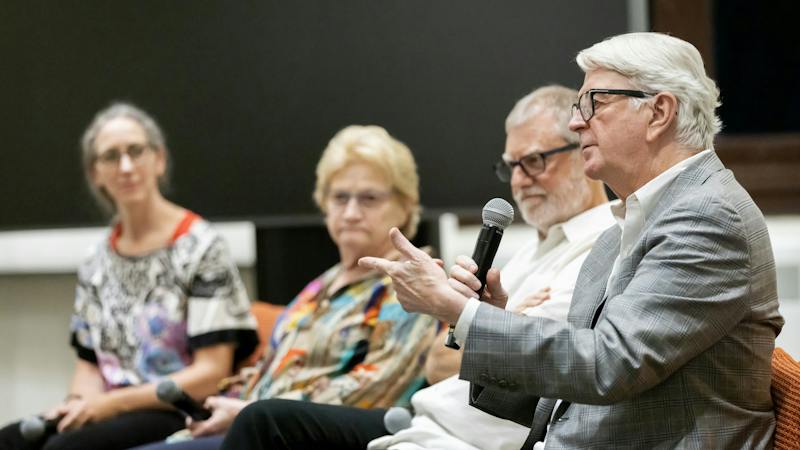
With the publication of the book on Sept. 1, an accompanying launch event followed in the next week. Collaborators of the parts–essay, parts–photography “journey through time” spoke about their contributions and reflections of the campus. The co–editors, essay contributor Catherine Seavitt and OLIN partner Susan Weiler, partnered up for a continuous presentation, giving us an interdisciplinary preview into the book’s contents. The topics varied greatly, from the American–native pawpaw fruit’s history of documentation, to the campus’ architectural roots in European sensibilities, to the layered relationships we share with these spaces we occupy on a daily basis.
The speakers held the floor with a confidence and energy that was readily met during the discursive portion of the night, where a myriad of questions extended into further conversation. Bunster–Ossa spoke about his photography portfolio and the evolution of his photos over the years. Beginning with conventional landscape photography techniques, the architect claims his portfolio took a massive leap when he considered positioning the elements of the photos unconventionally. The black–and–white quality also allowed for a focus on the contrast, which affected how the photos’ subjects stood out against their backgrounds and foregrounds.
For Bunster–Ossa, campus photography was initially a bit boring. A breakthrough came when he began to position fauna in front of buildings, which unlocked the ability to capture depth and spatial relations. One notable photo shows the stone facade of Rodin College House juxtaposed with a looming tree in the foreground. The windows peeks through the thin, fractal branches, creating an intriguing composition.
Further discussions focused on the trees on campus as their own actors and characters, helping us with mental health, time tracking, and even just sprucing up the walkways we often occupy.
When founding the University, Benjamin Franklin envisioned the green spaces as inviting in structure, open for use by all. He would be proud to see the numerous traditions on College Green. Franklin’s original intentions, however, came in clash with the general sentiments of both architects and the college administration—the former valued efficiency and functionality of the classroom, while the latter’s prioritizations mostly came down to acquiring more land. Penn’s initial expansion was without much direction; a report was eventually commissioned by Penn and led by Peter Sheapherd, then–dean of the Graduate School of Fine Arts, to remedy this. This report contributed, in part, to the decision to prioritize the construction of more green spaces.
Walking around campus, the intentional placement and prioritization of green spaces over the years is evident. Each path is lined with plaques for the accompanying flora, benches are nestled away in closed–off brush, and decorative monuments adorn the region. Beyond the coverage the plants may provide us for studying (or SABSing), there is a social quality they hold that is easily accessible. I think back to the frisbees I’ve thrown with friends in the lawns of the Quad, the picnics we’ve shared on high rise field, and the events held in the brushes of the Kelly Writers House garden.
Post–event, I was fortunate to have a sit down with Steiner, one of the book’s co–editors, to chat more about the book’s more underspoken contents. Perhaps the most clarifying sentiment throughout the interview was just how much thought went into not just the subject matter of the book, but what it aimed to communicate. Penn’s status as an elite institution often inspires literature based on its current contributions to various fields, and Steiner wanted to do more. As a result, instead of focusing on the thoughts and plans behind the campus, he aimed to communicate it’s more emotive aspects.
“We wanted to say something about the campus that hasn’t been said before,” says Steiner. “We set out to explain that the images that Ignacio took, that those spaces that he represents in the photographs, were not accidental. They were designed and funded.”
For example, the pawpaw fruit chapter, written by Seavitt, traverses beyond descriptions of the plant, touching on its uses and appeals to different groups. Valued initially with the Lenni Lenape for its sustenance and use as a time tracker between seasons, the fruit came to be rejected over time by early settlers for its pungent smell, something the Lenni Lenape had also appreciated it for.
After much time had passed, Penn professors became interested in documenting the fruit’s botanic properties across geographies. Originally, this chapter was placed later in the book, but after a suggestion from a reviewer, the chapter was bumped up in order to foreground both the contributions and culture of the Lenni Lenape as well as the scarce—but nevertheless important—history of the fruit’s documentation.
Subsequent chapters follow this semi–narrative, semi–factual construction, which gives the book an emotive quality. The writing connects us not just to our campus’ resources, but also to the people responsible for their implementation, integration, and maintenance.
Professor Steiner’s involvement with the Penn campus—beginning in 1975 as a graduate student—has colored this multidisciplinary work, depicting our relationship with this campus as timeless and topical, symbiotic in necessity, and ever–generous in trade. Ultimately, this book presents itself to be digested and appreciated without relation to the campus as an institution.
Initially, it seemed perplexing that the book communicated with less integration of student considerations, but the more I read, the more I could see where the co–editors were approaching it from. It reads with enough technical language to intrigue the academic but condenses the topic to engage the layperson. More than communicating a history, this book does well to communicate an expressed desire for a space to facilitate lives beyond the academic and the plans, considerations, and events that occurred to make that happen. Not just students, but horticulturists, historians, architectural enthusiasts, and a host of others will find this book engaging in different ways.
On the night of the book launch, Seavitt, a Penn’s Sylvania contributor, emphasized that we need the trees a lot more than they need us. They fed the Lenni–Lenape; they were here at the campus’ inception, playing a monumental role in our remaining in West Philly; and they will be here long after we graduate. This campus stands as an innovator in elevating American architecture to artistry, and its foundational philosophies are felt in a variety of ways throughout the community. Penn’s Sylvania stands as a testament to this campus’ relevance in both our academic and personal lives.
There will come a time when we’ll all have to say goodbye to this space, but it will always be here for us should we ever return.