
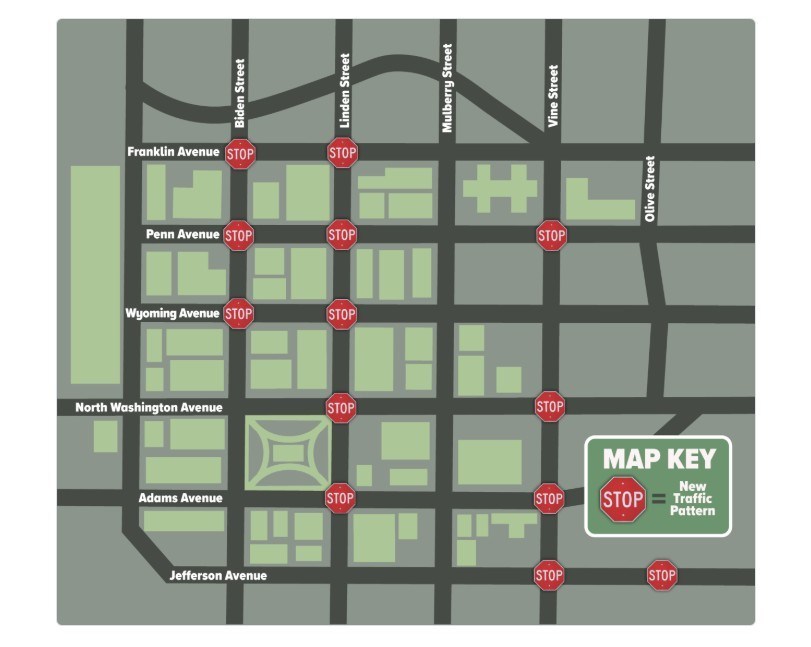
Major fundamental changes in traffic control in downtown Scranton will begin Oct. 19 with a test period of converting traffic lights at 13 intersections downtown to stop signs.
The intersections involved include:
Biden Street at Franklin, Penn and Wyoming avenues.
Linden Street at Franklin, Penn and Wyoming, North Washington and Adams avenues.
Vine Street at Penn, North Washington, Adams and Jefferson avenues.
Olive Street at Jefferson Avenue.
The first phase of this transition will involve installing new stop signs at those intersection and making existing traffic lights flashing red signals, according to information about the plan posted on the city’s website.
The city ran an ad in The Sunday Times and in Monday’s edition of The Times-Tribune alerting the public that starting Oct. 19 “A new traffic pattern is coming to Downtown Scranton,” on Biden, Linden, Vine and Olive streets; and for more information, to see scrantonpa.gov/traffic.
That website address gives a map of the downtown showing the 13 intersections, which all currently have light signals for traffic control.
“Beginning Oct. 19, 2026, the City of Scranton is changing how traffic moves through downtown. Phase 1 of the project brings new stop signs and flashing red signals to 13 intersections,” the website says. “At the 13 intersections marked on the map … crews will begin the first phase of traffic control changes by installing stop signs and start testing for signal removal (flashing red signals).”
Authorized a year ago by Mayor Paige G. Cognetti and the former Scranton City Council, the potential permanent conversion of some traffic light signals to stop signs is part of one of the largest streetscape overhauls in the city that remains underway.
After a ceremonial ribbon-cutting Wednesday of a recently completed gateway streetscape project in the 100 block of Jefferson Avenue and the 600 block of Lackawanna Ave., a reporter with The Times-Tribune asked Cognetti when converting traffic signals at some intersections to stop signs would occur. Saying it would begin soon, Cognetti described how a test period would first involve having both stop signs and flashing red signals at certain intersections, followed by the bagging of traffic signals at those intersections; and then evaluation of whether to keep stop signs in place permanently or go back to solely using the light signals for traffic control.
“It’s a 30-days flashing red with the (new) stop signs (installed) and then 60 days after that where the light is bagged and we make sure that it’s producing the right result,” Cognetti said. “Obviously it’s very expensive to put up or take down those traffic lights, so there’s a long period of at least three months to make sure that that’s the right thing before we would pull that (traffic light signal) infrastructure out.”
Streetscape and traffic-pattern changes stem from a 2023 connectivity study, which has also been called a walkability study, and that proposed numerous ways to improve pedestrian safety and traffic flow throughout the downtown.
In October 2025, council adopted three ordinances from Cognetti’s administration underlying the various downtown streetscape changes under the connectivity/walkability plan. Those called for replacing some traffic lights with stop signs and reverting some one-way streets to two-way; narrowing some vehicle travel lanes and adding curb bump-outs at intersections to improve pedestrian safety; and in certain spots adding bike lanes and parking spaces.
Most of the downtown streetscape projects, which total $20.4 million, have been completed. Many involved constructing new sidewalks and curbs and filling in old vaults under sidewalks. Some of the remaining ones will get done before winter and the rest will be completed in the spring.
Plans to revert some one-way streets to two-way remain in development.