
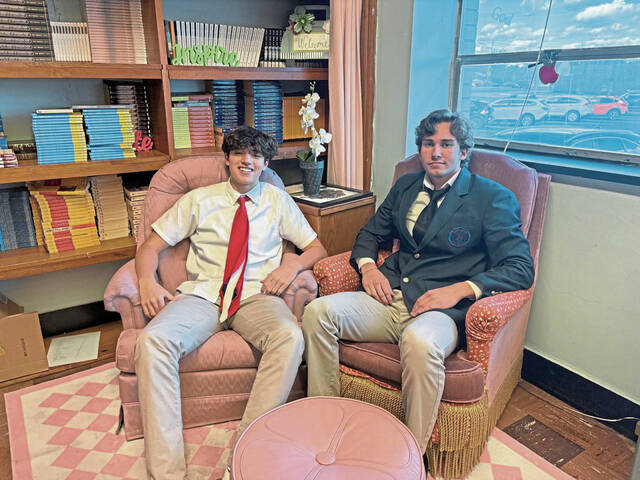
St. Joe’s seniors Max Shehab and John Marino were so moved by attending the Eradicate Hate Global Summit in Pittsburgh they lobbied school leaders to start a local club.
Hosted in September at the David L. Lawrence Convention Center, the three-day event was dedicated to preventing hate-fueled violence. It was born out of community support in the wake of the 2019 Tree of Life massacre in Squirrel Hill, with hopes to inspire students to create safer schools that build belonging.
Tom Ridge, former Pennsylvania governor and former U.S. Secretary of Homeland Security, is the global advisor.
Through a St. Joe’s chapter, Shehab and Marino want to spark local conversations on tolerance and inclusivity and also encourage volunteerism in the community.
“There was one speaker who talked about his brother being jumped, all because of his ethnicity,” said Shehab, 18, of Harrison. “It was eye-opening.”
Marino, 18, of Tarentum, said what he most took away from the event was the concept of community.
“I’m from a small town where a lot of my neighbors are close,” he said. “It’s important. It makes a difference.”
The summit was attended by 650 students across the region. It was filled with survivor testimony, expert advice and other lessons to help build relationships and forge solutions to racism and hatred. It had a quick impact on the 10 St. Joe’s students who attended, according to English teacher and club liaison Anne Schratz.
“They want to get together and talk about cultural awareness and have a space to vent,” Schratz said.
With her curriculum already highlighting Holocaust education, Schratz said exposure to the Eradicate Hate movement has further fueled students’ interest in diversity.
She recently assigned her class to read “I Am Malala,” a memoir about Malala Yousafzai, a Pakistani woman who, at 15, was shot after championing girls’ right to learn. She survived, went on to address the United Nations and won the Nobel Peace Prize in 2014.
“They won’t see someone like Malala here, but they are interested in learning about different cultures,” Schratz said. “This summit was exposure for them.”
During the summit, students listened to the stories of families affected by violence and worked in groups to brainstorm goals for school programs. They discussed ways of preventing political violence, activating bystanders and understanding AI’s role in attack planning and prevention.
Teacher David Widenhofer said the firsthand accounts had an immediate impact on many of the students who attended.
“One of our students said that what he took away from the summit was love,” Widenhofer said.
“Another student said that he needed to stop making certain kinds of jokes. He told me, ‘My friends and I tell them and we know that in our circle we don’t mean anything bad and we’re not against anyone. I used to think that that was OK, but now I don’t.’”
The school club plans its first meeting later this month. Widenhofer said he hopes the teens can offer ways to make everyone feel welcomed.
“I hope that the club will help students to develop conflict resolution skills that are non-violent and respectful of each other’s dignity as unique individuals,” he said.