
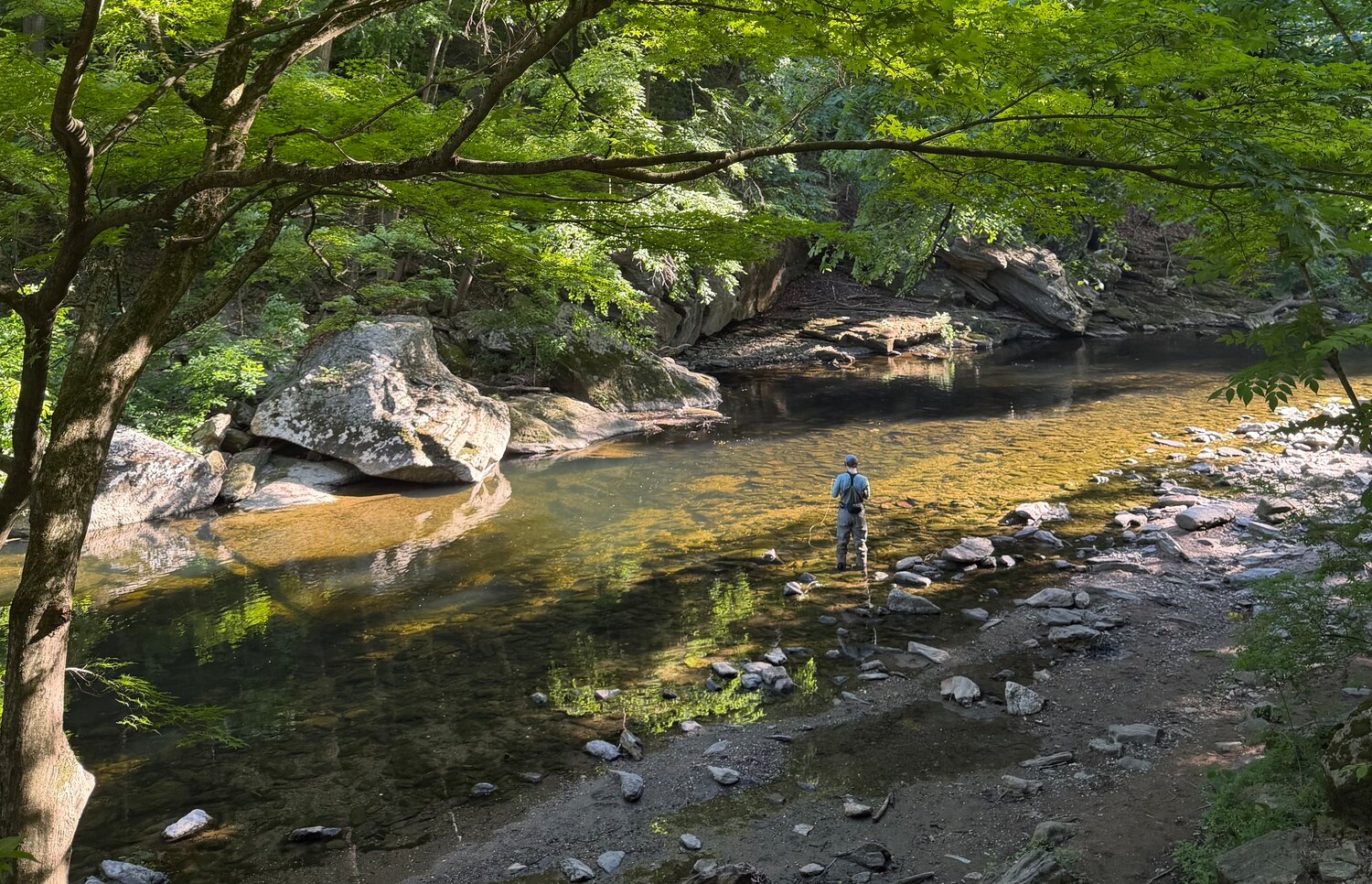
The 23-mile-long Wissahickon Creek is a vibrant hub for trout, bass and sunfish. But anglers should not eat any fish from the water source this season due to pollution.
The Pennsylvania Fish and Boat Commission (PFBC) and the Pennsylvania Departments of Environmental Protection (DEP) and Health issued a “do not eat” advisory on Oct. 7 for the Wissahickon Creek basin after finding unhealthy levels of perfluorooctane sulfonate (PFOS), a type of the forever chemical known as PFAS, in sampled fish tissue. Officials found PFAS levels that exceeded the state threshold of more than 0.04 parts per million. The advisory applies to all fish species in the creek.
In light of the findings, state officials have canceled this year’s trout restocking that was set for Oct. 15.
As DEP continues sampling fish tissue for PFAS — a statewide effort that began in 2021 — officials anticipate they’ll see more unhealthy levels of the chemical and trout stocking changes in the coming years, said Mike Parker, communications director for PFBC. Officials are considering finding alternative solutions to the “do not eat” advisories that allow for trout restocking and protect the health of anglers, he said.
Officials are hosting a public meeting at the Schuylkill Center for Environmental Education in Upper Roxborough on Nov. 5 to hear suggestions from local anglers.
“This is probably time to broaden the discussion and let people know what our policy is right now and why, but then see if we can work toward some alternative,” Parker said.
Megan Martin of Wissahickon Crick Anglers is concerned that the stocking cancellation means the organization can’t host its annual two-day trout fishing tournament in the spring. The event draws a couple hundred attendees to the creek every year and obtains fish from an outdoor hatchery. Martin anticipates that the state won’t permit the tournament due to the advisory.
“We’re all very upset about losing the stocking and the fact that there’s a don’t-eat advisory,” she said. “We’re just gonna try and see if there’s anything that our organization can do to help with the cleanup or to get us back on track for future stockings.”
Martin said she and her husband James, the president of Wissahickon Crick Anglers, fish at the creek every weekend during regular trout season, from April through Labor Day. The state stocks trout in the fall and spring.
DEP scientists analyzed fish collected around Fort Washington State Park, with some of the samples dating back to 2013-2021. They found samples with 0.0567 parts per million of PFOS, higher than the 0.04 limit for the “do not eat” advisory, a spokesperson for the department said in an email. The agency hasn’t identified the source of the PFOS contamination.
Apart from the potential effects of eating contaminated fish, the department hasn’t found any other public health concerns from these findings, the spokesperson said. PFAS have been linked to increased risk of multiple cancers, developmental effects in children, and liver and endocrine damage.
The testing was part of the state’s Fish Consumption Advisory Program, which analyzes sport-caught fish for various contaminants. Collected samples are assessed by the DEP, the Department of Health, the Department of Agriculture and the Fish and Boat Commission, Parker said.
DEP will continue monitoring the Wissahickon and collect data this fall to help the agency update its 2028 fish consumption advisories.
“The Pennsylvania Department of Environmental Protection (DEP) takes the health and safety of Pennsylvanians seriously and will continue to use the best available science to monitor and protect the Commonwealth’s waterways,” the DEP spokesperson said.
Parker said that canceling the trout restocking was a safety precaution to prevent anglers from accidentally eating contaminated fish in the creek. But the released trout itself would likely not be contaminated, since it spends significantly less time in the creek compared to wild fish populations.
It takes at least several months for PFAS to build up in fish and reach “do not eat” advisory levels, Parker said. And the trout population that is stocked in fall likely dies out by the spring after succumbing to warm water temperatures, anglers or wildlife predators.
Parker said in one PFBC study, experts stocked trout in a PFAS-contaminated stream. It took at least a couple weeks for PFAS tissue levels in the fish to reach traceable amounts and around three months to reach the “one meal per month” advisory limit, Parker said.
State officials are rethinking new approaches to addressing PFAS pollution in fisheries, with the expectation that consumption advisories will become more common, Parker said. Since 2021, there have been “do not eat” advisories due to PFAS in Middle Spring Creek, Briar Creek and currently Neshaminy Creek.
Scientists have found PFAS in drinking water sources across the United States. More than one fifth of Americans are being exposed to dangerous levels of forever chemicals in their tap water, according to a 2025 report by the Natural Resources Defense Council. PennEnvironment Research & Policy Center, Environment New Jersey Research & Policy Centers, and NJPIRG Student Chapters released a report on Oct. 7 mapping where PFAS are polluting the Delaware River and the region’s streams.
Some potential alternatives to the advisories include stocking trout in certain sections of the Wissahickon Creek or enforcing a catch-and-release regulation, Parker said.
“There’s this threat to lose stock trout fishing completely around Philadelphia,” he said. “We feel like we can we can work something out, give the information to people and sort of let them make their own choice.”
Martin said she thinks the fall trout stocking cancellation at the Wissahickon was the right decision, and she plans to attend the November meeting to get answers about what led to the advisory. If they don’t host the tournament, Martin said the organization is considering possibly using its funds to help the state clean the watershed.
“We do have a lot of anglers in the area,” she said. “It’s a beautiful part of the city. It’s a hidden gem that we have in Philadelphia. We’d just love to get the younger generation out there enjoying the outdoors, and it’s just always been something that our members have done with their fathers. It’s important for us to keep that tradition alive.”
PFBC will hold the public meeting on Thursday, Nov. 5, from 6-7 p.m. at the Schuylkill Center for Environmental Education at 8480 Hagy’s Mill Road.