
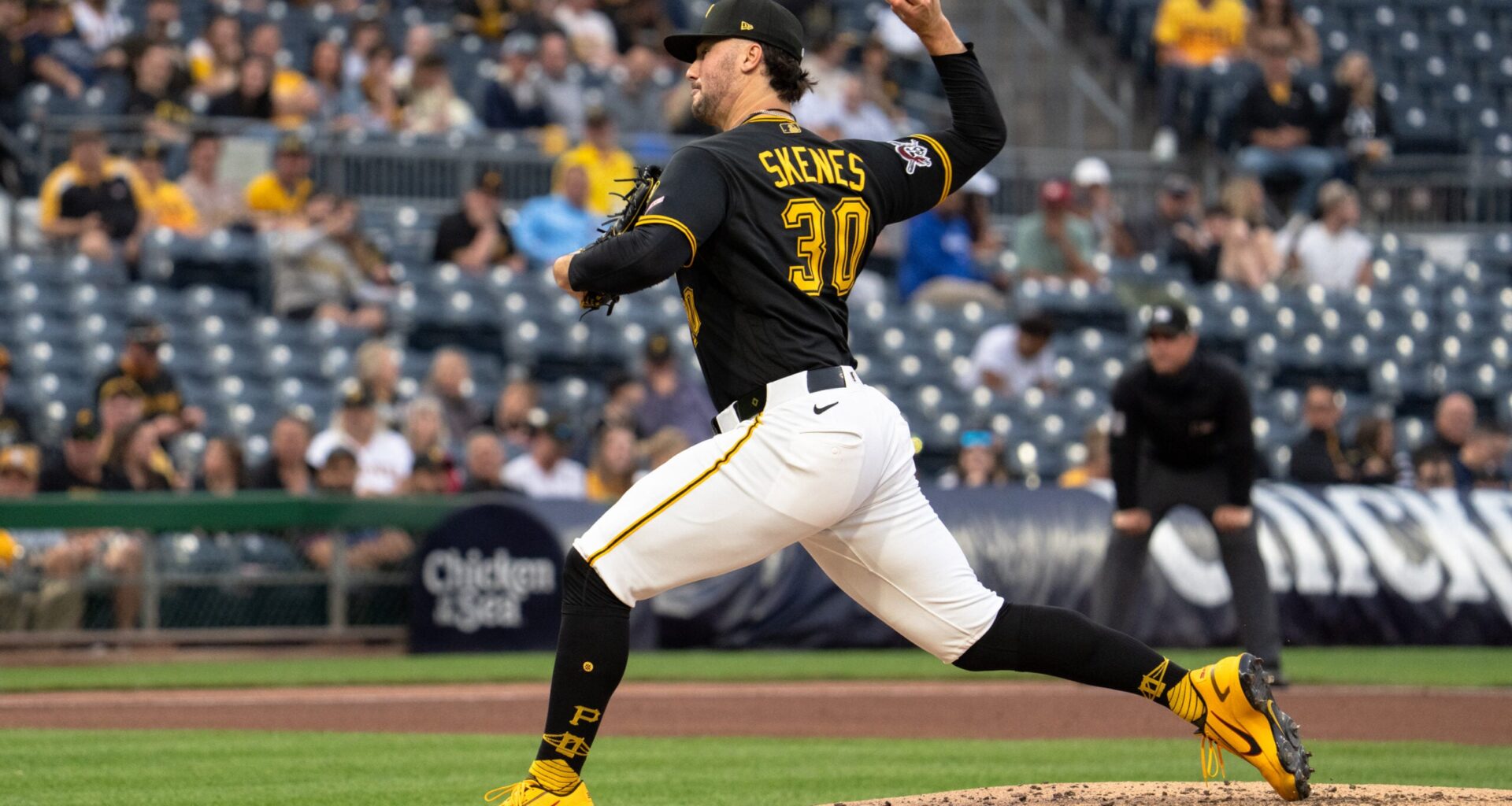
 Paul Skenes/Photo provided by Matt Lynch
Every baseball season produces dozens of storylines for each team.
The overarching storyline for the Pittsburgh Pirates in 2026 was Paul Skenes. After two dominant seasons, the right-hander had a tougher third year in the majors.
Skenes still had a decent season and was an All-Star for a third straight year. Yet he did not overpower hitters the way he did when he won the National League Rookie of the Year in 2024 and the NL Cy Young Award in 2025.
Granted, Skenes wasn’t going to pitch forever at the sparkling 1.96 ERA he posted in 55 starts over his first two seasons. Yet more was expected in 2026 than a 10-11 record and a 3.82 ERA in 32 starts.
Questions surrounded Skenes all season.
Was he hiding an arm injury? Was he feeling the effects of pitching in the World Baseball Classic? Did his drop in velocity come from weight gain? Was he lonely as his girlfriend Livvy Dunne pursued an acting career in Hollywood? Was he the victim of the Bucco Malaise, which eventually strikes everyone who plays for a franchise whose last postseason victory came in the 1979 World Series?
The most perplexing aspect of Skenes’ season is that neither he nor the Pirates seemed concerned that his ERA was nearly two full points higher than in his first two years. All parties insisted he was pitching well.
The drama surrounding Skenes is likely to continue this winter. This offseason will likely be different, with the owners’ expected player lockout on Dec. 1.
There seems little doubt that the sides will make changes to the collective bargaining agreement by the time they work out a deal, whether that is in February, April, July, or 2073. Yet there will likely still be some form of salary arbitration for at least some players without the MLB service time necessary to be eligible for free agency.
MLB Trade Rumors recently published its arbitration projections, with Skenes making $7.2 million in 2027. That would be a record for a pitcher eligible for arbitration for the first time.
One of the most misunderstood parts of arbitration is that salaries aren’t based on what a player would command on the open market. Instead, players are compared to their peers with similar service time.
No current pitcher with three years of MLB service time has won Rookie of the Year and a Cy Young Award. Thus, you might call Skenes a unicorn, but I won’t because it is the most overused word in the English language.
Instead, let’s call Skenes an outlier. That means it is hard to project his worth, though MLBTR’s Matt Swartz is the best in the business at arbitration projections, and it would make for a fascinating hearing if the sides can’t reach an agreement by the time they’re usually held in late January.
Hearings are ugly because teams point out every player’s flaws as they try to sway a three-person panel of arbitrators to rule in their favor. The arguments often leave players angry after their bosses tear them apart for a half hour.
Skenes won’t be a career-long Pirate. His salary will be out of their comfort zone after next season. However, the Pirates need Skenes to return to true ace form in 2027 if they are to end a postseason drought that started in 2016.
Do the Pirates risk angering Skenes in an arbitration hearing when they are counting so heavily on him next year? Or do they not worry about feelings since Skenes will likely be somewhere else in 2028?
Stay tuned because it could be a fascinating situation.
Mentioned in this article:Paul Skenes Pittsburgh Pirates
More about:Opinion