

Wikimedia Commons
Don’t be fooled by this wee falcon’s size; he’s as fierce as they come. This month, Mary Birdsong tells us more about the American Kestrel – whether you spot one in an open pasture or hanging out at your nearest big box retail store, this eye-catching bird is sure to get noticed.
Every birder has a good “lifer” story – the tale of how you saw a particular species for the first time. My husband’s and my lifer, American Kestrels, came to us in memorable ways.
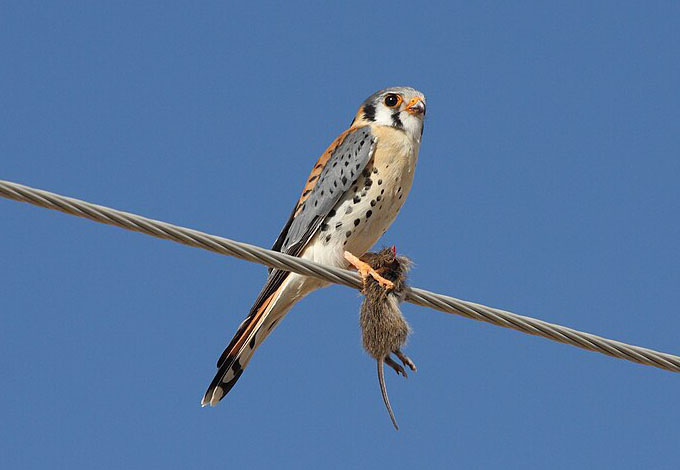
I saw my first-ever American Kestrel outside my office window in midtown Erie. I heard the excited alarm chatter of multiple birds, so I walked to the window to see what the fuss was. Perched in the tree no farther than 15 feet from me was a male kestrel with a mouse in its talons.
My husband Mike’s was crazier. We had heard rumors that a kestrel was inside the west-side Lowe’s enjoying an endless buffet of House Sparrows. We went with binoculars in hand and birded inside the store until we found it perched in the rafters. Yes, people were looking at us funny. The bird was eventually freed from the store and went on its merry way, no worse for wear. The moment is remembered fondly and is one of our favorite lifer stories to tell.
It’s easy to be smitten with this bird, the smallest falcon in North America. With a wingspan of approximately 22 inches and weighing in at a mere 4 ounces, this kestrel is considerably smaller than the other common North American falcons, the Peregrine (weighing in at around 2 pounds with a 41-inch wingspan) and the Merlin (about 7 ounces in weight with a 24-inch wingspan).
And while all falcons have distinctive plumage, the kestrel stands out with its bright striped rufous coloring and boldly patterned head. Males are distinguished from females by blue-gray wings and a solid rusty tail.
Besides big box stores, they can be found in a wide variety of open habitats, from pastures and agricultural fields to parkland and many developed urban areas. Other than small birds, their main food items are insects and small mammals.
While they are still the most abundant falcon in North America, the American Kestrel population has declined by nearly half since the 1960s, according to the Peregrine Fund, a nonprofit whose mission is to conserve birds of prey worldwide. Scientists are finding multiple complex factors at work. Possibilities include loss of insects and other prey due to climate change and habitat alteration, non-native European Starlings that may be outcompeting the native birds for natural nest cavities, predation by larger Cooper’s Hawks, and pesticides that are killing rodents and insects or weakening the falcons themselves. The most concerning of the pesticides are neurotoxic insecticides called neonicotinoids because they’re potent, widely used, and spread up the food chain.
Volunteers across North America are committed to providing nesting boxes and monitoring the birds’ activities. And according to the Peregrine Fund, the species may be making a small comeback. Good news.
If you want to find one, drive some rural roads and look for small birds on utility wires keeping a careful eye on their surroundings. It might just be an American Kestrel. I don’t think another one is going to be found at Lowe’s anytime soon, though.
Mary Birdsong is the lead shorebird monitor for Erie Bird Observatory. Learn more at eriebirdobservatory.org. Mary can be reached at mbirdsong@eriereader.com