
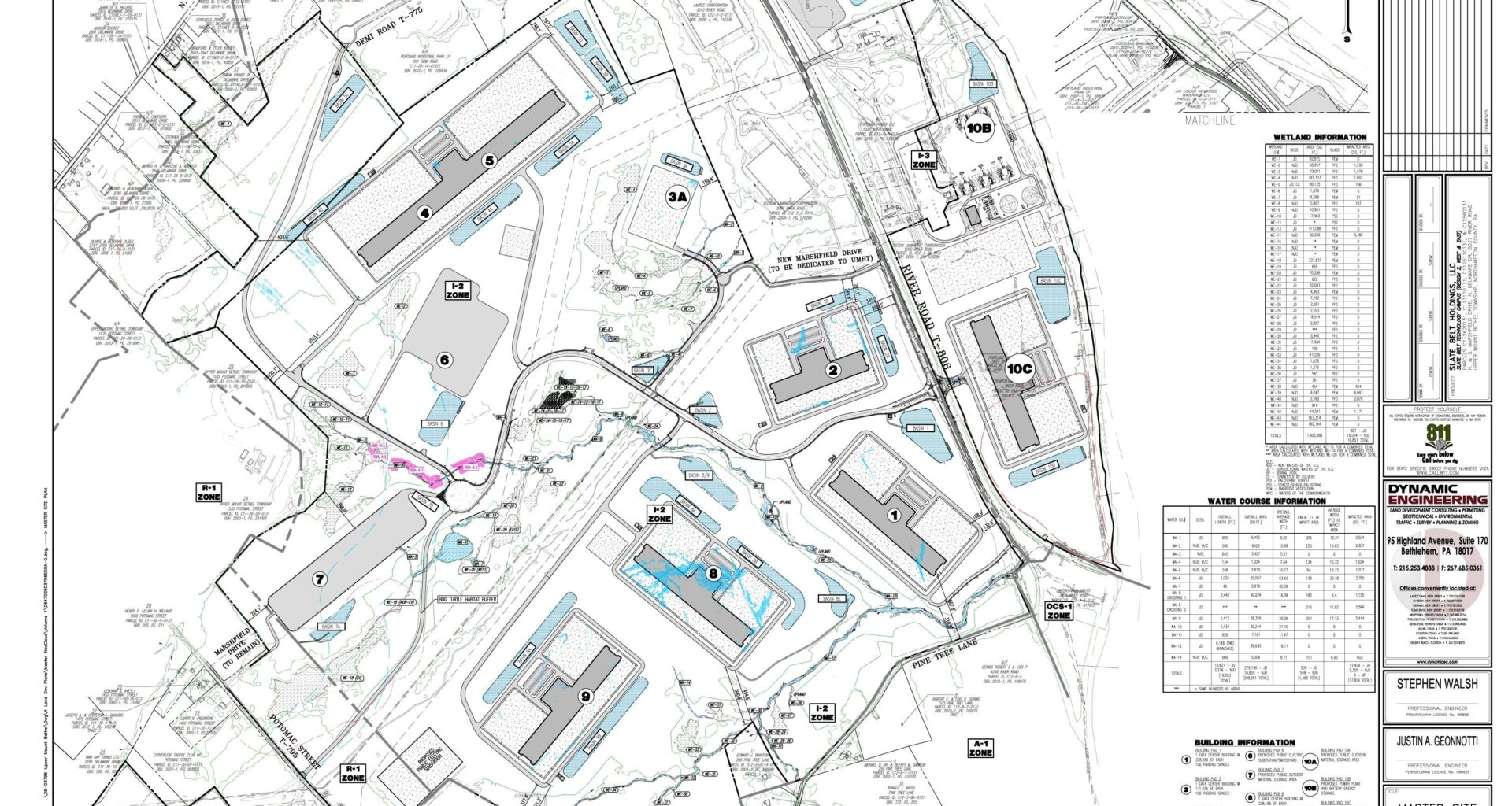
Six days before Upper Mount Bethel Township is scheduled to hear a challenge on its zoning regulations regarding data centers, the developers of a proposed hyperscale campus submitted updated site design plans and outlined a $50 million community benefits agreement in which payouts would be tied to development approval and construction milestones.
The plans align with the developers’ previously stated intention of reaching 2 gigawatts of electrical capacity but present two different visions of how to reach that goal on 900 acres that straddle River Road, with one design featuring fewer, smaller buildings.
An end user hasn’t yet been designated, which could affect the kind of technology employed if the data center campus is built, a spokesperson for Slate Belt Holdings, the development partnership between River Pointe Logistics and Talen Energy, told The Morning Call.
With that in mind, submitting two designs for approval will “provide options for the configuration of the data center campus,” the spokesperson said.
FirstEnergy has an agreement with Slate Belt to provide half its desired electrical load, the preliminary land development plans state. The project would need to be developed in phases as additional electric service is made available through the grid and from the construction of onsite generation.
Differing designs
The first design plan matches proposals Slate Belt sent when it filed validity challenges against the township zoning ordinance. In July, the first validity challenge included plans to build 23 data center buildings and two substations on 754 acres of land west of River Road. A second validity challenge filed last week included plans to build six data center buildings, battery storage and a power plant on approximately 152 acres east of River Road.
In total, that puts the first design at 29 data center buildings, each 121,500 square feet, for a total of 3.5 million square feet. Typical building height is listed at 80 feet.
The second design plan features only six data center buildings: five west of River Road and one to the east. Ranging from 171,426 to 395,026 square feet in size, those six buildings would total nearly 1.5 million square feet. Typical building height is listed at 35 feet.
“I can say that I’m glad to see one of the proposals has building heights limited to 35 ft so that our emergency services can easily access the roof if needed as well as greatly limit the sight for anyone enjoying the Delaware River,” township Supervisor Jon Erler said in a text.
“Project narratives” on the website for the project, dubbed the Slate Belt Technology Campus, say plans align to current Upper Mount Bethel zoning ordinances and to the version of the draft data center ordinance that Talen Energy sent to the township in July.
Those narratives also list some additional environmental commitments, such as using a closed-loop water cooling system and not relying on groundwater or Delaware River water.
Liquid drained from the cooling system, which would include water and propylene glycol added as needed for freeze protection, would not be discharged to the public sewer or stormwater management system but would be taken to an off-site disposal facility approved by the Pennsylvania Department of Environmental Protection, the plans say.
$50 million at play
Upper Mount Bethel supervisors have been discussing naming a consultant to help negotiate a community benefits agreement with Slate Belt. At Monday’s meeting, they left the question unresolved, voting to send out a request for proposals to find other options.
The terms of the CBA that Slate Belt proposed Tuesday are nonbinding and described as “an outline for discussion purposes only.”
The developers would require the township to take specific actions to advance the data center project in order to receive the first set of payouts, potentially worth $8 million.
An initial $1 million would be tied to finalizing the community benefits agreement. Approving the preliminary land development plan would release $3 million and approving the final land development plan would release another $4 million.
The next set of community benefit payments would total $20 million, proposed as a set of annual, $2.5 million payments over eight years. Those payments would begin after the first building occupancy permit for a data center building is received.
Another $22 million in community benefits would be tied to electrical capacity milestones.
Reaching 500 megawatts of total campus electrical load, including electricity used by computer equipment and cooling systems, would be worth $5.5 million. Another $5.5 million would be released for each additional 500 MW of electrical load, up to 2 GW.
Tying community benefit payments to electrical capacity milestones isn’t a new idea for Slate Belt. A deal floated in August that would have seen the developers drop their zoning challenge if township officials collaborated on data center regulations and approved the hyperscale campus plans tied a total donation amount of $50 million to the campus reaching 2 GW of computing capacity.
The latest proposed agreement has those milestones affecting the pace of payments, not their total.
“On the eighth anniversary of receipt of the first building occupancy permit, Slate Belt Holdings, LLC will pay a lump sum equal to $50 million less all CBA payments previously made or made on that date,” the agreement terms say.
A payment schedule included with the CBA terms says estimated first occupancy is 2029 and the full $50 million in community benefits would be scheduled to be paid by 2036.
The deal floated in August also proposed that Slate Belt donate to nonprofit causes designated by the township. The developers have since said payments would be made directly to the township.
Slate Belt’s proposed CBA lists suggested uses for community benefit funds and also says the list is “not intended to be prescriptive or exhaustive.” It includes infrastructure, emergency services, farmland preservation, open space and workforce development.
“A $50 million community benefits agreement is a major, direct commitment to Upper Mount Bethel residents, in addition to the tens of millions of dollars in new tax revenue, hundreds of both construction and permanent jobs, and broader economic benefits this project would generate,” Dale Lebsack of Slate Belt Holdings and chief asset development officer at Talen Energy, said in a news release.
“Our goal is to ensure that as this project moves forward, the township has dedicated resources to support local priorities, strengthen infrastructure and services, and deliver lasting benefits for the community.”