
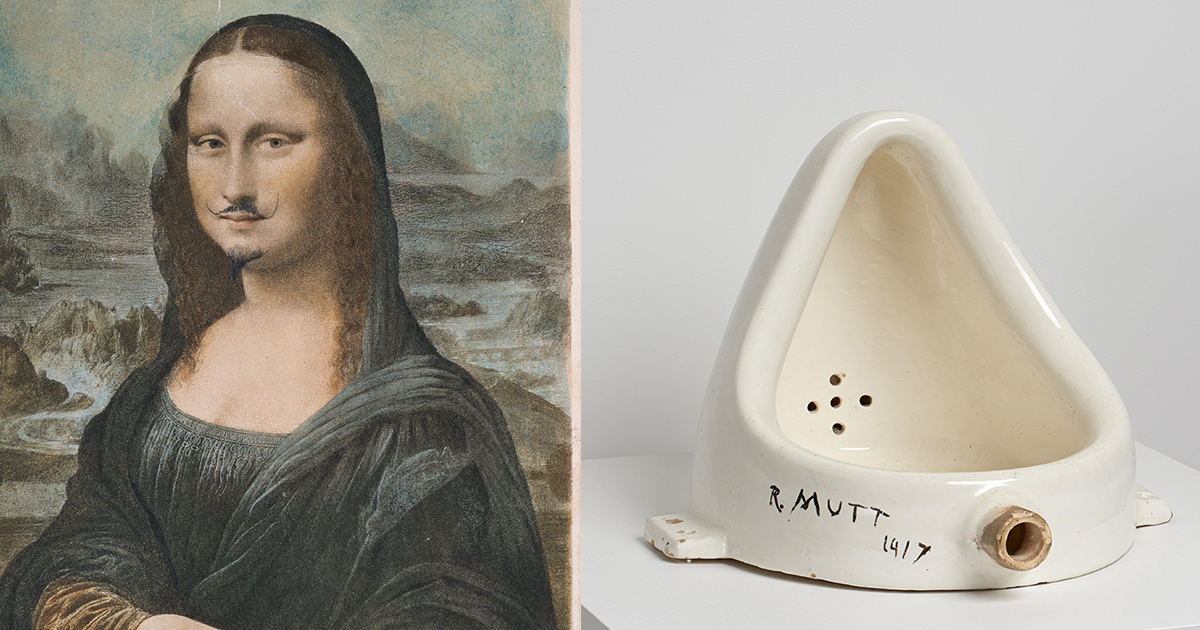
He put a mustache on the Mona Lisa and declared a urinal a work of art. Now, a sweeping new Philadelphia Museum of Art retrospective explores the provocateur whose ideas were decades ahead of their time.
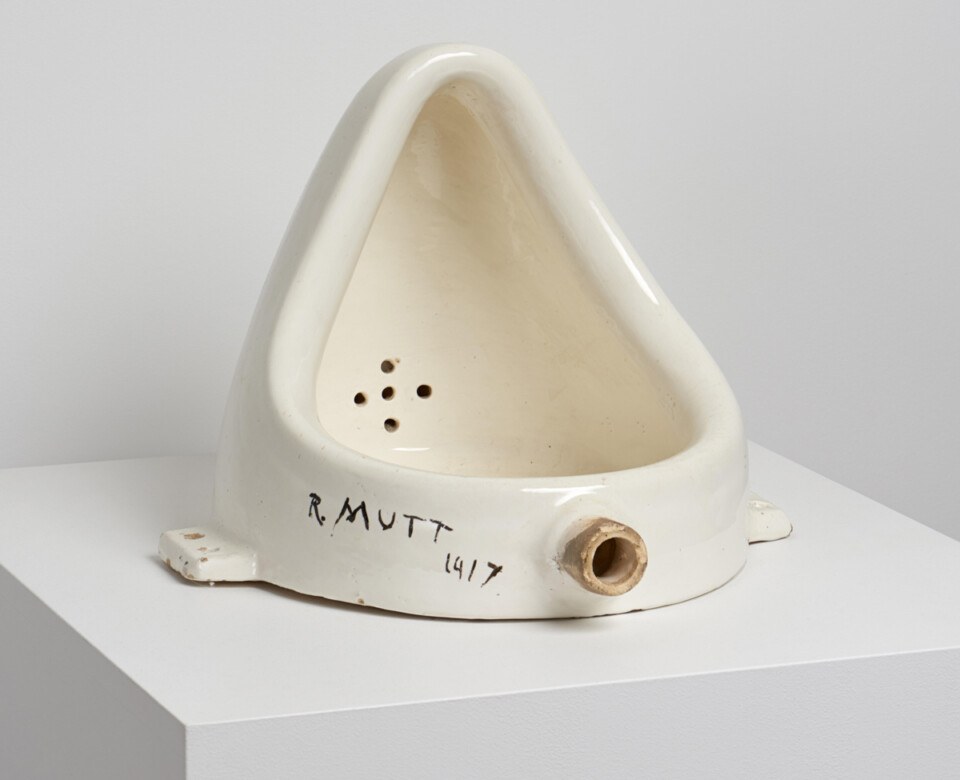
Fountain by Marcel Duchamp / Photographs and images courtesy of Philadelphia Museum of Art via Association Marcel Duchamp / ADAGP, Paris / Artists Rights Society (ARS), New York 2026
He looked like the soul of propriety, but Marcel Duchamp was a provocateur with a naughty streak. In 1917 he purchased a pissoir (urinal), signed it “R. Mutt,” named it Fountain, and submitted it to an exhibition of the Society of Independent Artists in New York. The Society promised everyone who paid the $6 initiation fee (including annual dues) would have their work displayed at the exhibition. Despite the guarantee, Duchamp’s offering was nixed.
According to William Glackens, the Society’s president (also the realist painter who advised his Central High chum, Dr. Albert C. Barnes, about acquiring art for the latter’s museum), Fountain was not art. According to Duchamp, lately a French realist painter whose work had taken a decisive turn towards the theoretical, a mass-produced object was art if the artist designated it so. Duchamp dubbed Fountain a “readymade.” Historians classify it as an early example of conceptual art, a movement that would reemerge 50 years later, after his death in 1968.
“Marcel Duchamp,” a collaboration between the Philadelphia Museum of Art — which hosts the world’s largest concentration of the artist’s work — and New York’s Museum of Modern Art (MoMA), opened here October 10th and will be on view through January 31, 2027. Before Duchamp, an artist’s skills were fundamental. Duchamp, however, was more interested in the ideas behind an artwork than in its execution.
His radical art practices included appropriation, assemblage, deconstruction, installation, and performance art — actions that continue to interest contemporary artists.
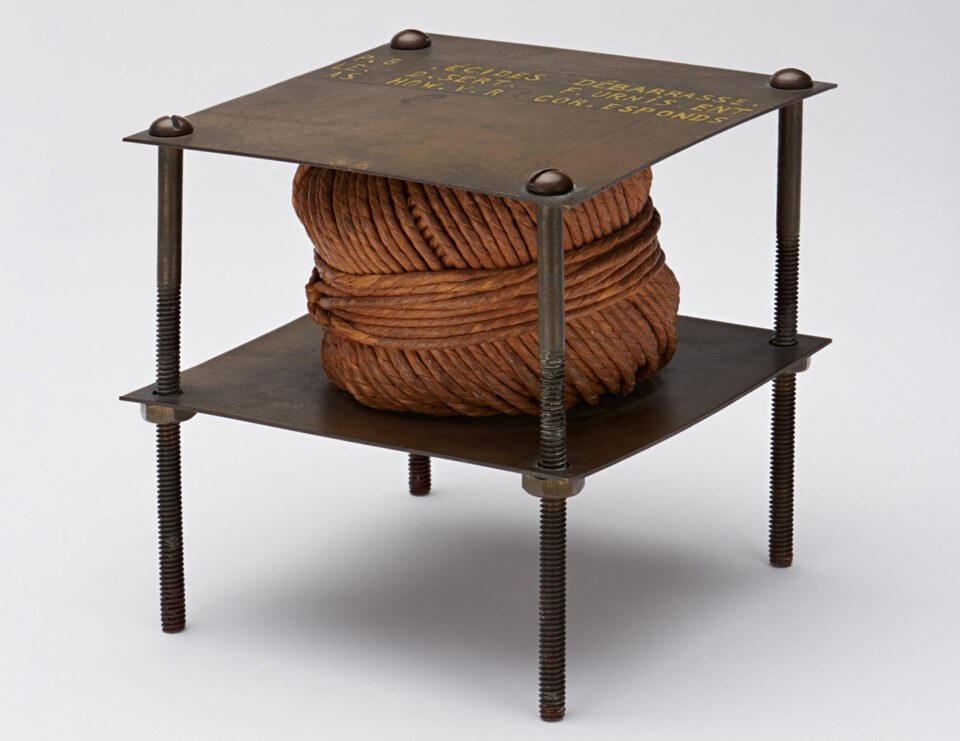
Marcel Duchamp’s With Hidden Noise
Thanks to PMA curator Matthew Affron, and his MoMA counterparts Ann Temkin and Michelle Kuo, the pleasure of this chronological (and comprehensive) survey succeeds both as a stellar exhibition and the biography of an eccentric, and cerebral, entertainer. I was smitten by a 1910 Cezanne-like luminous oil painting of his father, and satiric cartoons from the first decade of the 20th century.
Artistically speaking, he started out as a man of his time. Soon he would bring a scientific method (or is it a satire of the scientific method?) to his work.
Around 1910, Duchamp began to experiment with non-naturalistic colors seen in Fauve-inspired oil paintings. The following year, he created proto-Cubist preparatory drawings and paintings of elongated figures that look like the aliens in Close Encounters of the Third Kind playing string instruments. In what he described as “a static representation of movement,” he painted the first version of Nude Descending a Staircase in 1911.
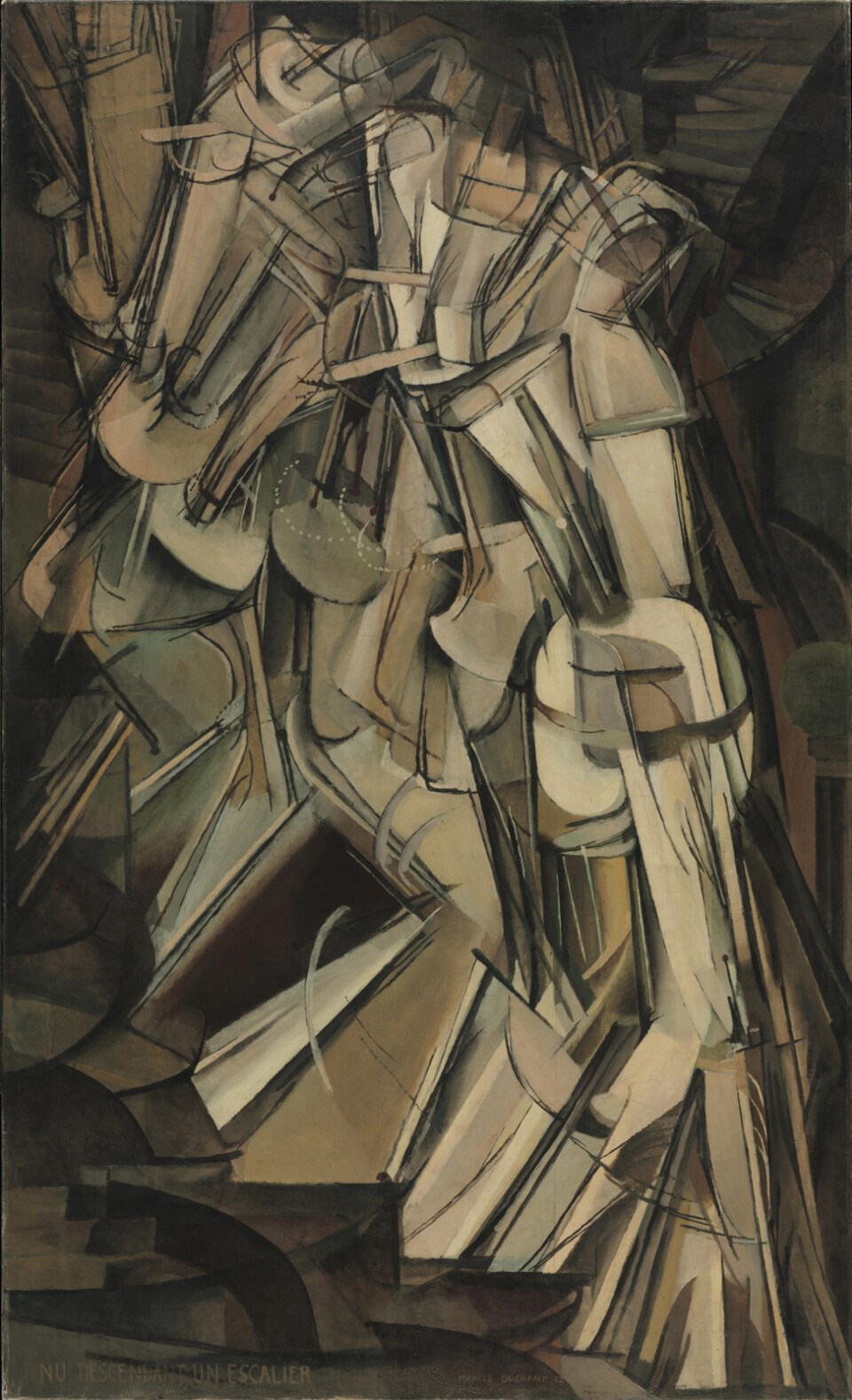
Nude Descending a Staircase #2
Early in 1912, he completed the second, canonical, version of the motion study (Nude Descending a Staircase #2) and was invited to show it at the Paris Salon des Indépendants. When Duchamp’s artist brothers told him that others in the exhibition had reservations about his work, Duchamp promptly withdrew it, quietly determining not to align himself with artistic movements in the future.
Nonetheless, he consented to exhibit Nude Descending #2 at the Armory Show in New York. The painting raised eyebrows, incited lampoons in the New York Times — “an explosion in a shingle mill” — and instigated a cartoon in the New York Evening Sun — “Rude Descending a Staircase,” — in which the cartoonist satirically illustrated a human traffic jam on the subway stairs at rush hour. Even Teddy Roosevelt joined the jesters, noting that he had a Navajo rug in his bathroom that was a better example of Cubism than the Duchamp.
The jokers failed to acknowledge the challenge (or is it the contradiction?) of an artist who painted a still image that depicted movement. Whether focused on human anatomy or machines, Duchamp was seriously engaged in detailing how things worked and how to make visible those processes not easily observable.
In 1915, Duchamp visited the United States, where he became permanent resident in 1942 and citizen in 1955. A heart murmur exempted him from serving in World War I. Upon his arrival, he was preoccupied with a new project informally known as The Large Glass.
Walter Pach, an American art historian who advised art collectors, introduced Duchamp to Walter and Louise Arensberg. They became his collectors and frequent co-conspirators. To support himself, Duchamp taught French to American artists. Philadelphia-born Man Ray embraced Duchamp’s playful, and sometimes naughty, side. Art writer Deborah Solomon called Duchamp “class clown of the school of modern art.”
In 1918, he decamped New York for Buenos Aires where he worked on the The Large Glass, and improving his chess game. After designing a set of chess pieces, he worked with carpenter to fabricate them. When his elder brother, sculptor Raymond Duchamp-Villon, died, Duchamp returned to Paris, to help arrange his sibling’s memorial exhibition.
He was still in Paris in 1919 when he created a “Rectified Readymade.” As the Louvre celebrated the 400th anniversary of Leonardo da Vinci’s death, Duchamp joined the fun and took a pencil to a souvenir reproduction of Mona Lisa, embellishing the Gioconda’s face with a moustache, goatee, and the title “L H O O Q.” Pronounce each letter and it sounds like a French speaker saying, of a woman caricatured as a man, “She’s got a hot ass.”
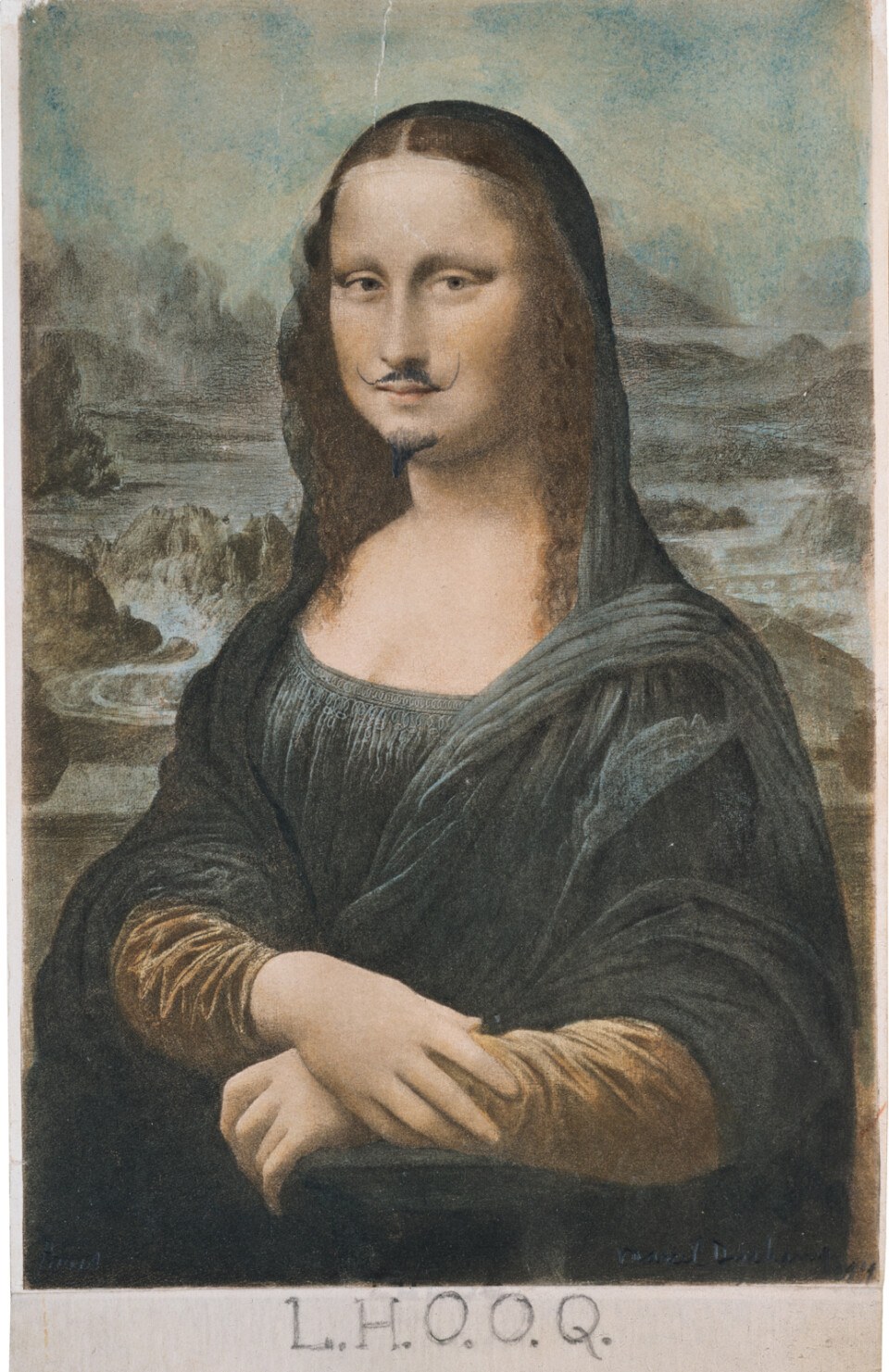
Marcel Duchamp’s L.H.O.O.Q.
Returning to the States in 1920, Duchamp, along with friend Man Ray, created a sexually fluid alter ego, Rrose Selavy. Pronounce it with a French accent, and you hear, “Eros, c’est la vie.” That translates to “Sex, that’s life.”
Duchamp enjoyed being the naughty boy as much as he enjoyed wordplay. Consider the title of his 1926 silent movie, the anagram (and near-palindrome) Anemic Cinema. Seven minutes in length, the film has nine shots of black discs revolving counterclockwise, each disc lettered with a nonsensical sentence in French. A favorite, translated: “Among our lazy hardware items, we recommend the faucet that stops dripping when you’re not listening to it.”
Also in 1926, Duchamp first exhibited his “definitively unfinished” Large Glass, now officially titled The Bride Stripped Bare by Her Bachelors, Even, at the Brooklyn Museum. Though he had begun thinking about it in 1912, the PMA, where it has been permanently installed since 1954, the museum gives 1915-23 as the years of its creation. Standing upright, it is a nine-foot-high glass horizontally divided into two frames. The upper one houses the solitary Bride, a mechanical-looking insect emitting what Duchamp called “love gasoline.” The lower frame houses nine bachelors aroused by the perfume of the Bride’s gasoline, and a chocolate grinder (a frequent motif in Duchamp’s work). The efforts of the Bride and attempted consummation by the Bachelors are, alas, unfinished. Whenever I read commentary about The Bride and Her Bachelors, it’s like parsing the assembly instructions for an Ikea purchase. Looking at the piece itself, I’m inevitably mesmerized.
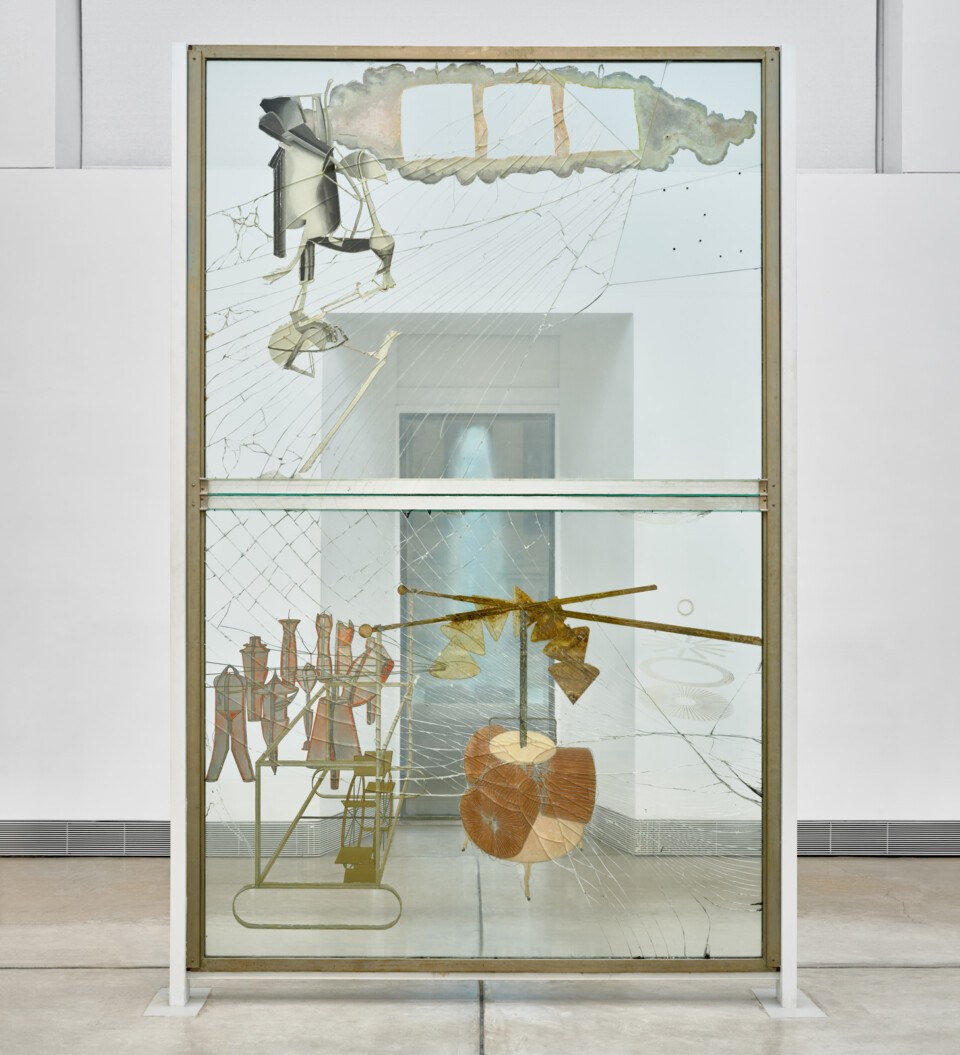
The Bride Stripped Bare by Her Bachelors, Even (The Large Glass)
Over his last two decades, Duchamp intentionally spread the rumor that he had given up art for chess. He continued making “erotic objects” such as Female Fig Leaf (1950) and Objet-Dard (a phallic sculpture likening the male member to a dart). In secret, he was making his final piece, an assemblage, Etant Donnes (1946-66).
Etant Donnes (“Given that …“) is permanently installed at the PMA, in a darkened gallery next to the light-filled one where The Large Glass stands. It’s a piece that obliges viewers to become voyeurs, as they look through a peephole to see a ravaged female body next to a snuffed-out lamp. I think of it as the Statue of Liberty knocked off her island pedestal, ravished and abandoned. And then I think that Duchamp was always ahead of his time.