

Get ready for a spooky Halloween season with “Monsters, Myths, and Legends,” a guided tour of vampires, werewolves, sea monsters, and other mythic beasts which highwire the line between fear and fascination.
With a veteran guide touring you through the strange and sublime, you will dig deeper into the meaning of monsters – what or whom they protected, punished, and revealed about the cultures which conjured them.
Once adventurers are equipped with a magic amulet, your expert tour guide will share scholarly insights and rich interpretation beyond the object labels, with a spooky twist.
Ask questions, explore complex themes, and unlock surprising connections across cultures as you encounter the myths, monsters, and legends created by ancient imaginations.
Now as you read further, explore the origins of Halloween going back to the era of Julius Caesar and his commentary on the Druids and Gallic customs.
The Celts, who lived 2,000 years ago in the area that is now Ireland, the United Kingdom and northern France, celebrated their new year on what we call November 1.
This day marked the end of summer and the harvest and the beginning of the dark, cold winter, a time of year that was often associated with human death.
The Celts believed that on the night before the wintry new year, the boundaries between the worlds of the living and the dead became blurred.
On the night of October 31, as we refer to it, they celebrated Samhain, when it was believed that the ghosts of the dead returned to earth.
In addition to causing trouble and damaging crops, the Celts believed that the presence of the otherworldly spirits made it possible for the Druids, or Celtic priests, to make predictions about the future.
For a people entirely dependent on the ever-changing natural world, these prophecies were an important source of comfort and direction during the long, dark winter.
By A.D. 43, the Roman Empire had conquered the majority of Celtic territory.
In the course of the four hundred years during which the Romans ruled the Celtic lands, two festivals of Roman origin, the Feralia and festival of Pomona, were combined with the traditional Celtic celebration of Samhain, the original Halloween.
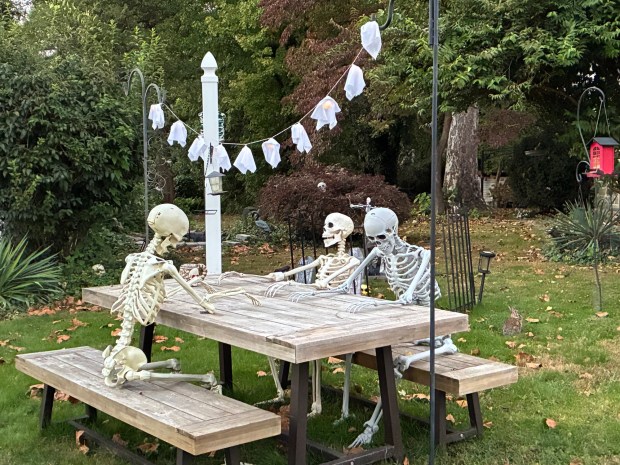 Narberth Borough denizens meet for a ghoulish conversation just days before Halloween. (Photo submitted by Mary Brown)
During the celebration of Samhain, the Celts wore costumes, typically consisting of animal heads and skins, to ward off the ghosts of the dead.
The Roman festival Feralia, in late October, commemorated the passing of the dead. Pomona, the Roman goddess of fruit and trees, was also honored during harvest time.
The symbol of the Roman goddess Pomona was the apple and the incorporation of her worship, through a process called syncretism, into the Celtic Samhain probably explains the Halloween tradition of “bobbing” for apples, or gifting them as symbols of rebirth.
On May 13, A.D. 609, Pope Boniface IV dedicated the Pantheon in Rome in honor of all of the Christian martyrs, and the Catholic feast of All Martyrs Day, or All Saints Day, was established, later observed on November 1.
The All Saints Day celebration was also called All-hallows or Allhallowmas (from Middle English Alholowmesse = All Saints Day) and the night before it, the traditional night of Samhain, began to be called All-hallows Eve and, eventually, developed into the word Halloween.
To commemorate the end of summer, the Druids built huge sacred bonfires, where the people gathered to burn crops and animals as sacrifices to the Celtic deities.
During this celebration, the Celts covered their bodies, typically with animal heads and skins, painted their faces, and attempted to tell each other’s fortunes.
When the celebration was over, returning to their own thatched huts and abodes, they re-lit their hearth fires, which they had extinguished earlier that evening, from the sacred bonfire to help protect them during the coming winter.
Centuries later, in North America, the celebration of Halloween was extremely limited in colonial New England because of the rigid Protestant belief systems there. Halloween was much more common in Maryland and the southern colonies.
As the beliefs and customs of different European ethnic groups as well as of the Native Americans meshed, a distinctly American version of Halloween began to emerge.
The first celebrations included “play parties,” public events held to celebrate the harvest, where neighbors would share stories of the dead, tell each other’s fortunes, dance and sing.
Colonial-period Halloween festivities also featured the telling of ghost stories and mischief-making of all kinds.
By the middle of the nineteenth century, annual autumn festivities were common, but Halloween was not yet celebrated everywhere in the country.
In the second half of the nineteenth century, America was flooded with new immigrants. These new immigrants, especially the millions of Irish fleeing Ireland’s potato famine of 1846, helped to popularize the celebration of Halloween nationally.
Incorporating Irish and English traditions, Americans began to dress up in costumes and go house to house asking for food or money, a practice that eventually became today’s “trick-or-treat” tradition.
Young women believed that on Halloween they could divine the name or appearance of their future husband by doing tricks with yarn, apple parings, or mirrors.
In the late 1800s, there was a move in America to mold Halloween into a holiday more about community and neighborly get-togethers than about ghosts, pranks and witchcraft.
At the turn of the century, Halloween parties for both children and adults became the most common way to celebrate the day. Parties focused on games, foods of the season, and festive costumes.
Parents and guardians were encouraged by newspapers and community leaders to take anything “frightening” or “grotesque” out of Halloween celebrations.
Due to these efforts, Halloween lost most of its superstitious and religious overtones by the beginning of the twentieth century.
Today, we celebrate with parties and school parades – held outside or inside – and display pumpkins and autumnal decorations galore, all colorfully rich and creative, and even a little spooky.
Mary Brown, President of The Philadelphia Classical Society and Masciantonio Committee Co-Chair of The Classical Association of the Atlantic States, teaches Latin at Saint Joseph’s University.