
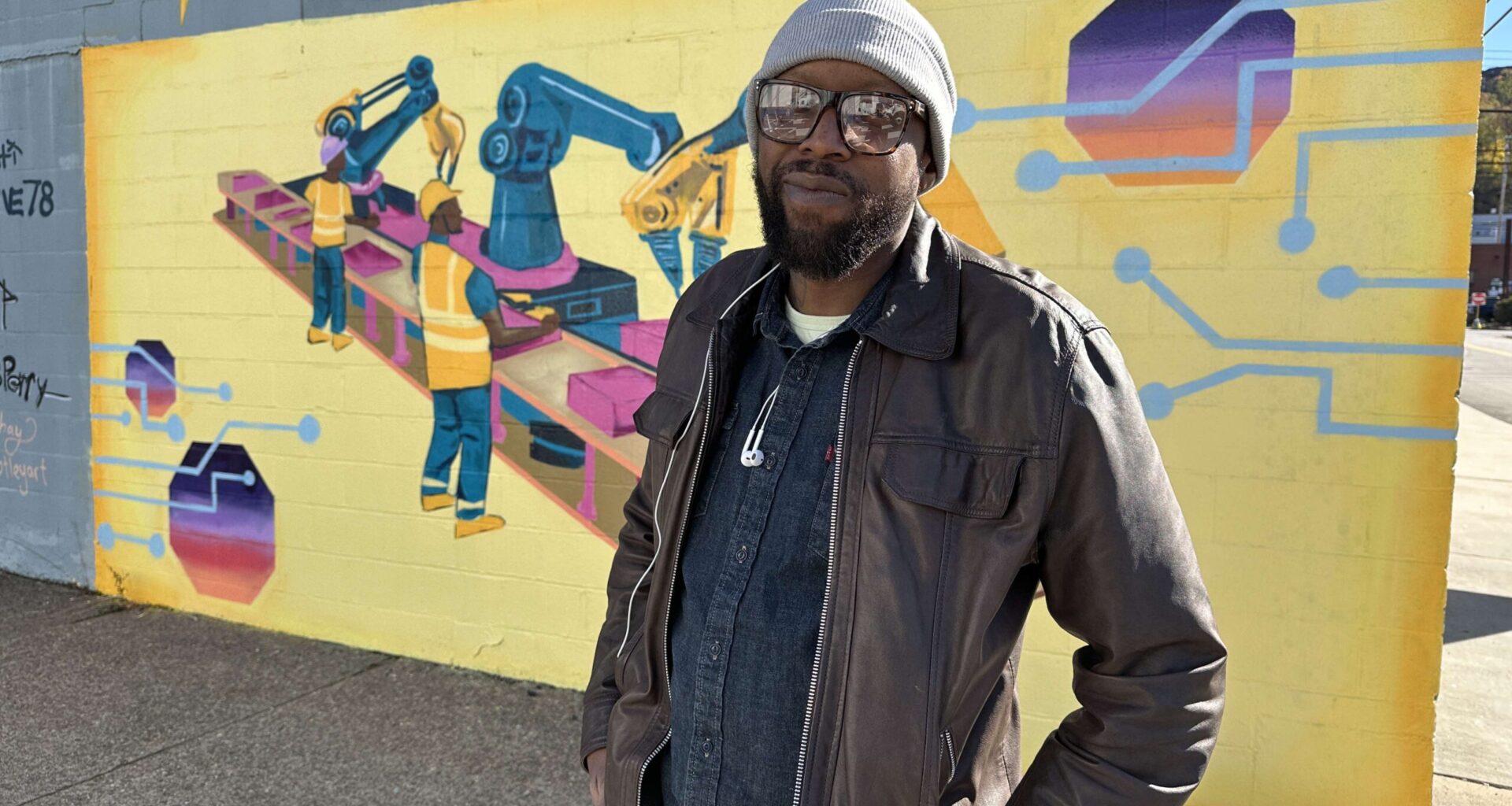
Corey Ochai’s first mural confronts a challenge: Can we keep humanity at the center of our era of automation?
Ochai is an artist and a first-term councilman in Sharpsburg, a small borough that borders Pittsburgh across the Allegheny River, where he’s also made history as its first Black councilmember. His mural is one of three newly installed at the corner of Penn Avenue and 30th Street, in a post-industrial neighborhood called the Strip District that is part of what civic boosters now call Robotics Row.
“People walking by were asking what we were doing, and saying thank you for beautifying their neighborhood,” Ochai said of his work, which has a spray-paint feel of people in hard hats working a futuristic conveyor belt. “We started conversations about what automation means for jobs. I realized this is only possible because of technology — and community.”
Murals in the series make that connection directly, bringing out the human hand in what appears to be primarily tech-fueled.
Across Penn Avenue, artist Phil Seth’s mural looks sharp and precise — almost digital. But step closer and it reveals paint drips, brush strokes and the unmistakable evidence of a human hand.
“I wanted that contrast,” Seth said. “From far away, it looks machine-made. Up close, you can see the imperfections — the proof that a person was here. It’s a reminder that all this technology should advance our quality of life, not erase us from it.”
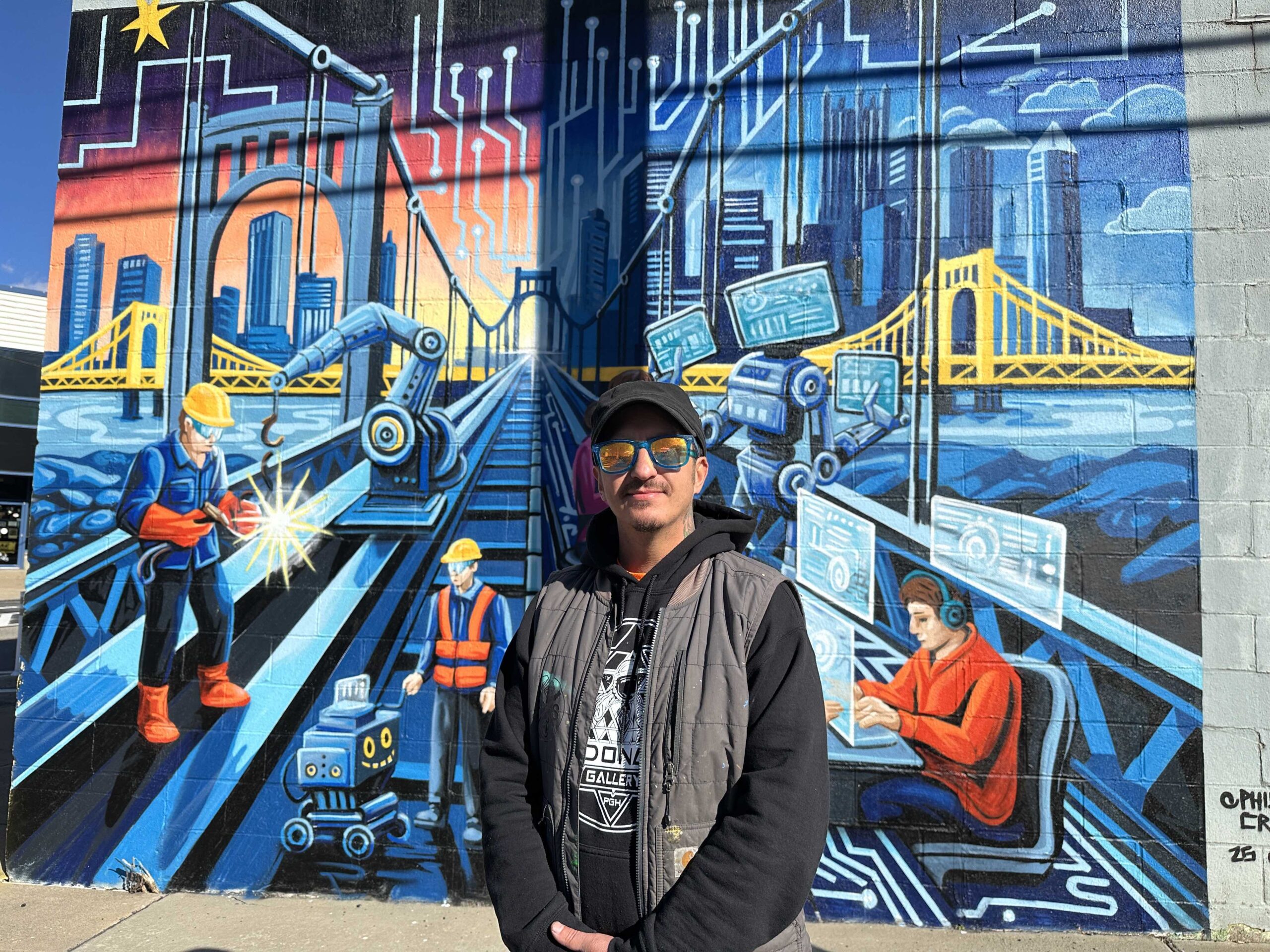 artist Phil Seth (Christopher Wink/Technical.ly)
An ecosystem in color
Good art stirs passion. Today’s automation anxiety does too. Pittsburgh had both on display last week, with autonomous trucks and robot dogs taking center stage at a major robotics event near the public art unveiling.
The mural series was formally opened during Pittsburgh Tech Week and following Robotics Discovery Day, and commissioned by the New Economy Collaborative (NEC), which was created with federal funding. Organizers are busy matching entrepreneurs and would-be roboticists with programs and resources, and interpret a future in which that growth outpaces job dislocation, said NEC lead Annie Colarusso.
This mashing of art and economy has precedent. In the 1930s, the federal government’s New Deal funded thousands of pieces of public art, including murals, said Maddi Love, who recommended the artists. She’s a digital marketer with overlapping roles in Pittsburgh’s tech sectors – supporting Pittsburgh Robotics Network, which organized last week’s robotics event and the NEC, where I work with her too.
Economic strategy can feel sterile, ranking people and places by ruthless efficiency. Art humanizes, and so is a powerful tool to demonstrate priorities.
Lead artist Emily Paige Armstrong, a muralist and former member of the Pittsburgh Robotics Network team, designed the piece with artist and educator Kian Dubay. Their mural stretches across a prominent Strip District wall on Penn Avenue — a place Armstrong calls “a renaissance site” for the city’s economy.
“Pittsburgh is having a renaissance,” Armstrong said. “A lot of the jobs returning now are tech jobs that are safer, better-paying and more meaningful. It’s important that people are centered at the forefront — that we prioritize humanity and community as technology grows.”
Dubay, who teaches art locally, sees the project as a way to inspire curiosity rather than fear.
“Pittsburgh is the robotics headquarters of the country,” she said. “This project gets people excited about that — not scared of it.”
At the same time, Dubay acknowledged the tension artists feel as AI expands into creative domains. As Technical.ly’s own ethics policy for AI use reminds, “Technology is neither good nor bad; nor is it neutral,” and so artists should demonstrate their centrality, Dubay said.
“When the camera was invented, painters didn’t disappear,” he said. “AI will reflect us. We just have to decide what we want to see.”
From assembly lines to artistry
In policy circles, Pittsburgh has credible robotics legitimacy. Its creative sector deserves stature too. The one-time home of pop art icon Andy Warhol, Pittsburgh has more than 200 murals by one estimate — one of the country’s top totals of public art.
This project intends to show that the arts and technology do not have to be at odds but can work in synchrony if leaders choose so.
Pittsburgh will only thrive if both technology and art are balanced, as the councilman-artist Ochai reminds. His mural centers on an assembly line filled with people and machines working side by side — an image, he said, that reflects what he learned through the project.
More familiar with a smaller canvas, he used VR to visualize his first larger project before starting.
“I was skeptical at first,” he admitted. “But I came to see how much opportunity exists if we keep people in the frame. Technology can give you confidence. It did for me. Now, I look at every building and think: That’s a canvas.”
The interplay of driverless trucks and automated loading docks with creative expression is an uneasy one. The first comment when I posted these artist interviews was critical of technology co-opting art. These artists argue for balance.
“This was a collaboration of community, creativity and technology,” lead artist Armstrong said. “It’s proof that when artists and engineers work together, the future looks a little more human.”