
Want to coast through spring semester? Avoid LSMP 4210B. Maybe steer clear of FNCE 2570, too.
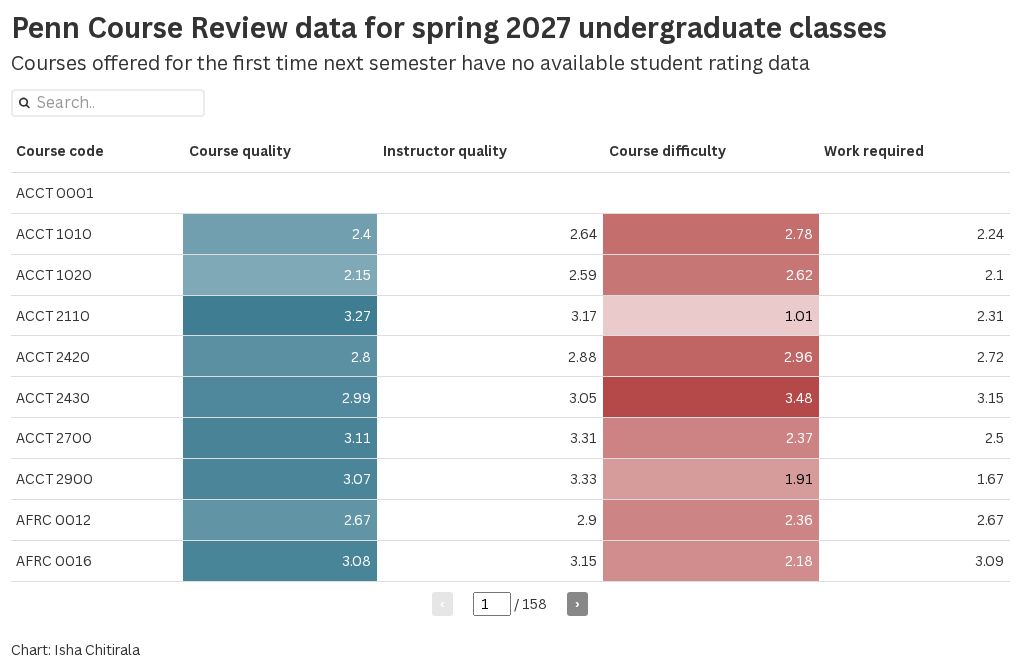
As Penn students prepare to select classes for the spring semester, The Daily Pennsylvanian analyzed more than 1,500 undergraduate-level courses using Penn Course Review student ratings — which are sourced from end-of-semester surveys — to find which classes students consider to be the hardest, the easiest, and everything in between. Courses are rated on a scale of zero to four in areas such as difficulty, workload, amount learned, and overall quality.
The figures are based on aggregate ratings across all semesters with available data.
Get the DP delivered straight to your inbox.
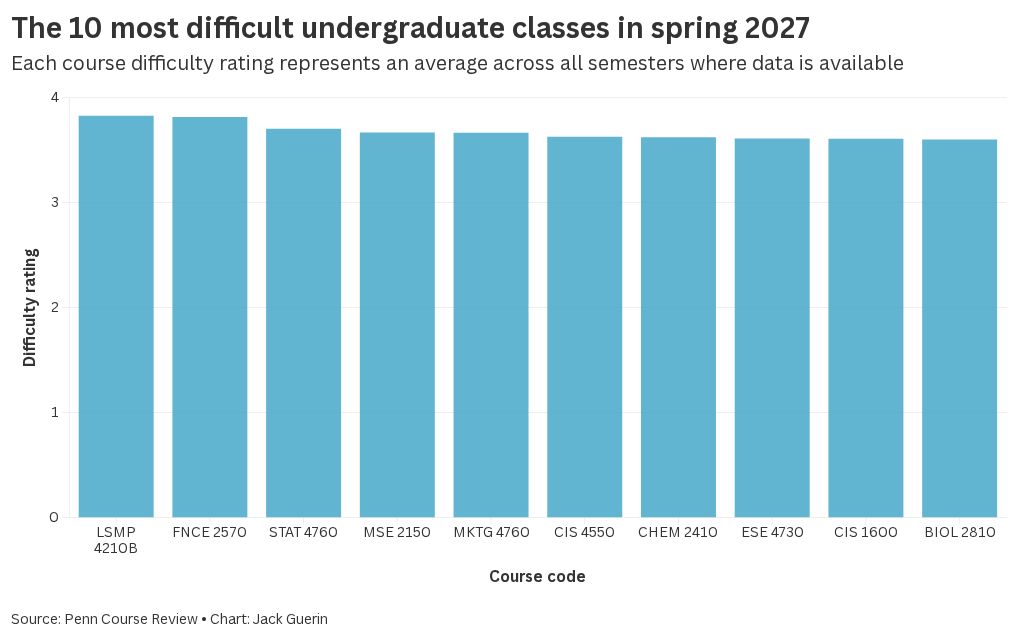
With a 3.83 out of four, LSMP 4210B — a capstone course for students in the Vagelos Program in Life Sciences & Management — has the highest difficulty rating of any course. FNCE 2570: Foundations of Asset Pricing follows at 3.82, and STAT 4760: Applied Probability Models in Marketing comes in third at 3.70.
The easiest-rated non-language class was EAS 2420: Energy Education in Philadelphia Schools, with a 0.58 difficulty. EAS 2420 only ranks behind SPAN 0800: Spanish Conversation, a half-credit course.
Among the 1,271 courses with available ratings in both categories, difficulty and workload show a strong positive correlation. Three courses rank in the top 10 for both most difficult and most work-intensive: LSMP 4210B, CIS 4550, and ESE 4730. LSMP 4210B was rated the most work-intensive class, at 3.95 out of 4, followed by CIS 4550: Internet & Web Systems at 3.85.
In ratings for first-year writing seminars, difficulty often deviated from course workload. On the whole, Critical Writing Seminars had the fifth-highest average workload among all departments, at 2.98, but an average difficulty of just 2.08. Writing seminar instructors also received notably high ratings, averaging 3.30 — significantly above the average rating students gave the courses themselves.
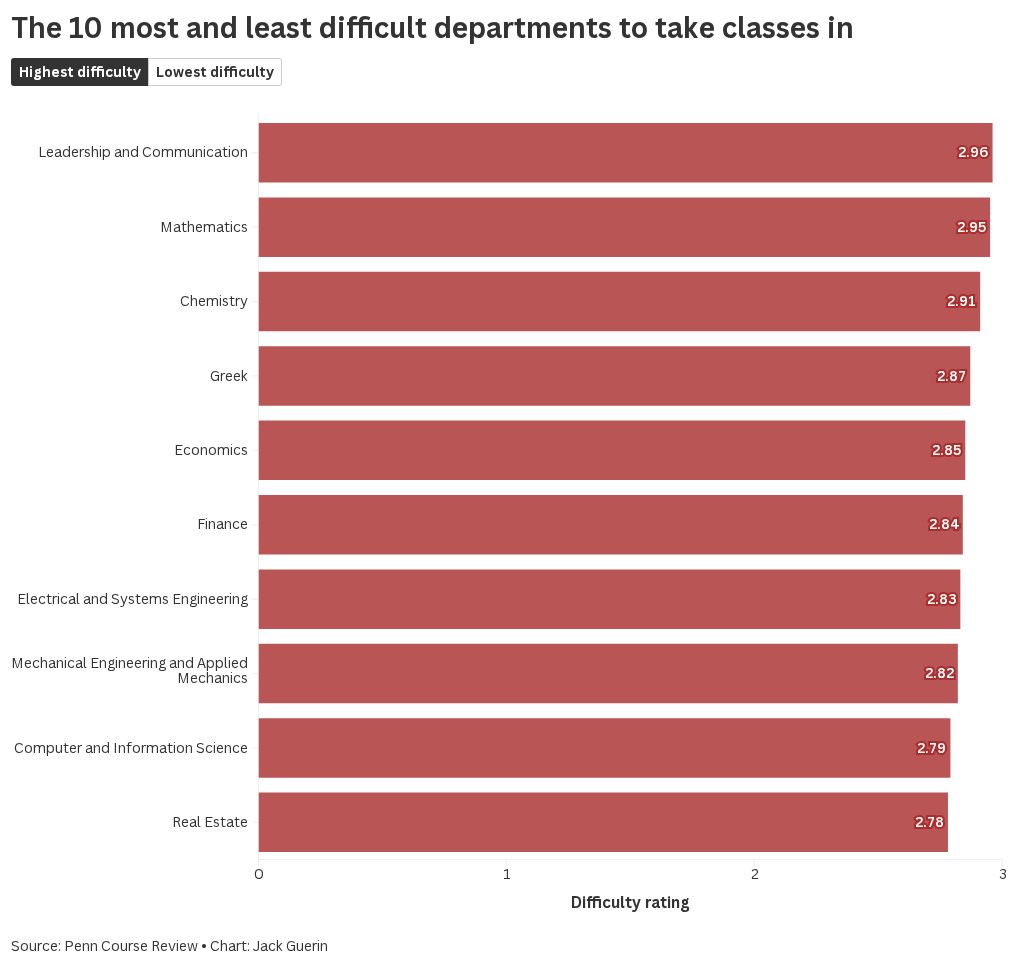
Leadership and Communication-focused courses, or LEAD, had the highest average course difficulty rating, at 2.96, followed by Mathematics courses at 2.95 and Chemistry courses at 2.91. LEAD courses also had the heaviest average workload at 3.17, with Mechanical Engineering and Applied Mechanics and Computer and Information Science close behind.
Theatre Arts courses had the lowest average course difficulty at 1.47, with Cinema and Media Studies next at 1.65. The language departments led in the lightest workload, with American Sign Language at 1.22, Korean at 1.30, and Chinese at 1.44.
MATH 1070: Mathematics of change, Part I — an introductory calculus course — scored an outlying 1.00 in terms of quality, by far the lowest of any course. The Mathematics department had the lowest average course quality of any department, at 2.30, followed by Chemistry at 2.47 and Economics at 2.61.
Penn’s language departments also took home the majority of top spots in quality rankings, with Korean at 3.59, followed by Russian at 3.53 and Chinese at 3.51.
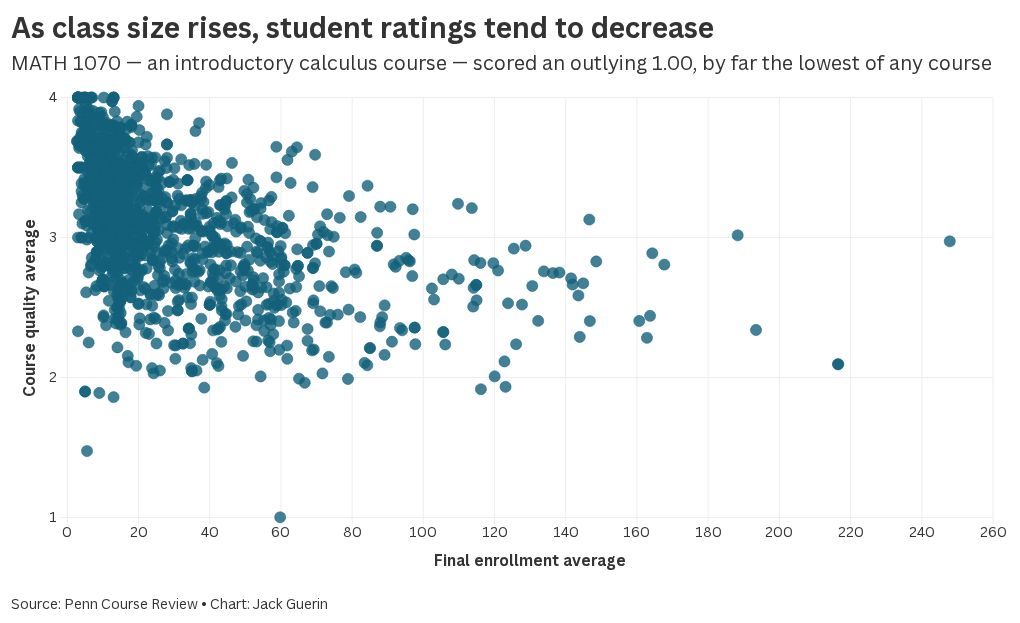
Class size also appeared to shape how students perceive a course: average enrollment and quality rating were negatively correlated, meaning that as final enrollment rose, average course quality tended to fall. Courses with fewer than 15 students averaged a quality rating of 3.32, versus 3.06 for courses of 15 to 40 students and 2.74 for those with more than 40.
Staff reporter Ariel Zhang contributes to data reporting and can be reached at zhang@thedp.com. At Penn, she studies international relations. Follow her on X @arielchuyan.