
PHILADELPHIA (WPVI) — Invention has always been part of Philadelphia’s DNA.
A program at Temple University helps undergrads bring their great ideas to life.
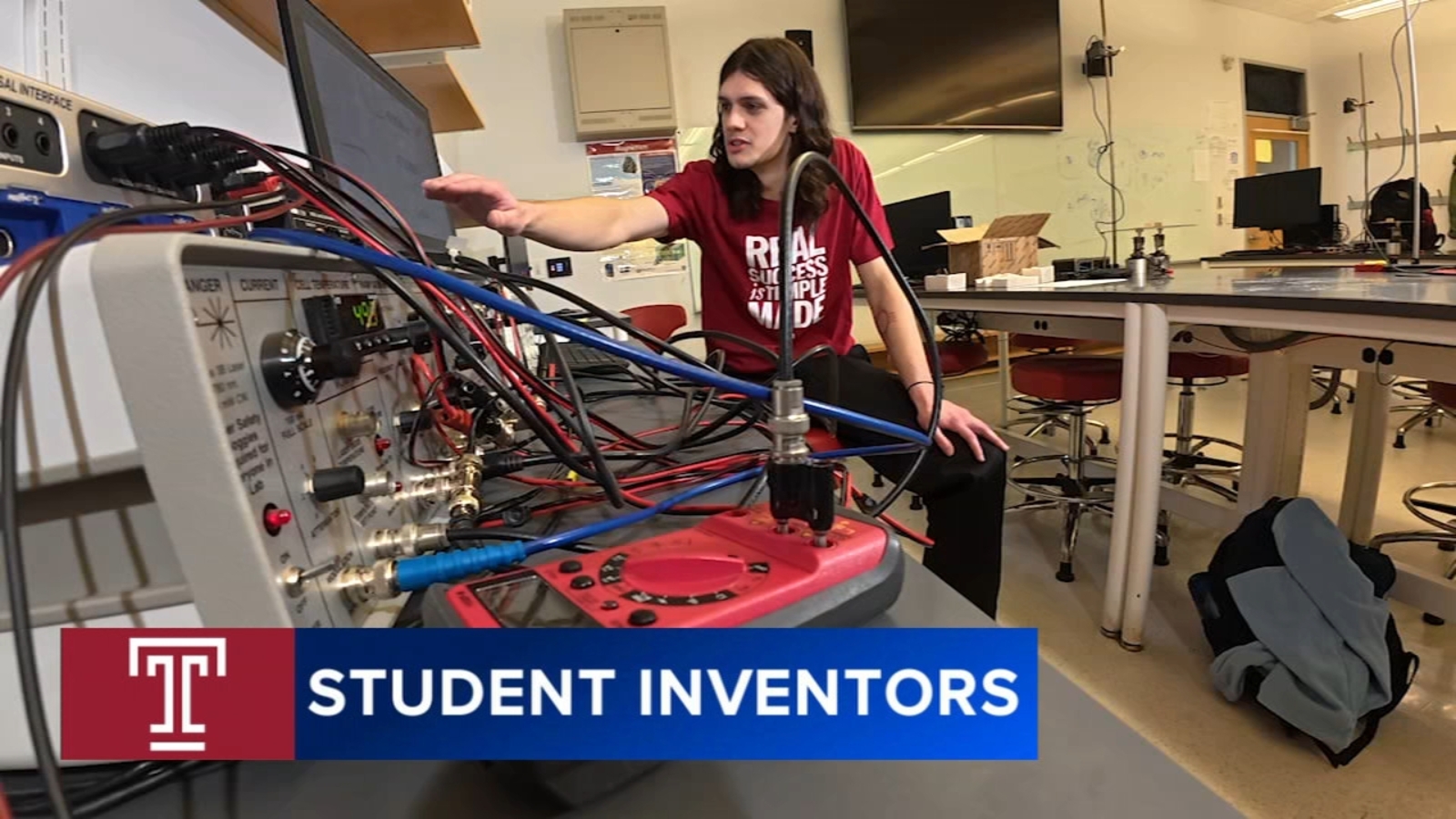
“This is called an optical magnetometer. It’s a thing that detects magnetic fields,” explains Ben Maitre, a physics major and junior.
“I’m designing porcelain corals that we can implement for deep-sea coral restoration,” notes Eva Close, a senior who is a biology major and art minor.
Eva merges biology with art.
Both are Temple Diamond Research Scholars, undergrads doing groundbreaking research normally reserved for graduate students.
Ben’s goal is a low-cost, mobile device to detect early-stage lung cancer without radiation.
“The tumor needs more blood than the surrounding healthy tissue. We can make the blood release a magnetic field, and then this device can detect that field,” he says.
The scholars work with collaborators and mentors across Temple and beyond. That can even include other institutions.
Ben’s partners include Temple Health cancer experts.
“What’s often surprising to our scholars is the degree to which folks are interested in helping them,” says associate vice provost Emily Moerer, who oversees the program.
Moerer says the 7-month program “really gives the scholars enough time and space to develop a significant body of work.”
It also helps develop students’ research skills, with a strong emphasis on communications.
Top Stories
“We focus on communication and their ability to communicate with each other and communicate their highly complex projects to an educated but non-specialist audience,” she says. “That is really critical in being able to translate this research and this work to a broader audience.
Support from faculty collaborators is also key.
“They foster that mentoring relationship and they also develop critical skills in our students that we know are in demand of employers, things like creativity, dealing with ambiguity, collaboration, problem-solving, and communication skills,” Moerer says.
Eva’s idea came from a love to create: “I’ve been taking ceramics classes since I was really little.”
And seeing news of the catastrophic Deepwater Horizon oil spill when she was 5.
Her biology lab was already trying to restore coral there.
“They had tried ceramic in the past and it didn’t work. And so I brought to them the idea of using porcelain,” Eva says enthusiastically.
Coral branches are made in a mold, then embedded in a concrete base.
The concept is already in tests.
“We have one in the Gulf of Mexico. It’s about 100 miles off the coast of Louisiana,” she says proudly.
And they’ll go back to the Gulf next year to see if coral has attached to those branches.
Temple has 16 Diamond Research scholars this year, each working on equally unique projects.
Copyright © 2026 WPVI-TV. All Rights Reserved.