
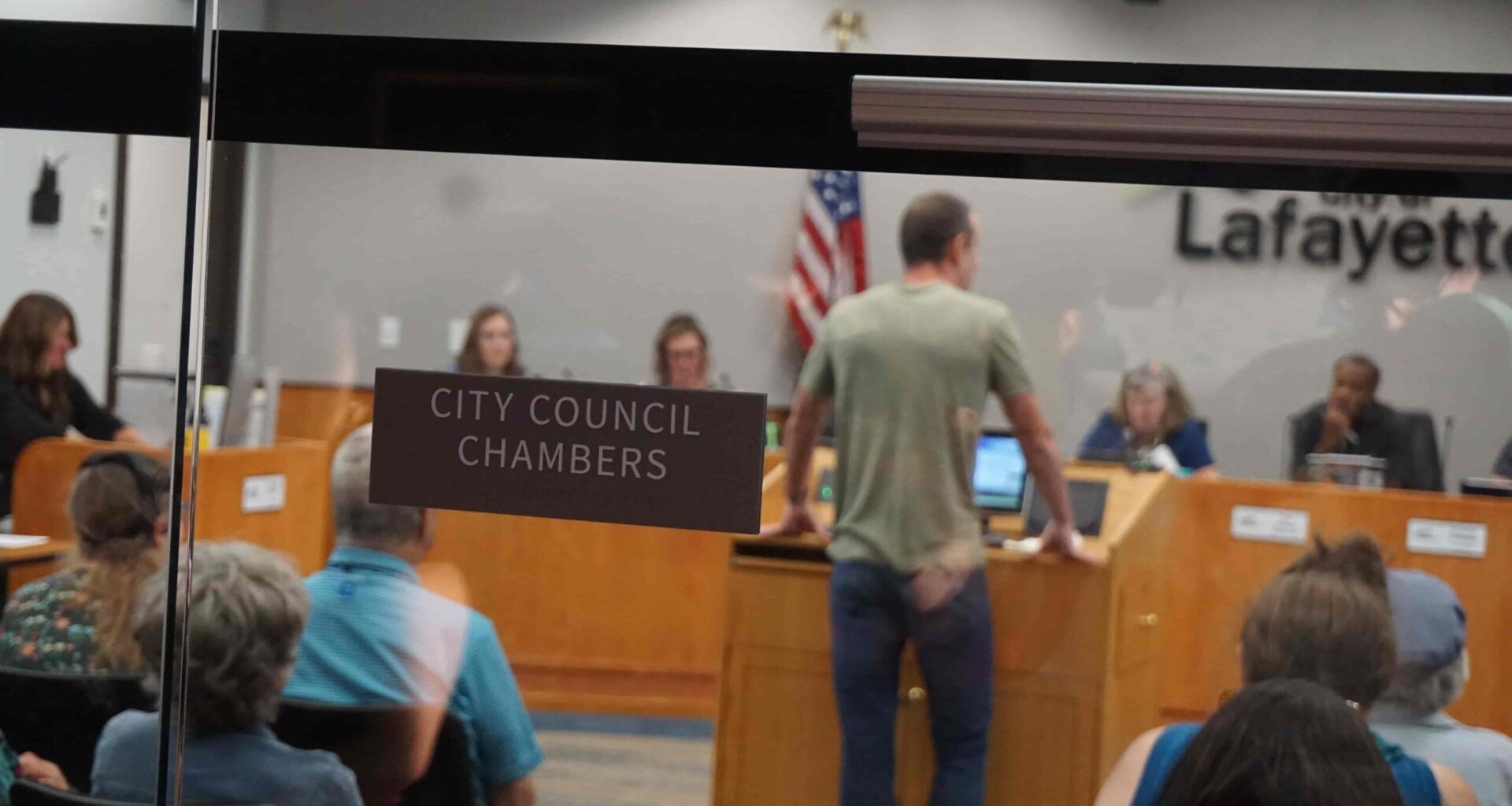
Featured photo: Michael Watson addresses the Lafayette City Council during a town meeting on October 6, 2026.
Concerned community unites to DeFlock Lafayette
Dozens of concerned community members filled Lafayette City Hall on Tuesday, Oct. 6, packing the chamber to voice opposition against funding for Flock Safety cameras.
The crowd gathered to debate the city’s 2027 fiscal plan, which hinged on two competing proposals: Resolution No. 2026-24A, which retained funding for the Automatic License Plate Readers, and Resolution No. 2026-24B, which struck the surveillance technology from the budget.
Twenty-six attendees took the podium during public comment, unanimously speaking out against renewing the city’s contract with Flock Safety. Although the speakers expressed deep respect for the Lafayette Police Department, their stance remained incisive and unyielding regarding the intrusive reach of the cameras.
Among the vocal opposition, resident Preston Padden captured the room’s sentiment concisely: “We’re private citizens. We deserve a degree of privacy, and if you want to break that, you need a warrant.”
Resident Sean Campbell criticized the continuous logging of vehicle movements as “clearly indiscriminate, unconstitutional mass surveillance.” Campbell emphasized the rare solidarity forged by the controversy, noting it was powerful that “in a time where people are so divided, this seems to be an issue that both sides of the aisle, peoples of all walks of life, are agreeing on.”
Speaking as a community member, former Mayor of Lafayette Jamie Harkins emphasized that current safeguards built into the Flock contract apply to searches by Lafayette officers, not searches by officers from other areas.
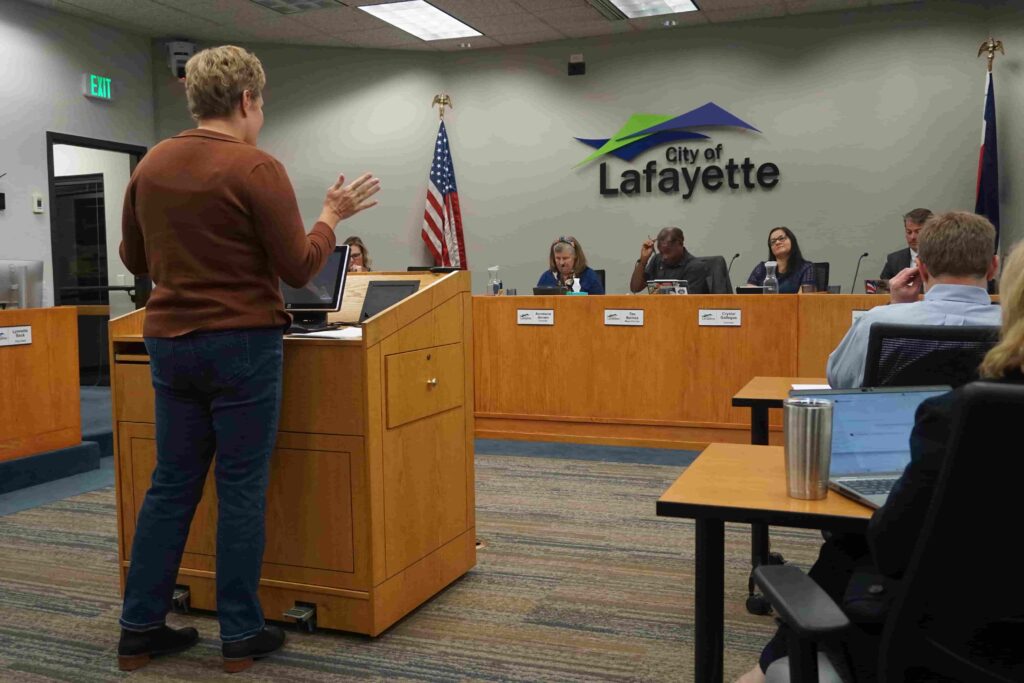
Jamie Harkins talks about Flock Camera safeguargs during public comment in a Lafayette City Council meeting on October 6, 2026.
Harkins noted a recent case in Sarasota, Florida, where tips from a USA TODAY reporter led to the Sarasota Police Department firing and arresting Officer Cory Waiters. In this case, the camera’s safeguards did not flag Waiters repeatedly searching for his ex-partner’s license plate as unusual activity, and USA TODAY’s tips made the police department aware of the activity.
Finally, Kiah Murray, an Emotionally Driven Cognitive Divergence (EDCD) instructor at Wild Sun Behavioral Services, recounted her own personal harrowing incident with Flock. Lafayette’s Flock cameras repeatedly misidentified another woman’s vehicle as stolen. The mistake culminated in officers confronting the driver outside the school, in full view of her child, other neurodivergent students, and gathered families.
Such misidentifications reflect a growing national pattern driven by excessive reliance on automated surveillance. In a lawsuit reported by Gizmodo, Chrisanna Elser sued Colorado’s Columbine Valley Police Department after Flock cameras wrongly linked her vehicle to a theft suspect. Officers subsequently used the network to track her movements for an entire month: all without a warrant.
According to the complaint, the ordeal caused severe physical and professional trauma: Elser lost over 15 pounds, suffered stress-induced hair loss requiring medical treatment, almost faced administrative leave at her financial firm, and felt compelled to withdraw from a keynote presentation she had prepared for over a month.
Her case underscores the severe personal chaos and misplaced confidence these automated systems can unleash on innocent residents.
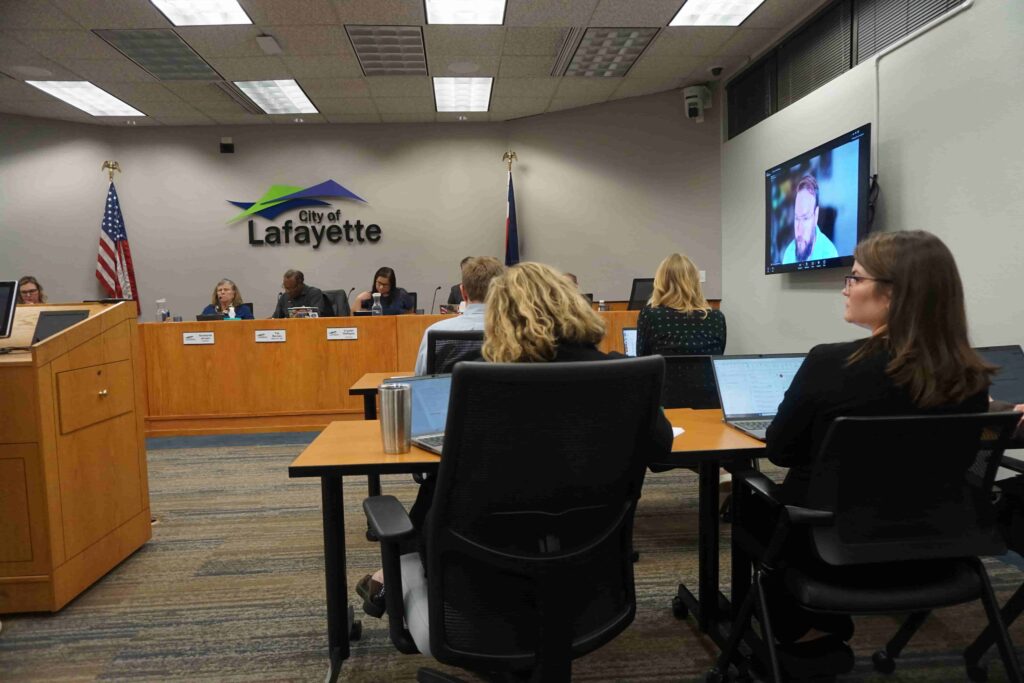
The Lafayette City Council listens during public comment in a town hall meeting on October 6, 2026.
Following public comment, the City Council acknowledged the community’s firm but respectful advocacy. Councilor Kyle Beaulieu directly addressed the audience:
“You’ve decisively said this is what you want. Zero people have written into the city to say keep Flock, so I think when you have such unanimity, it’s really important we execute on the ask.”
Beaulieu added, “We have clearly broken trust, so I think it’s really imperative on us to do what we can to restore trust and demonstrate to you, the community, that we’re listening to you and acting on your direction.”
Councilor Annemarie Jensen echoed the gratitude: “I have so much gratitude for how everyone has handled themselves tonight. It warms my heart that you get that about Lafayette, that we are the kind of community that respects one another.”
She also highlighted the immense turnout: “I spent a big hunk of my life as a community advocate, showing up at council meetings for all kinds of things, and I’ve never seen such a big turnout for anything that I have ever worked on.”
In a decisive 5-1 vote, the council passed the alternative budget that completely stripped funding for the Flock contract. Councilor Crystal Gallegos cast the sole dissenting vote, stating she required additional information to make an informed decision on the technology. Follow-up votes on Ordinances 18B and 19, formally codifying the 2027 fiscal allocations and omitting funding for surveillance technology, passed unanimously.
With this vote, Lafayette joins a growing roster of communities across the nation where residents are uniting to challenge unchecked municipal surveillance, reclaiming their rights and demanding a direct voice in how their neighborhoods are monitored.
Safety or surveillance? Erie residents question Flock cameras at town hall
Erie residents questioned the town’s use of automated license plate-reading (ALPR) cameras during a two-hour town hall on Oct. 8, raising concerns about privacy, data security, and the possibility of increased surveillance.
The discussion brought together Mayor Andrew Moore, Erie Police Chief Lee Mathis, Commander Mike Haefele and a representative from Flock Safety, the company behind the cameras.
Although police defended the technology as an important crime-solving tool, several residents called for stronger oversight and limits on its future use.
Erie currently operates 24 Flock cameras, which photograph vehicles and license plates as they pass. The system records the time and location of each image, allowing police to search for vehicles potentially connected to criminal investigations.
Although Erie has used the cameras since 2022, the town hall came amid growing scrutiny of Flock Safety across Colorado. Concerns about data privacy, information sharing with outside law enforcement agencies, and potential government surveillance have led several communities to reconsider the technology. Fort Collins, Steamboat Springs and Moffat County have ended their Flock contracts, while other cities have switched providers. Against this backdrop, Mayor Andrew Moore organized the forum to hear residents’ concerns and discuss how Erie uses its cameras.
Mathis told residents the cameras help Erie’s relatively small police force investigate crimes more efficiently.
The department has 26 patrol officers serving approximately 40,000 residents. According to Mathis, calls for service have increased by roughly 20% in recent years.
“We are a department that’s committed to transparency,” Mathis said. “We wanna show you what we use the system for.”

Erie Police Cmdr. Mike Haefele, left, Police Chief Lee Mathis, center, and Mayor Andrew Moore, right, discuss automated license plate readers during a town hall at Erie Town Hall in Erie, Colo., on Oct. 8, 2026.
According to information Moore shared after the meeting, in 2025 the system generated alerts involving 386 stolen vehicles, 27 missing persons, and 526 warrants.
However, alerts do not necessarily indicate separate crimes or arrests. Officers explained that one vehicle can trigger multiple alerts when it passes several cameras.
Mathis explained that the technology has helped identify hit-and-run suspects, recover stolen vehicles, and support a homicide investigation.
The department also reported that vehicle thefts had dropped by approximately 50% after the cameras were installed, though Mathis acknowledged that other factors could have contributed to the decline.
In response to privacy concerns, the department shortened its data retention period from 30 days to seven days.
Despite that safeguard, residents questioned whether the cameras collect more information than police need.
Several speakers said their concerns went beyond how the current police department uses the technology. They worried about what future town leaders, technology upgrades, or outside agencies might do with the information.
Erie resident Andrew Siemens questioned the department’s practice of reviewing its own camera searches and suggested using an independent auditor.
“I feel it’d be a lot better for somebody on the outside,” Siemens said.
Other residents raised concerns about cybersecurity weaknesses and whether Flock’s systems could be independently tested.
A company representative said Flock had addressed previously identified security issues and now uses external cybersecurity firms to evaluate its technology.
However, residents questioned whether those measures were enough.
One, Ben Hemphill, specifically challenged the comparison made between license plate readers and other technology, such as smartphones and doorbell cameras.
“I can opt out of Google. I cannot opt out of Flock to move around this town,” he said.
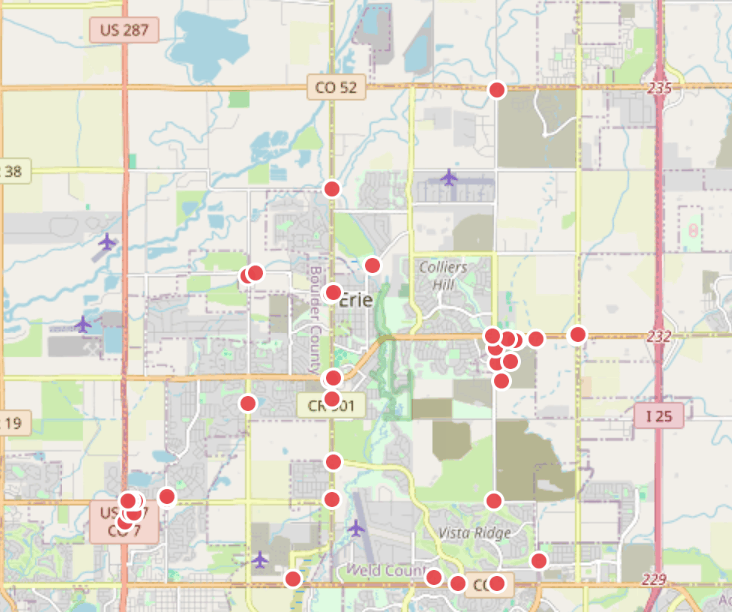
An interactive, community-maintained map shows reported Flock license plate reader locations throughout Erie. Not all cameras are operated by the Erie Police Department, which reported owning 24 cameras as of October 2026.
While the police department currently shares camera data with other Colorado law enforcement agencies, Mathis said it no longer participates in the broader nationwide network it previously used.
Mayor Moore said the meeting helped him better understand residents’ concerns, particularly the feeling of being watched even when no one is actively tracking them.
In an Oct. 8 Facebook post, Moore outlined three areas he believes deserve further attention: making camera locations and data practices more transparent, creating rules to prevent unchecked expansion, and exploring independent audits.
“Regardless of the data, access protections, and general safeguards, a few community concerns jumped out at me that need to be addressed,” Moore wrote.
He also suggested that future leaders consider policies limiting which surveillance technologies the town can purchase or use.
Moore is stepping down in November and encouraged incoming Mayor Appoint Brandon Bell and the new council to continue the discussion.
No formal decisions were made during the town hall.
The future of Erie’s Flock cameras could become part of the town’s upcoming budget and policy discussions.
Officials said approximately $67,000 remains in the proposed 2027 budget for the program, although the department does not plan to add cameras next year.
The town’s existing contract is expected to come up for renewal in 2027. Council could revisit funding or consider additional restrictions before then.
Officials also discussed adding questions about license plate readers to Erie’s 2027 community survey, which is expected to take place around March.
Residents can find more information about the cameras, including department policies and a transparency portal, on the town’s license plate reader information page.
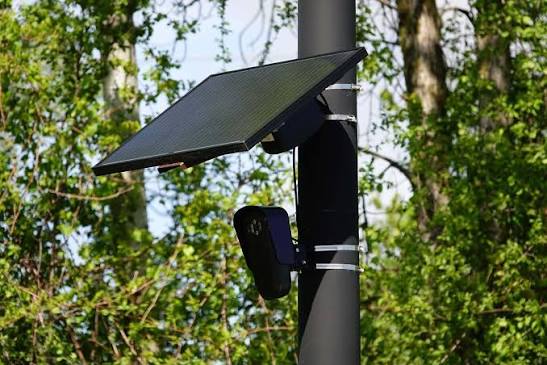
For now, Erie’s cameras will continue operating as the town weighs whether the public safety benefits outweigh residents’ concerns about privacy and surveillance.
The debate remains unresolved, but Moore said the community’s feedback should help guide future decisions.
“As I step down from office in November, I encourage the incoming council and Mayor Appoint Bell to act on the items above and continue the public dialogue to ensure the concerns are balanced with the benefits of safety in our community,” Moore wrote.
In today’s corporate world, finding true, honest journalism is getting harder, and that includes local news, too. From corporate takeovers to the nonprofit industry, finding reporters willing to ask the hard questions seems like a thing of the past.
Which is why Yellow Scene remains fiercely independent and never, ever accepts quid pro quo. We are only beholden to our readers, not funders.
The truth is, we really cannot do this without you. If you value our journalism, become a sustaining supporter for $8 a month. Your support keeps honest reporting alive and gets the hard copy delivered to your home.