
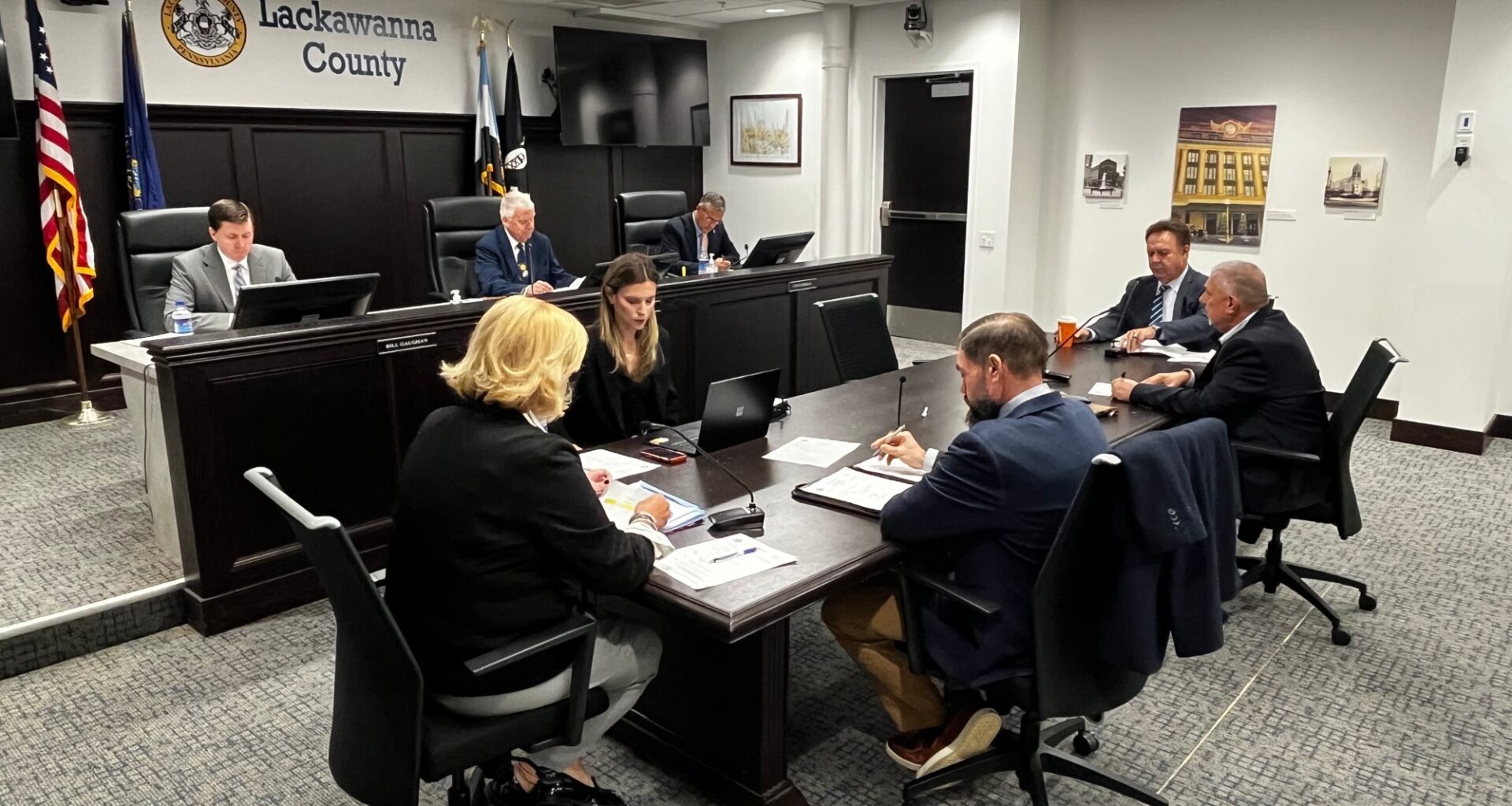
SCRANTON — Lackawanna County Commissioner Bill Gaughan asked the county’s financial consultants to review its roughly $190 million preliminary budget for 2027 and evaluate whether it’s consistent with the multiyear financial management plan they authored for the county.
Unveiled last week, the preliminary 2027 budget remains a work in progress but currently carries a roughly $4 million deficit that county Chief Financial Officer David Bulzoni said will be difficult to eliminate without raising property taxes. The draft budget does not include a tax increase, and Commissioners Thom Welby and Chris Chermak recently said they won’t approve a hike and further burden taxpayers after 2025’s increase of nearly 33%.
Gaughan hopes to avoid a tax increase too, but said Wednesday that objective “needs to be supported by a credible, sustainable financial plan.”
That’s why he requested the comprehensive budget review by PFM Group Consulting LLC, the firm the county engaged in 2024 amid a pronounced fiscal crisis marked by a massive structural budget deficit and other challenges. PFM’s work informed a number of sometimes painful yet arguably unavoidable steps county officials took in recent years to right the fiscal ship, including the precipitous 2025 tax hike that helped close the structural gap between budgeted revenues and expenditures.
But it’s a gap that’s reemerged as annual expenditure growth driven by increasing healthcare and pension costs, inflation and other factors continues to outpace growth in county revenues. Bulzoni said as much last week, noting budgeted expenses in the draft 2027 spending plan grew by more than $9.2 million compared to the county’s 2026 budget, an increase of 5.1%, while revenue from property taxes, the county’s largest recurring revenue source, is projected to increase by just $267,324, or 0.26%.
Officials were able to shrink the preliminary deficit to about $4 million from what was originally an almost $9 million projected shortfall through cuts and the factoring in of several nonrecurring revenue sources. And while they’re confident they’ll be able to shrink it further in the coming weeks, failure to bolster revenues through a tax increase or other means won’t solve the underlying structural deficit problem likely to compound in future years if unaddressed.
In the multiyear financial management plan it crafted for the county, PFM recommended commissioners consider regular, incremental tax increases to keep pace with expenditure growth. Bulzoni echoed that recommendation last week, warning the county’s 2028 budget “will also arrive with a built-in deficit.”
Gaughan said Wednesday he recently asked PFM a “very straightforward question: Does this budget keep Lackawanna County on the path of long-term financial stability, or are we beginning to drift back toward the problems of the past.”
He specifically wants PFM to evaluate whether and to what extent the draft budget aligns with the county’s longer-range financial management plan and whether the budget’s financial assumptions are sustainable. He also asked the firm to examine the county’s use of one-time revenue sources, review areas where county operating costs significantly escalated, “identify realistic opportunities to control spending without compromising essential county services” and provide updated financial projections for 2028 and 2029, “including what our anticipated deficits would look like if all things remain equal.”
Work on the preliminary budget will continue prior to final passage later this year, and anything PFM provides could inform future revisions and adjustments.
Chermak said officials are “looking at everything” as they work to further curtail expenses and close the deficit gap, with Welby echoing a similar sentiment.
“There’s a lot of work that our team … has been doing, as well as our departments, to come back to us with some more modifications that will hopefully eliminate that deficit or bring it down to a manageable number,” he said. “There’s a lot of work that has to be done with that yet, and there’s a lot of work that will be done with that as we move forward.”
Welby also encouraged residents to provide input at any of four public budget hearings the county will hold starting next week. The first hearing will take place Tuesday at the South Abington Twp. Municipal Building, 104 Shady Lane Road, beginning at 6 p.m.
Subsequent hearings are scheduled for Oct. 29 and Nov. 5 at the Dickson City and Spring Brook Twp. municipal buildings, respectively, with both beginning at 10 a.m. The final hearing will be held Nov. 9 in the fifth-floor conference room of the county government center in downtown Scranton, also beginning at 10 a.m.
Gaughan said he’ll carefully review any budget analysis PFM provides and share relevant information with the public.
“My goal is … to make sure decisions being made are based on sound financial analysis, accurate projections and a clear understanding of their long-term consequences,” he said. “Balancing the 2027 budget is one very important responsibility. Making sure that budget doesn’t create a larger problem in 2028 or 2029 is just as important.”