
Monday started out as one of those cold, dreary Pittsburgh Mondays that you have to plod through as if it were sticky and slick with mud. The previous night’s Steelers’ game, a loss, made it worse. Yinzer folks were certain to be groggy and grouchy.
By 9:48, Zack Tanner had dragged himself out of bed and begun getting dressed. While putting on his shoes, he heard a buzz. His phone. He’d placed it on the couch. He looked down at the screen. Joe Pass was on the line. Tanner is past president of the Newspaper Guild of Pittsburgh; Pass serves as the guild’s attorney. The two have had a lot of phone conversations because the union’s members have been on strike against the Pittsburgh Post-Gazette for more than three years.
Tanner picked up the phone. “What’s up, Joe?”
“Praise be,” Pass said calmly.
“Praise be, what?” Tanner was confused.
“It’s over,” Pass said. “We won.”
Four minutes before placing the call, Pass received notification that the U.S. Court of Appeals for the Third Circuit had denied the newspaper’s appeal of a National Labor Relations Board decision in favor of the strikers. This was a big win for the workers and the end of the line for the Post-Gazette’s attempts to overturn earlier decisions.
The conversation ended quickly. Tanner had much to do in the next few minutes. The striking workers meet online every weekday at 10 a.m. to check in with each other and go over organizing tasks. It was a perfect time to share the good news. At 9:58, Tanner sent out a message to all strikers: “Everybody come to this morning’s meeting.”
Moments later, those logging into the guild’s Zoom account heard a song blaring over their computer speakers and headphones: “Celebration” by Kool & the Gang. It was a hint, and not so subtle. This is the day the strikers had been waiting for.
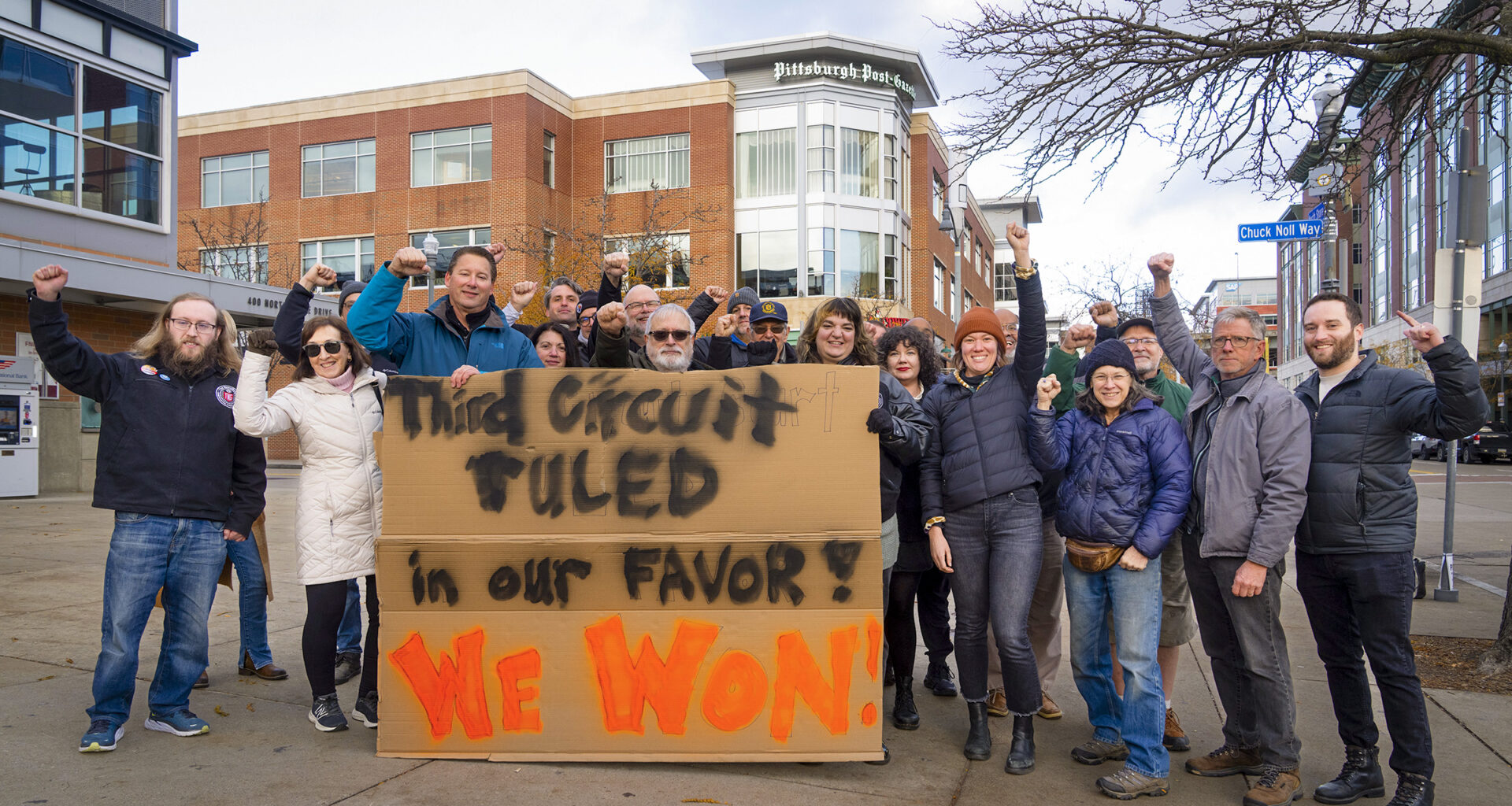
Rick Davis, a striking sports editor, took the news calmly and stoically. He’s not an excitable guy. But his wife, Katrina Pyo, realizing what had happened, sprung into action. She grabbed a few cans of spray paint and a large piece of cardboard, took the items outside and quickly created a sign. “Third Circuit Ruled in our Favor,” it read. “We Won!” She placed the sign in the front yard for the benefit of all those neighbors who ask, “How’s the strike going?”
Andrew Goldstein had stayed up late watching the Steelers’ loss and was rubbing his eyes when Tanner’s message about the meeting popped up on his phone.
“Is this real?” he wondered. Goldstein took over as guild president 10 days earlier. He hopped into the meeting and joined Tanner in answering questions, discussing next steps and organizing a gathering on the North Shore later in the day.
As soon as the meeting ended, around 11 o’clock, he bolted from his apartment on Forward avenue in Squirrel Hill, darted across the street and sprinted through the lawn of Allderdice High School. Goldy, as he’s known by his fellow strikers, hasn’t shaved or cut his hair since the strike’s beginning, so his long locks and beard blew in the wind.
“It was a perfect scene,” he recalled later. “There was a burst of sun and these golden leaves from big beautiful trees falling around me.” He crossed Shady Avenue and pounded on the front door of a two-story brick home. His grandparents’ home. “Come in,” a voice called out.
Goldy entered. Inside sat his great aunt Sylvia. Every day Sylvia asks about the strike. Goldy never had any news. Today was different. Goldy raised his arms and announced, “We won!”
***
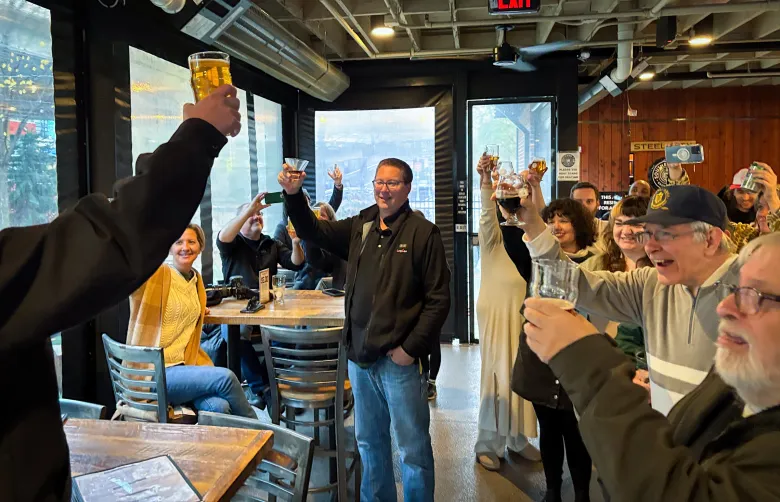 Post-Gazette strikers toast their victory on the North Shore on Monday, Nov. 10, 2025. (Steve Mellon/Pittsburgh Union Progress)
A few hours later, the strikers gathered on the North Shore to commemorate the historic day with a group picture in front of the Post-Gazette building. Davis brought the sign his wife had made, and the two of them held it high in front of the PG’s third-floor newsroom so any peering managers would see.
After a few photographs, the strikers walked down the street to a bar to toast their big day. Goldy did the honors. He kept it short and to the point.
“You all know how grateful I am to all of you and to everyone’s families,” he said. “The sacrifices you’ve made. You’ve gone above and beyond what anyone could ever ask for. So, I just want to say cheers to the strikers. Cheers to the Newspaper Guild of Pittsburgh.”
Afterward, the strikers gathered in small groups, sipped on drinks and tried to process all that had happened the past several hours. How was a historically long strike supposed to end? No one knew. The announcement at the morning meeting seemed to stun everyone.
“I was literally speechless,” said photographer Pam Panchack, who sat at the bar next to her colleague and fellow photographer Allie Wimley. “I couldn’t believe a decision had finally come down.”
“It was hard to celebrate,” Wimley added. “We’ve had a lot of false alarms, so it took a while for me to realize this is a real thing.”
Natalie Duleba, standing nearby, agreed. A member of the guild’s executive committee, she remembered the union’s first bargaining session after the strike’s beginning. The union’s bargaining committee sat across from attorney Richard Lowe, who represented the Post-Gazette. Veteran negotiators who’d dealt with Lowe in the past told Duleba the sessions would be difficult. The PG’s position never changed, no matter what concessions were offered by the guild.
“I was like, ‘No, we’re on strike now, it’s going to make a difference,’” Duleba said. “And that feeling lasted, I don’t know, 30 seconds when the bargaining with Richard Lowe actually started.”
The sessions proved fruitless. Then, in late January 2023, an administrative law judge handed the strikers a victory by ruling the PG failed to negotiate in good faith, illegally imposed working conditions and unlawfully surveilled workers engaged in union activities. The newspaper, the judge ruled, must rescind the unilateral working conditions it had imposed and restore the union’s previous contract.
This ruling generated a lot of excitement among strikers. It seemed then the strike would soon end. But the PG appealed the ruling and the strike continued. More than a year and a half later, in September 2024, the five-member National Labor Relations Board in Washington, D.C., affirmed the administrative law judge’s ruling. Again, the PG appealed and the strike continued. Now, however, the newspaper is running out of appeals. (A story it published by the Post-Gazette on Monday night quoted a statement saying, “We will appeal to the full Third Circuit Court of Appeals.”)
“So even though this is the end of the line legally for them, I think that we’ve all been trained to just hold our breath and just make sure that it’s actually happened before we celebrate,” Duleba said.
Striker Erin Hebert understood, then offered a “but.”
”I think we’re all hesitating to celebrate too much because we feel like the other shoe might drop,” she said. “But there’s no shoe coming. There’s none left. They’re out of shoes.”
Davis, the sports editor, couldn’t help himself – he compared the current situation to a sporting event.
“I’ve been in sports all my life and until I see zeros on that clock on the scoreboard, the game’s not over,” he said. “I apologize for the sports analogies, but, you know, we might be up 30 points with less than a minute to play, but there’s still a minute to play. You know, for the past three years, we have allowed ourselves to celebrate and enjoy every victory along the way. But then after two months after that victory, we’re still on the strike and we’re saying, ‘OK, what next?’ I’m waiting for that scenario. Is it PTSD? Probably. But I just can’t get excited until I see that there’s no time left on that clock.”
Striker Tyler Pycena stood across from Davis, nodding his head. For him, it took a while for the news to settle in. Now he was allowing himself to smile. “It’s really inspiring to hear this verdict,” he said. “We held a company that tried to break federal labor law to account. We did not allow our employer to just trample on us. When that sinks in, you can smile.”
Panchak saw the victory as a win for all workers. She thought about all the other workers who’ve organized their workplaces the past few years, and those who’ll do so in the future.
“I’ve always insisted that this strike is about baristas, it’s about nurses, it’s about all workers who are exploited for the benefit and profit of a larger corporation,” she said. “Most folks don’t want to be millionaires. They just want to work eight hours a day, get their paycheck, have their vacation, have their health care, and just have just a normal life. They don’t want to work 12 hours a day like those tech nuts do. I mean, Elon Musk thinks 12-hour days should be the thing now. He thinks you should just sleep in your office.”
When Wimley first came to Pittsburgh to work at the Post-Gazette, she thought she’d be in the city a few years, then move on – and that would be the pattern of her journalist’s life, jumping from one job to another, one city to another. She thinks differently now.
“I moved here, and I’ve fallen in love with Pittsburgh,” she said. “I’ve made Pittsburgh home, and I don’t want to leave. And I think that’s, like, something that should just be normal, that you can stay in one place.”
The Third Circuit’s decision was a step toward creating working conditions and compensation that make staying possible.
News of the court’s decision released a flood of emotions for Hebert. She logged into the morning’s meeting a few minutes late and “when I realized what was happening, I just broke down crying for about 30 straight seconds,” she said. “I had my head in my hands, and was full-body sobbing when it hit me.”
All day, her emotions had been bouncing between shock and joy. “Slowly, the weight of the past three years is finally starting to lift,” she said. “It’s really overwhelming. It’s still kind of hard for me to get my thoughts straight about it.”
Hebert is co-chair of the guild’s Health and Welfare Committee, which is charged with making certain strikers have the resources to pay their bills, and have access to health care. She’s been moved by the connections strikers have forged with each other the past three years. Those connections will pay off in the weeks ahead, as the strikers return to work at the Post-Gazette.
“We’re going to go back in there with all of this collective strength from the fact that we’ve stuck together,” she said “We’ve worked through many disagreements on strategy, we’ve had conflicts and all of the things that could possibly happen when you have an institution that’s run by humans.”
The strike, she said, required workers to assume “a baseline radical honesty.”
“You have to be honest with yourself and also with whoever you’re organizing with about your strengths, your limitations, what you’re going through. We were forced to be very vulnerable with each other early on.”
Davis thought about those days when the weight of the strike seemed overwhelming. It was tempting, in those times, to call it quits.
“I guarantee you, every one of us probably thought about it at least once a day,” he said. “When you look at your financial situation, when you look at what it’s doing to you and your family. If you didn’t think about it, there was something wrong.
“But now we can hold our heads high. We did the right thing, and nobody can take that away from us. Not the scabs, not management, not the Blocks. Nobody can say what we did was wrong because we have federal judges who are agreeing with us. We have the NLRB who agreed with us. Everybody along the way agreed with us.
“So anything from this point on, in my eyes, is gravy. Because we did it, we stood tall, we’re standing tall, and we can be as proud as hell. “
Pycena was thinking about the strike supporters, all those people who voluntarily joined strikers picket lines — often at ungodly early morning hours and in wet, cold conditions — and who donated money and time. This was a strike of T-shirt sales, fund-raising phone calls, bake sales, pleas for funds from the guild’s parent union, the Communications Workers of America, which stepped up with a large donation. Strikers spoke regularly at meetings of the Allegheny/Fayette Labor Council, and members stuffed bills into the guild’s bucket.
“Honestly, this would not have happened without people actually giving a shit about us,” Pycena said. “We couldn’t just do it ourselves. It literally would not be financially feasible. So we’ve had people not just give a shit about us morally, but they put their money where their mouth is and helped pay for rents and emergency car bills, they helped when people’s furnaces broke down in the winter, when their air conditioning broke down in the summer. Without them, we could not have made it. This is everyone’s win.”

Steve is a photojournalist and writer for the Pittsburgh Post-Gazette, but he is currently on strike and working as a Union Progress co-editor. Reach him at smellon@unionprogress.com.