
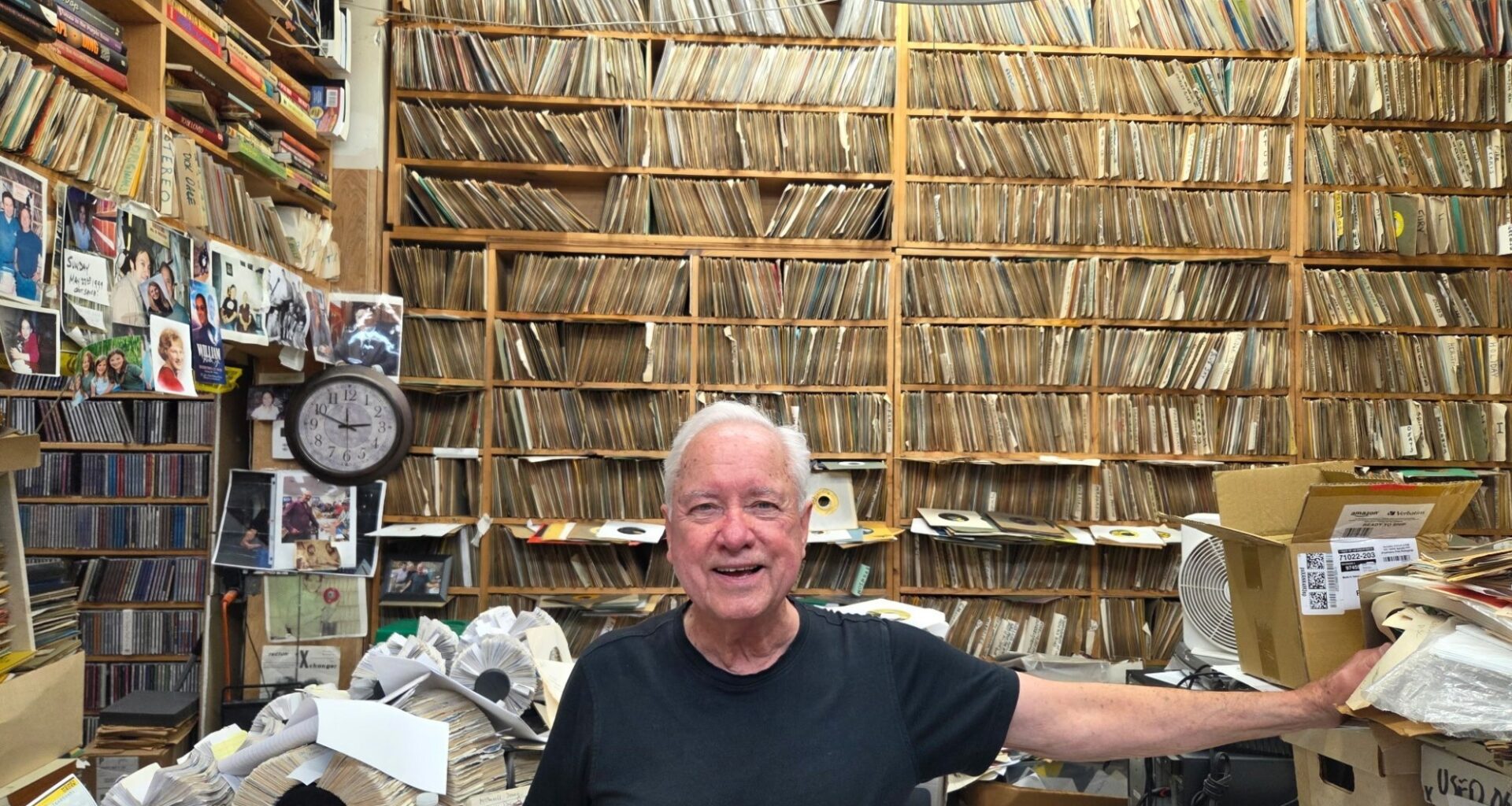
UPPER DARBY — For Val Shively, a rare record is never just a rare record. It is a piece of musical history, a connection to an overlooked artist and, often, the beginning of another story.
The legendary owner of the iconic R&B Records in Upper Darby has spent more than 60 years building a life around music. His shop is packed with millions of records, while his private collection of more than 11,000 rare 45-rpm singles represents a lifetime passionately devoted to music, especially the vocal-group harmony music of the 1950s and 1960s.
Now, Shively’s extraordinary personality, his vast knowledge of music and his questions about what will become of his collection are at the heart of “Recollections: Val Shively and 50 Years of Collecting Records in Philadelphia,” a documentary directed by Christopher Plant and executive produced by Chris Fralic.
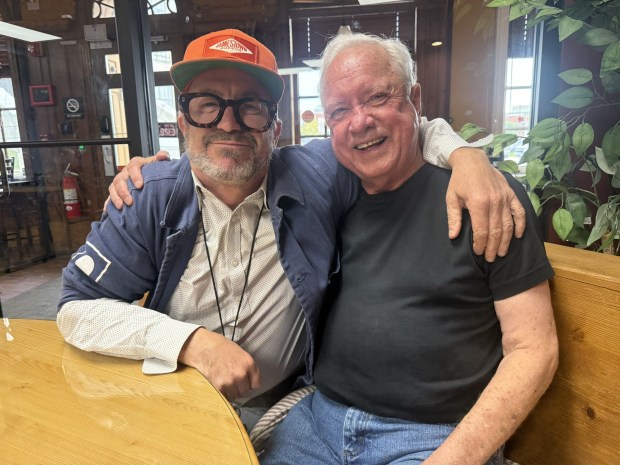 In an interview this week, Filmmaker Christopher Plant, left, and record collector Val Shively discuss “Recollections: Val Shively and 50 Years of Collecting Records in Philadelphia,” the documentary about Shively and his lifelong passion for vinyl records. The legendary Upper Darby record dealer’s decades-long pursuit of doo-wop and musical history is the subject of a film screening on Oct. 29 at Jamey’s House of Music, with a post-film Q&A featuring Shively and Plant. (PEG DEGRASSA/ DAILY TIMES)
The film will be screened on Thursday, Oct. 29, at Jamey’s House of Music in Lansdowne, where Shively and Plant are expected to participate in a question-and-answer session following the screening.
Fralic, who financed the documentary project, is also listed among the expected guests for the event, which is hosted by Jamey Reilly of Jamey’s House of Music and Andrea DiFabio of Vinyl Revival.
The evening begins with kitchen service and happy hour at 6 p.m., followed by the film screening at 8 p.m.
Tickets are $10 in advance or $15 at the door. Online advance sales close at 5 p.m. on the day of the event. A portion of the proceeds will benefit the Delaware County Press Club.
The story behind the film reaches well beyond one night at a music venue. It is a portrait of a man whose lifelong obsession has helped preserve a largely hidden corner of American music history.
A transistor radio changed everything
Shively was 12 years old in 1956, growing up in Upper Darby with a mother who worked as many as three jobs to support the family and a father, he recalled, as spending much of his time fishing. Money was scarce. School was difficult.
Although he is now an inductee in the Upper Darby High School Hall of Fame, along with such luminaries as Tina Fey and Jim Croce, Shively, of the Class of ’61, said he often felt like an outsider while he was a student at the high school because he struggled academically and socially.
Shively quickly realized that music offered a pleasurable escape. Elvis Presley’s “Don’t Be Cruel” made a lasting impression.
“That record put me in a trance,” Shively recalled.
He carried his fascination with music everywhere, listening to Little Richard, Jerry Lee Lewis and other artists on an Emerson transistor radio that he kept close, even under his pillow at night.
A few years later, while studying at Pierce School of Business Administration in Center City, his interest deepened into an obsession. Radio personality Jerry Blavat’s broadcasts introduced him to unfamiliar vocal groups and records he felt compelled to track down.
Shively became particularly devoted to doo-wop and group harmony: music by vocal groups, many of them Black artists, whose recordings never reached the commercial success of the best-known acts of their era. He took a job at a center city record store, where he made $1 an hour, trading his salary for credit to buy more records. He then spent a decade working for a record distributor.
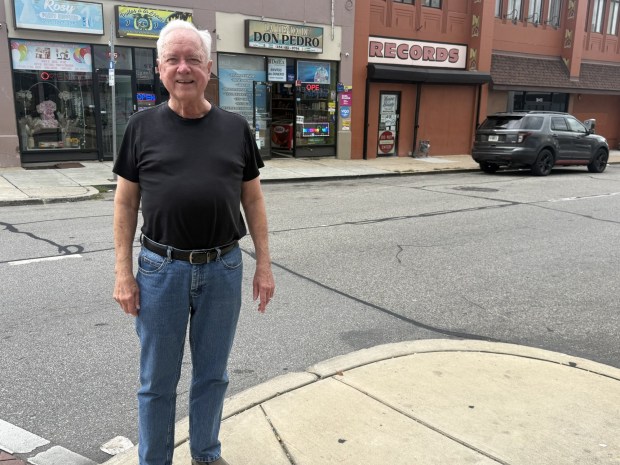 R&B Records owner Val Shively stands on the street corner outside of his unique store in Upper Darby. Shively is known around the world as the king of vinyl. (PEG DEGRASSA/ DAILY TIMES)
He began selling records he already owned to finance the purchase of others.
He traveled to New York and searched record shops throughout Philadelphia, Chester and Camden, buying from collectors, jukebox operators and radio stations. He learned to recognize labels, singers, groups and recordings that other people might have overlooked.
“I had to have these records, and learn everything about them,” he said.
The pursuit became the organizing principle of his life.
After a period living in Kentucky with his family, Shively returned to the Philadelphia area on July 4, 1964, determined to be near the music and the people who shared his passion. He began selling records by mail, developing a customer list and building a business around the recordings he loved.
His mail-order operation began in 1966. He eventually opened R&B Records in 1972, creating a business that would become known among collectors around the world.
A record store unlike any other
R&B Records, 49 Garrett Road, is widely regarded by devoted collectors as one of the world’s great record stores. Its inventory is estimated at 4 million to 5 million records, including 45s, LPs, 12-inch singles, cassettes and CDs spanning doo-wop, rock ‘n’ roll, Latin, pop, garage, punk, reggae, gospel, instrumentals and many more.
The shop carries original pressings and reissues, along with picture sleeves, company sleeves, artist photographs and other memorabilia.
Shively’s specialty remains vocal-group harmony, but his knowledge extends across genres and decades.
His private collection is a different matter.
It consists of more than 11,000 rare, mostly pristine 45-rpm records from the 1950s and ’60s, a collection considered among the finest of its kind. Individual records can be worth thousands of dollars, with the rarest reportedly valued as high as $15,000.
The store operates according to Shively’s own rules. Casual browsing is discouraged, and customers are not free to handle records. The rules reflect a lifetime spent protecting records that can be difficult or impossible to replace.
Shively has a reputation for being blunt and sometimes gruff, but his devotion to customers who share his interests is equally central to the business. He personally handles orders, examines and cleans records, packs shipments and often adds a personal note or an extra item for a collector.
His mail-order customers include people in the United States and strongholds of record collecting such as Japan and England. He also keeps decades of contacts close at hand, with a counter surrounded by old-school Rolodexes.
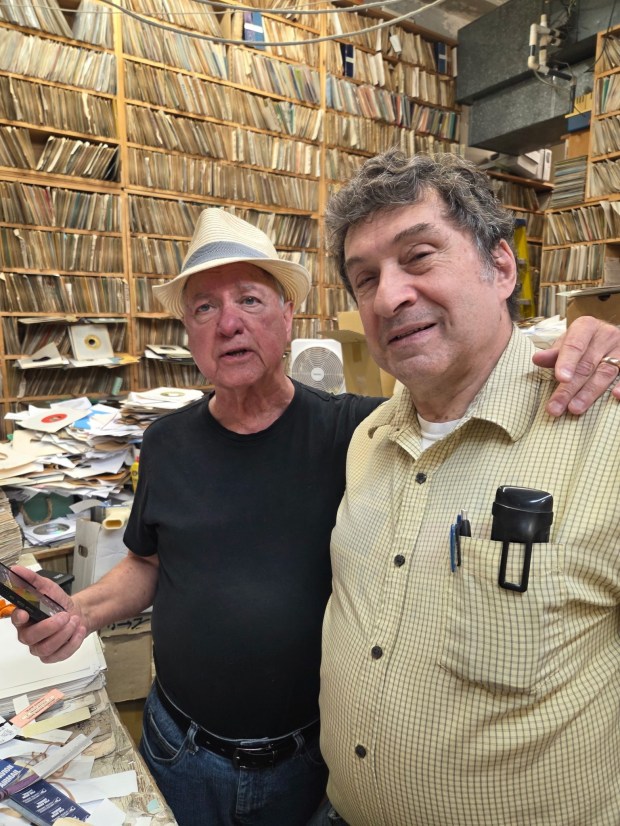 R&B Records owner Val Shively, left, with Chuck Dabagian, who has worked at the record store in Upper Darby since 1978. Shively credits Dabagian with keeping the inventory in order and knowing where to find the various records needed by customers. He also mails out orders, answers the phone and does many other tasks in the store. (PEG DEGRASSA/ DAILY TIMES)
Chuck Dabagian, who has worked full-time for Shively since 1978, helps keep the enormous inventory organized alphabetically by label and artist.
For Shively, the collection is not simply about accumulating objects. It is about knowing what they are, who made them and why they matter.
That knowledge is one reason the film’s preservation message is so important. Shively holds stories and information about obscure performers and recordings that may not exist in any other readily accessible form.
From a podcast idea to a documentary
The film took root with Fralic, a venture capitalist, partner at First Round Capital, and vinyl enthusiast, who became intrigued by Shively and his collection.
Fralic had encountered the story of Questlove, the Philadelphia-born musician and Roots drummer, and his early experiences at Shively’s shop. Questlove’s connection to the store helped illustrate how a place devoted to obscure records could influence musicians and music scholars whose work reached far beyond its walls.
Fralic, who has also been associated with the record-collector book Dust & Grooves by Eilon Paz, wanted to document Shively and his musical legacy. He first visited R&B Records in 2021.
“I couldn’t believe how packed it was,” Plant said Fralic told him about the shop.
Fralic initially approached Plant, owner of Kismet Cowork in Philadelphia, about creating a podcast about Shively’s collection. Plant, a Philadelphia-based producer whose work has included podcasts for institutions such as the Franklin Institute, had experience in audio and media production but had never directed a documentary film.
Plant arrived, expecting to record a conversation lasting perhaps an hour or an hour and a half.
“That first day was supposed to be a 60-to-90-minute conversation, but it turned into five hours,” Plant recalled. “I’m obsessed with music, so I was excited to learn about and shine a light on Val’s collection.”
The shop, Shively’s personality and the visual world surrounding the records quickly convinced Plant that an audio project would not be enough. He proposed making a film instead, and Fralic agreed.
Plant’s first visit yielded more than three hours of footage, much of which became part of the finished documentary. He said Shively is most compelling in his own environment, where he can speak freely and move among the records that have defined his life.
“I quickly recognized that Val is most effective when he is unleashed,” joked Plant.
Plant said he and Shively hit it off almost immediately and have developed a friendship as a result of the film project.
“Almost as soon as I met Val, we clicked,” Plant shared. “He’s a character. Our friendship formed effortlessly.”
Shively is an interesting man, beyond his incredible music collecting that prompted a 12-page article about him in the July 2021 Smithsonian Magazine.
Life-changing event
Despite his international fame as a record collector and his enormous commercial success with R&B Records, the Upper Darby resident, felt something was missing in his life back in 1999.
He looked out his door and saw a church, went in and soon accepted Jesus Christ in his life and was baptized.
“Before I received the Lord, I worshipped money and its power,” Shively shared. “I thought possessions gave you happiness and that’s probably why I was everything but happy.”
Shively said that he now has a heart full of love and gratitude to God for all his blessings. God is the center of his life, and he couldn’t be happier. He includes a flyer, with the story of his conversion and acceptance of Jesus Christ in his life, with every record order that he sends out, hoping to give the same gift of a fulfilled heart to someone else.
The documentary captures Shively’s serious side, his humor, his idiosyncrasies and his sometimes prickly manner, but it also explores the vulnerability beneath the public persona: A man who found belonging through music and now wonders what will happen to the legacy that he has spent a lifetime assembling.
Shively’s wife Patty, is another important presence in the documentary. The couple married in 1990 after a 20-year relationship, and she offers a view of the man beyond the record-store counter.
The documentary has evolved through several versions and screenings, including presentations at the Rock & Roll Hall of Fame, Drexel University, Philadelphia’s Fitler Club, the Long Island Film Fest, and the Franklin Institute. A longer version premiered under the Franklin Institute’s Grand Dome in 2025.
In December 2025, Fralic donated the film to the Rock & Roll Hall of Fame Library and Archives, where it is preserved in the institution’s permanent physical collection. The full documentary is also available to watch through the Rock Hall’s website.
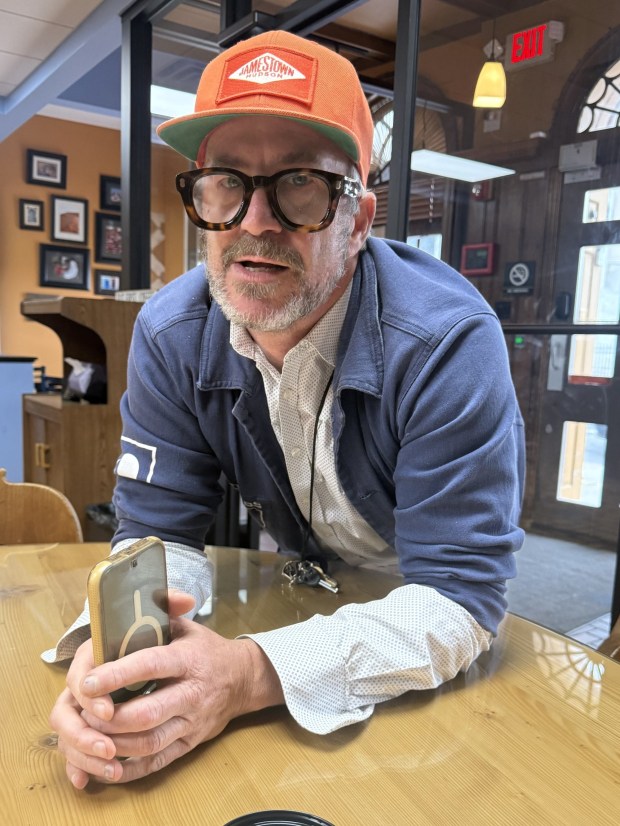 In a recent interview, filmmaker Christopher Plant, of Philadelphia, talks about how the documentary “Recollection: Val Shively and 50 Years of Collecting Records in Philadelphia,” is more than just the story of Shively’s life-long passion for music. It’s about finding a way to preserve a unique and historically important collection for generations to come. (PEG DEGRASSA/ DAILY TIMES)
Preserving more than the records
The Rock & Roll Hall of Fame and the Library of Congress have expressed interest in Shively’s cultural legacy and the significance of his private collection.
For Plant and Fralic, that interest underscores the larger purpose of the project. The goal is not simply to celebrate an unusual businessman or a remarkable record store, but to encourage the long-term preservation of the collection and the knowledge attached to it.
“We will continue the campaign of future stewardship of Val’s collection, which is the crux of our film,” Plant shared.
The self-taught film director has made over 1,500 podcasts throughout his career, winning the “Best Podcast in Philly” award in 2021, so his transition to making a documentary film wasn’t all that difficult, he said. It was like telling a longer version of a good story.
Shively’s records document artists and musical traditions that might otherwise be forgotten. His recollections help supply the context: the names, connections and histories that turn a stack of old singles into a record of American musical life.
The documentary also reflects Shively’s own awareness that a lifetime of collecting raises an inevitable question: What happens to all of it when he is no longer there to explain it?
That question gives the film an urgency beyond nostalgia.
Vinyl has returned to popularity, and younger DJs and producers continue to search for rare sounds that can find new life in mixes, performances and recordings. But Shively’s most important audience may include future researchers and listeners who have yet to discover the music he has spent decades preserving.
Upper Darby resident Val Shively, the subject of the documentary “Recollections: Val Shively and 50 Years of Collecting Records in Philadelphia,” at the door of R&B Records, where over 4 million records, mostly 45s, are housed. Shively fills orders in his unique shop that come in from around the world. (PEG DEGRASSA/ DAILY TIMES)At 82, Shively remains deeply engaged with the records and the stories behind them. His shop may be known for its strict rules and his famously grouchy demeanor, but beneath that reputation is a man who has devoted his life to music that mattered to him long before it became a collector’s treasure.
The Oct. 29 screening offers local audiences a chance to meet Shively through Plant’s lens, and to hear directly from the filmmaker about the challenge of documenting a character who is difficult to separate from his life’s work.
What you need to know
• For information and tickets to the Oct. 29 screening of “Recollections: Val Shively and 50 Years of Collecting Records in Philadelphia,” visit Jamey’s House of Music at http://jameyshouseofmusic.com.
• Jamey’s House of Music is at 32 S. Lansdowne Ave., Lansdowne.
• The kitchen and happy hour run 6 to 10 p.m. Showtime is 8 p.m.
• A portion of the proceeds will benefit The Delaware County Press Club and its scholarship program.
• For more information: http://thepressclubpa.org. For more information about record collector/entrepreneur Val Shively: http://valshively.com.