
Law enforcement officers from across the state traded their patrol cars for a classroom this week for a leadership conference at Lackawanna College.
Hosted by the Scranton Police Department, the intensive, West Point-developed program aimed at equipping police leaders through a blend of theory and practical application, using scenario-based learning.
Twenty-seven participants, including lieutenants, sergeants and even a police chief, walked through the doors of the college this week at 9 a.m., greeting students as they made their way to class where they would learn how to be better leaders.

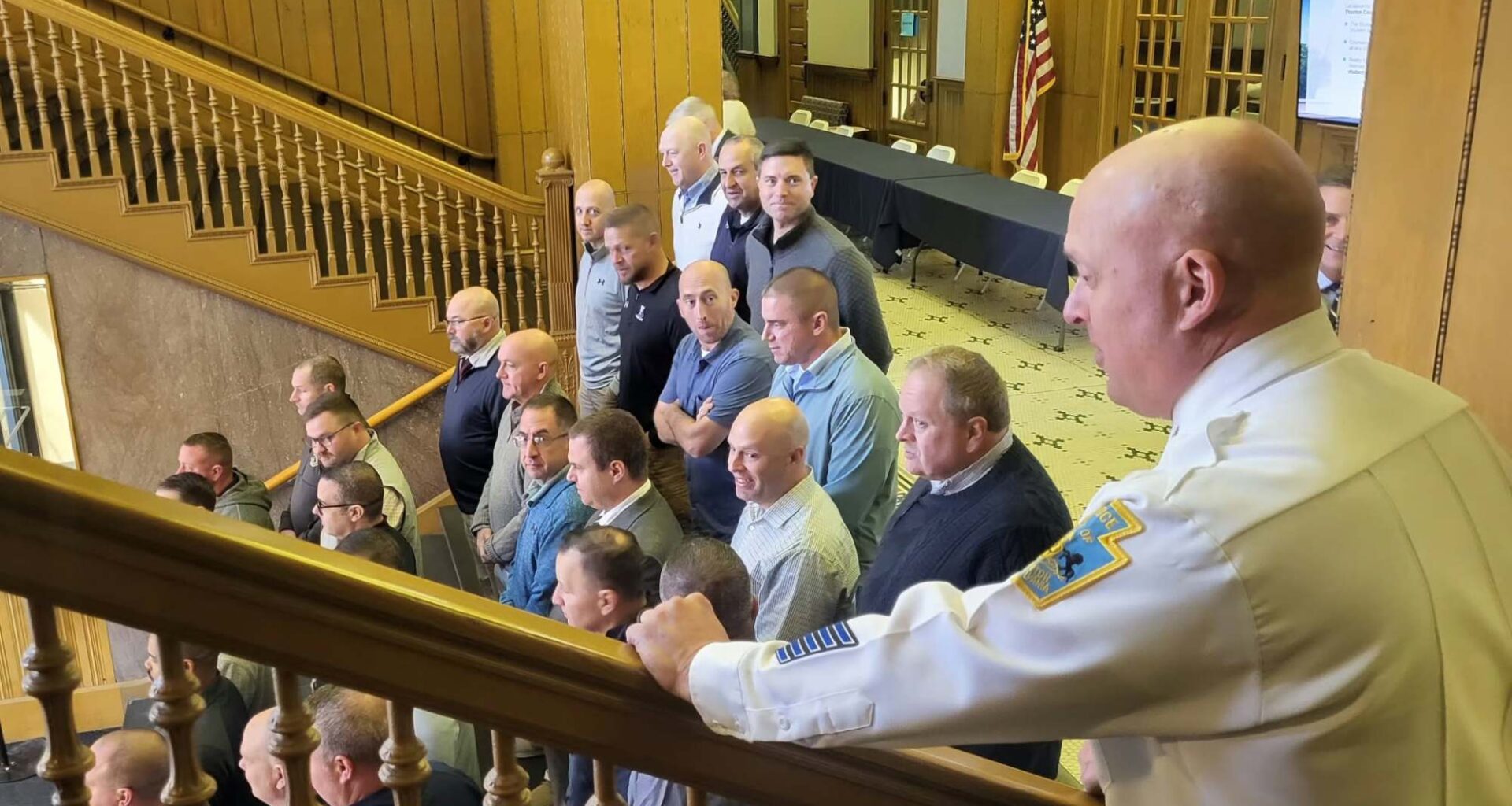
Shown are Command & Leadership Seminar attendees at
Lackawanna College on Thursday, Oct. 22, 2026. The program, developed with the U.S. Military Academy at West Point, utilizes behavioral science theories and scenario-based learning to train police supervisors and command personnel. (SUBMITTED/SCRANTON CITY)

Dunmore police Sgt. Michael Igoe heads to leadership training class at Lackawanna College on Oct. 22, 2026. The seminar provided science based information for police leaders across the state. (GERI GIBBONS/STAFF PHOTO)

Scranton police chief Thomas Carroll, center, poses with Paul Sorrentino and Al Stiehler, educators from the New Jersey State Association of Chiefs of Police (NJSACOP). The men led a police leadership training at Lackawanna College this week. They are shown on Thursday, Oct. 22, 2026. (GERI GIBBONS/STAFF PHOTO)

Stroud Area Regional police Lt. Michael Sampere heads off to a leadership seminar at Lackawanna College on Thursday, Oct. 22, 2026. The week-long seminar provided evidence based education for police leadership across the state. (GERI GIBBONS/STAFF PHOTO)
Show Caption
1 of 4
Shown are Command & Leadership Seminar attendees at
Lackawanna College on Thursday, Oct. 22, 2026. The program, developed with the U.S. Military Academy at West Point, utilizes behavioral science theories and scenario-based learning to train police supervisors and command personnel. (SUBMITTED/SCRANTON CITY)
“The profession changes so fast. The needs of the community change so fast,” Scranton Police Chief Thomas Carroll said. “We’re learning what works and what doesn’t.”
He emphasized the five-day New Jersey State Association of Chiefs of Police Command & Leadership Seminar wasn’t in response to any leadership deficiencies, but instead an opportunity to prepare leadership for the challenges of the 21st century and equipping them to prepare others for leadership positions.
Participants came from as far away as Pittsburgh to take part in what Carroll called “education” rather than simple “training.”
Hosting it at Lackawanna College, which provides Police Academy training, was especially appropriate because it highlighted the importance of continuing education in response to a changing law enforcement landscape, he said.
Dunmore police Sgt. Michael Igoe said that, in addition to education, the program also provided a great opportunity to network with others who will serve as valuable resources in the future.
“We intend to stay connected,” he said.
Participants, especially those from out of the area, had a chance to familiarize themselves with Scranton and what it has to offer.
Just like any school, the training also offered extracurricular activities each evening to build relationships and have some fun. His fellow officers especially enjoyed a golf simulation activity, Igoe said.
Hearing out different approaches
Lt. Mike Sampere, of the Stroud Area Regional Police Department, said he appreciates hearing different thoughts and ideas from others in leadership on issues such as recruiting, retention, management and personnel issues.
“Answers often come from others,” he said. “Networking is important.”
Paul Sorrentino, professional development director, said the program is based on behavioral science to help attendees lead in a complex policing environment, building decision-making, leadership, partnership and self-awareness skills necessary to navigate current challenges and future change.
Trainer Al Stiehler took the course in 2006 and found it “life-changing.”
“It’s a difficult profession. We provide the tools to navigate those challenges successfully,” he said. “Leadership establishes the culture.”