
By the time the largest infrastructure project in Allegheny County’s history is finished in 2032, it will reside 150 feet underground, span 4.9 miles and be filled with sewer water.
It’s the Ohio River Tunnel, a core part of the Allegheny County Sanitary Authority (Alcosan)’s Clean Water Plan and the first of three upcoming tunnels to reduce the amount of waste that enters local waterways.
Pittsburgh is one of many cities that struggle with sewer overflows during “wet weather” events like heavy rainfall, which are becoming more frequent as the climate changes, according to state House District 20 Rep. Emily Kinkead, D-Brighton Heights, who serves as Alcosan’s board chair.
Kinkead said the tunnel system, worth over $1 billion in contracts, is “a once-in-a-generation investment in the future of clean water.”
The Butler County-based Brayman Construction Corporation and the Charlotte-based Lane Construction Corporation hold equal shares of the contract through their joint venture, Steel City Tunnel Partners.
“This is going to clean up our rivers and it’s going to create good, union, family-sustaining jobs that are going to have an impact for years to come,” Kinkead said.
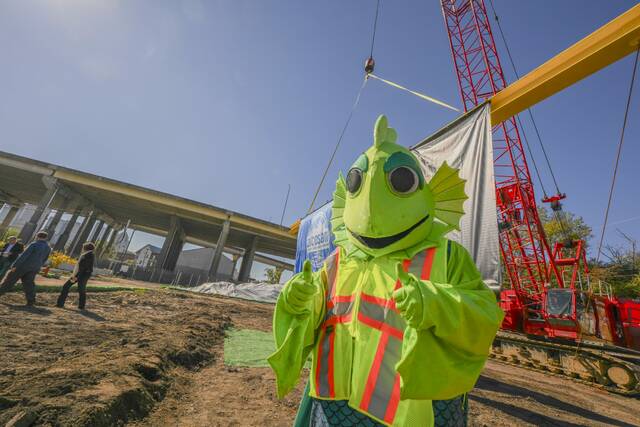
Kinkead joined county and construction officials alongside Alcosan’s mascot, Frankie the Fish, to break ground Thursday on the tunnel near the former Heinz Factory in Troy Hill.
Once operational, the tunnel will capture dirty water on the North Side and divert it to a new wet weather pump station at Alcosan’s wastewater treatment plant in Marshall-Shadeland. Smaller branch tunnels will captures flows from Saw Mill Run and Chartiers Creek.
Workers will set up eight construction sites with access shafts along the length of the tunnel by next fall. After that, a massive cylindrical Tunnel Boring Machine will drill 150 feet down so the installation can begin.
Kinkead said the tunnel will become the largest infrastructure project in the county’s history until its sister projects — named after the Allegheny and Monongahela rivers — surpass it.
Alcosan expects the Ohio River Tunnel to reduce overflow volume by approximately 440 million gallons per year, and the entire Clean Water Plan system to reduce volume by 7 billion gallons annually.
Alcosan had been developing its clean water system since 2008, but its preliminary Wet Weather Plan in 2012 would have cost $3.6 billion and went through several revisions over the years to reduce expenses.
“Without putting too fine a point on it, this project has to deal with a lot of crap — literally,” Allegheny County Councilman Jordan Botta, D-Bloomfield, said on Thursday.
Botta argued that a more resilient wastewater system would be conducive to cleaner rivers and more robust public health.
“This is difficult, complicated work, but it is absolutely essential to the future of Allegheny County,” he said.