
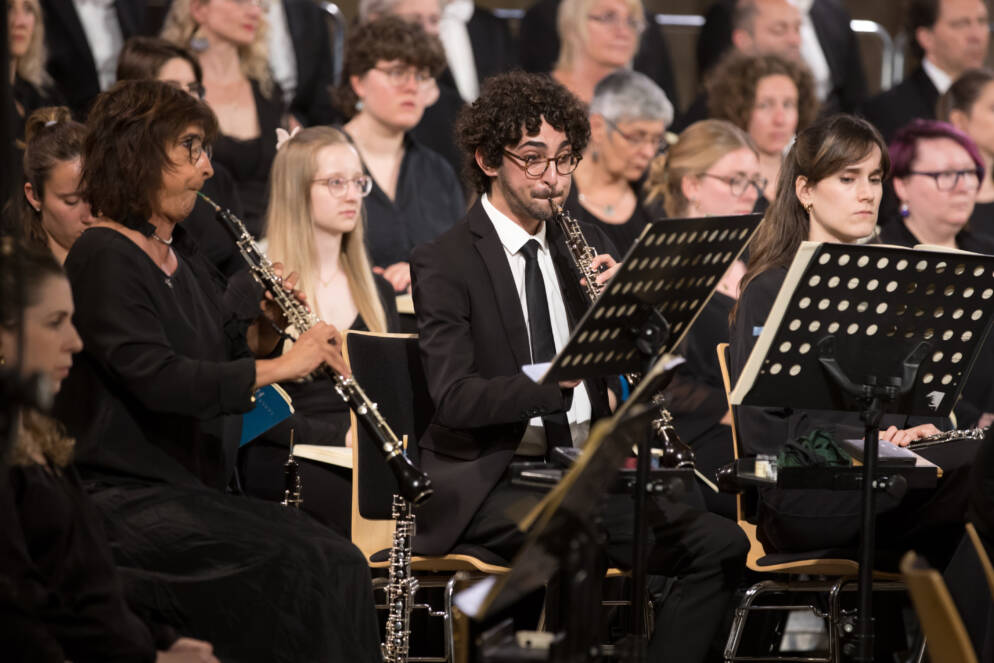
 Woodwind players of the Galilee Chamber Orchestra play a passage. Courtesy of Polyphony
On Nov. 19, the Galilee Chamber Orchestra, the first professional orchestra in Israel consisting of Jewish and Arab musicians, will make its in-person Philadelphia debut at the Kimmel Center, the second stop on a three-city U.S. tour.
“I hope that [audiences] will see that it is possible to find a way to live together, to work together, despite differences,” said Nabeel Abboud Ashkar, co-founder of Polyphony, the orchestra’s sponsoring organization. “Not just work together, [but] create something beautiful together, because in the end, the Mendelssohn symphony or the Mozart concerto that we’re going to play on the stage is something beautiful, something profound.”
In May 2021, the Galilee Chamber Orchestra took part in a Zoom concert for Philadelphians that was co-sponsored by several local Jewish organizations and churches.
This month, the orchestra, made up mostly of musicians in their late teens and early 20s, will visit Gainesville, Florida, on Nov. 17, come north for the concert in Philadelphia, then head to New York to perform at Carnegie Hall on Nov. 20.
The Galilee Chamber Orchestra is one of five different programs sponsored by Polyphony, a music education program based in Nazareth that works to bridge the divide between Israel’s Arab and Jewish communities through classical music.
“Polyphony works with different age groups, in different capacities and in different educational settings,” explained Abboud Ashkar. He said organizers chose Polyphony as a name because “what is great about polyphony in music is that you have multiple voices and melodies happening simultaneously.”
“Where each voice would exist on its own, and you can listen to it and enjoy it, but when you put them together, they harmonize in a way that creates a much richer and more beautiful melody than just listening to any one voice independently,” he said. “We see this as a metaphor for society and how community and differences are an added value. Something that contributes rather than diminishes.”
Abboud Ashkar, who grew up in Nazareth listening to classical music, noticed a need in his community for quality music programming. He decided to attend Tel Aviv University, double majoring in physics and music. After graduating, he then moved to Germany to get his master’s degree in violin performance.
Then, in 2006, he returned to his hometown and founded the Barenboim-Said Conservatory with the support of the Barenboim-Said Foundation.
“The idea was to enable young Arab kids to become really excellent at classical music and excellence was a big part of what we were striving for,” said Abboud Ashkar.
Abboud Ashkar said in order to be able to achieve that excellence, he was convinced he had to go to Tel Aviv and ask teachers to make a two-hour commute to Nazareth. “And it worked. As crazy as it sounded, it actually was easier than one would have thought,” he said.
“I was able to involve three wonderful teachers who were willing to come in the first year,” he explained. “In 2006, three teachers were willing to come twice a week to Nazareth and teach young Arab children. … By the end of the first year, we realized we had a winning formula here.”
Today, out of the 36 members of the orchestra, close to half are Arabs.
“Within Israel, it stands for something that the orchestra members believe strongly in, that there’s no alternative to being able to find a way to live peacefully together,” said Abboud Ashkar. “There’s no alternative to engaging in a dialogue that’s based on respect, equality [and] based on appreciation of each other and the willingness to understand and listen to each other.”
Abboud Ashkar said Polyphony’s programming is just the start of the conversation. “This is where people meet. But it’s just the beginning of a much bigger process that the young musicians engage in with their parents, the teachers, everybody,” he said.
“For two years we give them the chance and the tools to become more familiar with each other and to engage in a more constructive dialogue,” he explained. “Many times, they’re surprised how much they are alike, but also at some point, they discover differences, and both are important.”
Abboud Ashkar also added that in the polarized times that we live in, music provides a common ground to come together.
“I hope that [the music is] part of the message, but also the fact that people care,” added Abboud Ashkar. “They come and they want to hear us and they want to support us. It’s a very strong message that resonates back in Israel and also among communities in the U.S., that there is a place for living together. There is a place for empathy and sympathy, for one another.”