
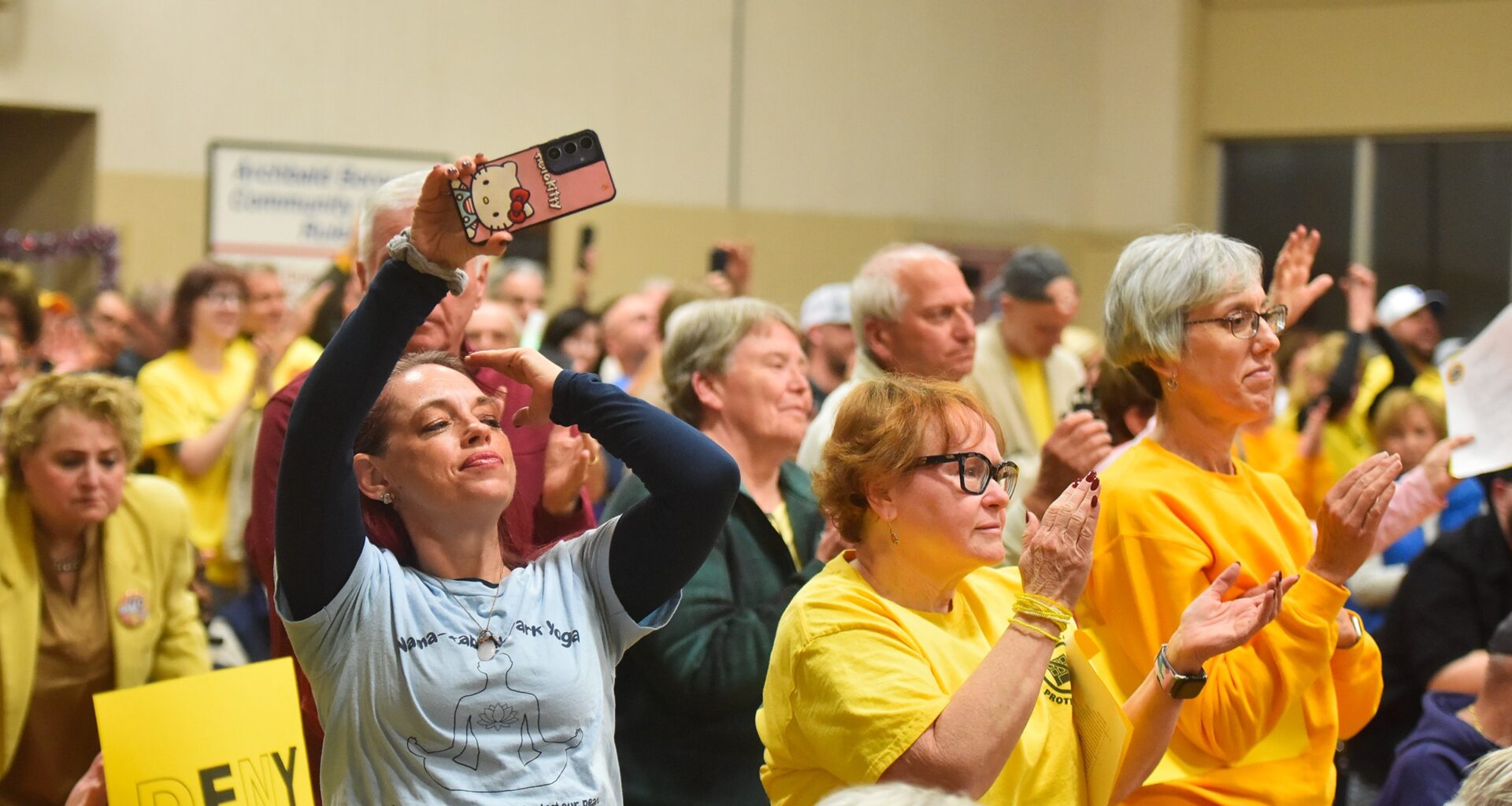
ARCHBALD — Tamara Misewicz-Healey listened with bated breath Wednesday as borough council prepared its roll call vote to deny Wildcat Ridge’s plans for 14 data centers on the mountainside above Eynon and Sturges.
“(It was) incredibly nerve-racking,” the Stop Archbald Data Centers co-founder and industrial hygienist said. “You’re just like holding your breath and hoping that you were heard and that the facts were heard, and that that’s enough.”
A review of Archbald Borough Council’s 24-page decision explaining the rationale behind its unanimous decision to deny nearly 5.7 million square feet of data centers indicates Misewicz-Healey’s arguments were heard.
Over the course of nine public hearings and about 26 hours of testimony and cross-examination, Misewicz-Healey and Stop Archbald Data Centers attorney Justin Richards of Elliott Greenleaf PC in Wilkes-Barre built a case against Brooklyn-based Cornell Realty Management’s proposed Wildcat Ridge Data Center Campus. The two consistently argued that the project’s 777-page conditional use application and testimony from its representatives failed to satisfy Archbald’s zoning requirements, notably to protect the health, safety and welfare of residents.
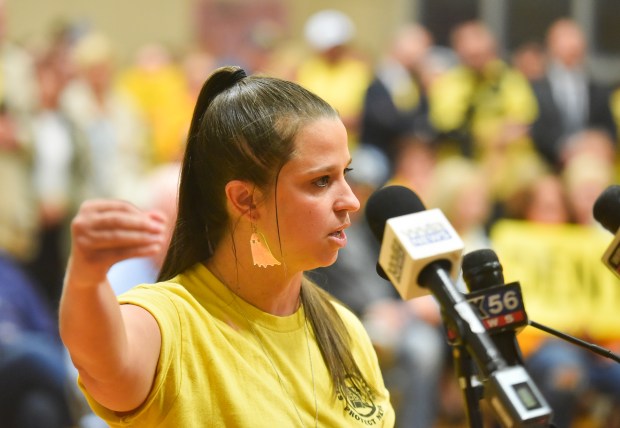 Archbald resident Tamara Misewicz-Healey speaks during the Archbald council meeting at the Archbald Borough Building in Archbald Wednesday, October 21, 2026. (SEAN MCKEAG / STAFF PHOTOGRAPHER)
In a written decision released Thursday, Archbald’s special counsel, attorney Brett C. Flower of Eckert Seamans in Harrisburg, incorporated arguments initially raised by Misewicz-Healey and Richards during the hearings.
“Council finds that the Applicant has failed to demonstrate through credible evidence, that the proposed use will not substantially injure or detract from the use of neighboring properties; that traffic will be accommodated in a safe and efficient manner; or the public health will be adequately safeguarded,” Flower wrote. “Accordingly, the Applicant has failed to demonstrate compliance with the Borough Ordinances regarding the establishment of a data center use.”
As part of its decision, council tossed out testimony from multiple Wildcat Ridge representatives after deeming they were not credible, while accepting testimony from Archbald’s own sound expert, J. Michael Spencer of JMS Acoustics in Bethlehem, and a public health assessment from Michael Cork, Ph.D., a Harvard University environmental health scientist and biostatistician. Stop Archbald Data Centers hired Cork’s firm, EmPower Analytics Group, to conduct a public health assessment on Wildcat Ridge’s nearly 600 backup generators, which determined the generators alone could produce anywhere from $3.3 million to $124 million in annual countywide health impacts.
Lackawanna County subsequently hired EmPower Analytics to conduct a $165,000 countywide health study to determine the cumulative impacts of data centers and power plants proposed throughout the county.
Wildcat Ridge proposed to build 14 two-story data centers, each 80 feet tall with 202,340-square-foot footprints, across 574.2 acres along Business Route 6 and Route 247, or Wildcat Road.
Denial requirements
Dated Oct. 22 and signed by council President Louis Rapoch on Wednesday, the document outlines the nine hearings held on Wildcat Ridge between January and September, including summarizing testimony, explaining issues the borough found with Wildcat Ridge’s testimony and reports, and expounding on council’s reasoning for its denial.
Citing case law, Flower notes that council must deny a conditional use when the application does not meet the standards of the borough’s ordinance. As the exclusive finder of fact in the proceedings, council also has the power to reject testimony if they find it lacking credibility — even if the testimony was undisputed — and the applicant bears the burden of demonstrating compliance.
Specifically, an applicant must provide sufficient information to Archbald council to demonstrate:
• The project will not create a hazard or congestion in terms of traffic impacts.
• The site layout and circulation will allow for the safe operation of the use with minimal negative impacts on neighboring properties and public streets.
• The surrounding neighborhood will not be substantially negatively impacted.
• The use will not present a significant hazard to the public health and safety, such as fire, toxic or explosive hazards.
• The proposed project is suitable for the site.
Credible evidence
As the fact finders of the hearing, council determined that evidence on Wildcat Ridge’s traffic estimates and potential health impacts was not credible.
Planning Consultant Thomas Shepstone of Shepstone Management Co., who was recognized as an expert in planning, testified Wildcat Ridge would not cause a negative impact or significant hazard in terms of public health, safety, fire, toxic or explosive hazards, according to the decision. However, Flower points out Shepstone was not offered as a witness with any experience or background in public health, and his community impact analysis was created from data provided by Perplexity, an artificial intelligence search engine.
Shepstone’s testimony regarding public health, safety and welfare was not credible because it was outside the scope of his qualifications, and it was in direct opposition to Cork and Spencer, whose opinions were based on substantive evidence, according to the decision.
To rebut Cork’s report in August, Wildcat Ridge presented engineer Thomas Muscenti of Trinity Consultants. Council found that his testimony on Wildcat Ridge’s potential health impacts was not credible because his background was in regulatory compliance and permitting — he does not have a health, safety or welfare background, Flower wrote.
Flower also addresses Wildcat Ridge’s traffic generation report, deeming it noncredible because it based traffic estimates on a data center with an average size of 500,000 square feet — 8% the size of the nearly 5.7 million square feet of data centers proposed by Wildcat Ridge.
The report also ignored truck and construction traffic, Flower wrote.
Engineer Jerilyn Luben of L&V Engineering, who presented information on the traffic impacts, classified Wildcat Ridge’s truck traffic as “negligible” without explaining the basis for her conclusion, and the information on vehicle trips she provided contradicted jobs information submitted by the applicant, Flower wrote. As a result, council did not find her testimony credible, according to the decision.
Data center impacts
In its denial, council describes the impacts of noise, emissions from the campus’s 588 large backup diesel generators, risks of potentially storing nearly 2.3 million gallons of diesel fuel on site, impacts of increased traffic, a lack of coordination with first responders, and Wildcat Ridge witnesses who testified about the health and safety impacts of the project without being qualified to do so.
J. Michael Spencer, the borough’s sound expert, determined the generators would have a significant negative impact on the surrounding community, creating a public nuisance, Flower wrote. Because the campus would be built on a mountain, the sound would impact residents more severely, she wrote. Based on the borough’s limits on generator testing and the mandatory minimum hours each generator needs to run annually, the decision explains that Wildcat Ridge would have to run at least 3.6 generators every nonholiday weekday just to complete its minimum testing.
Wildcat Ridge’s own sound expert noted the noise increases as well.
“The Applicant’s own acoustics expert, Caitlin Ormsbee, testified that she had never experienced a project that would present a 30 dB(A) change to the existing sound levels despite modeling hundreds of projects,” Flower wrote.
The decision also points out that the sound study “omitted material information that likely artificially reduced the impacts of the project.”
Notably, it significantly underrepresented the output of its backup generators. Each of the backup generators would produce 3 megawatts of electricity, but Wildcat Ridge only modeled 1-megawatt generators.
The modeling also excluded tonal impacts of the machinery and low-frequency sounds, increased traffic noise and noise from switchyards, Flower wrote.
“The objective standards of the ordinance alone do not necessarily mean that the health, safety and welfare of the residents would not be significantly impacted,” according to the decision, which also addressed air permitting requirements for generators. “Significant air quality public health risks are still possible while meeting federal air quality standards.”
Archbald’s zoning ordinance also requires a project to have a secondary means of access that is satisfactory to first responders; there is no record of Wildcat Ridge providing credible evidence proving it provided that access to satisfy first responders, according to the decision.
“The Applicant has not coordinated with the fire department,” Flower wrote.
Depending on whether it maintained enough diesel fuel to supply its generators for 24 or 48 hours, Wildcat Ridge would store between 1.148 million gallons and 2.296 million gallons of diesel at its campus.
“Council does not find that the Applicant has presented adequate information regarding the hazards of storing this amount of diesel fuel as a toxic and flammable substance on an elevated site with the primary ingress and egress to the mountain for first responders, employees, and residents, directly adjacent to, and below, the project location,” Flower wrote.
Reactions
With the written decision issued, Cornell Realty Management has 30 days to appeal the denial to the Lackawanna County Court of Common Pleas.
Project attorney Edmund J. Campbell Jr. of King of Prussia-based Campbell Rocco Law declined to comment Wednesday on whether his client would appeal, though an appeal is highly likely.
Representing Stop Archbald Data Centers, Richards lauded the decision Wednesday.
“I believe that council’s decision is supported by the law and the evidence, and obviously we are very pleased,” Richards said. “We feel that justice was served here at the municipal level, and we’re prepared to take the fight forward in the event that there is an appeal.”

Wildcat Ridge attorney Edmund J. Campbell Jr. of King of Prussia-based Campbell Rocco Law looks on after Archbald Borough Council denied the Wildcat Ridge Data Center Campus project on Wednesday, Oct. 21, 2026 at the Borough Building. (CHAD SEBRING/STAFF PHOTO)

Attorney Justin Richards addresses representatives of the proposed Wildcat Ridge Data Center Campus during a public hearing at Valley View High School in Archbald, Pa., on Tuesday, Aug. 4, 2026. (ISAAC DIAZ / STAFF PHOTO)
Show Caption
1 of 2
Wildcat Ridge attorney Edmund J. Campbell Jr. of King of Prussia-based Campbell Rocco Law looks on after Archbald Borough Council denied the Wildcat Ridge Data Center Campus project on Wednesday, Oct. 21, 2026 at the Borough Building. (CHAD SEBRING/STAFF PHOTO)
As far as Misewicz-Healey is concerned, the community will continue to fight.
“We’ve accepted that this is going to be a marathon, but what I say is, ‘You know what? We live here, so we’re just going to keep showing up,’ ” she said. “This isn’t some little thing. This is our future, our children’s future, our health.”
She commended residents for unifying against data centers.
“I think there’s been this momentum of getting to know your community again and uniting again over political party — over everything,” Misewicz-Healey said. “We’re neighbors, and we have this shared region and culture, and if we come together, we can save it, and we can build a brighter future together.”