
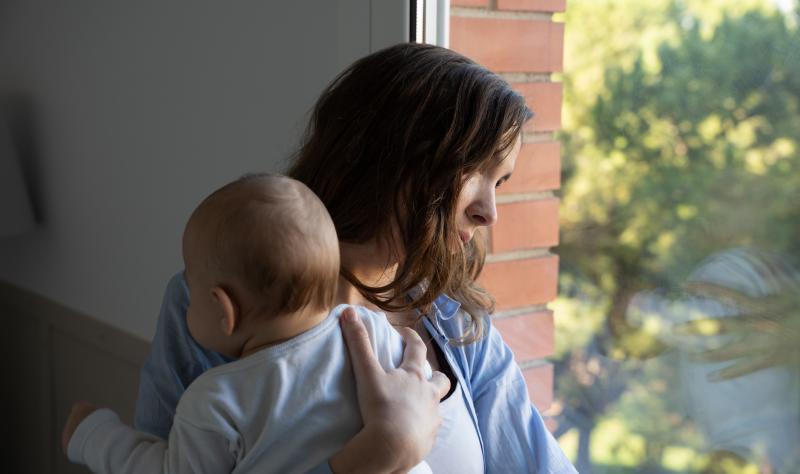
Laura Esch was in disbelief. Her local paper was reporting that Pennsylvania had its first two measles-related deaths in 35 years. Both were infants.
The story included a video of Gov. Josh Shapiro speaking at the hospital where she had delivered her younger daughter, Lucy, just a few months prior.
It felt like the COVID-19 pandemic all over again, Esch told CIDRAP News. Only this time she was a mom.
Esch lives on the eastern side of Lancaster County, which sits about 70 miles west of Philadelphia on the Maryland border.
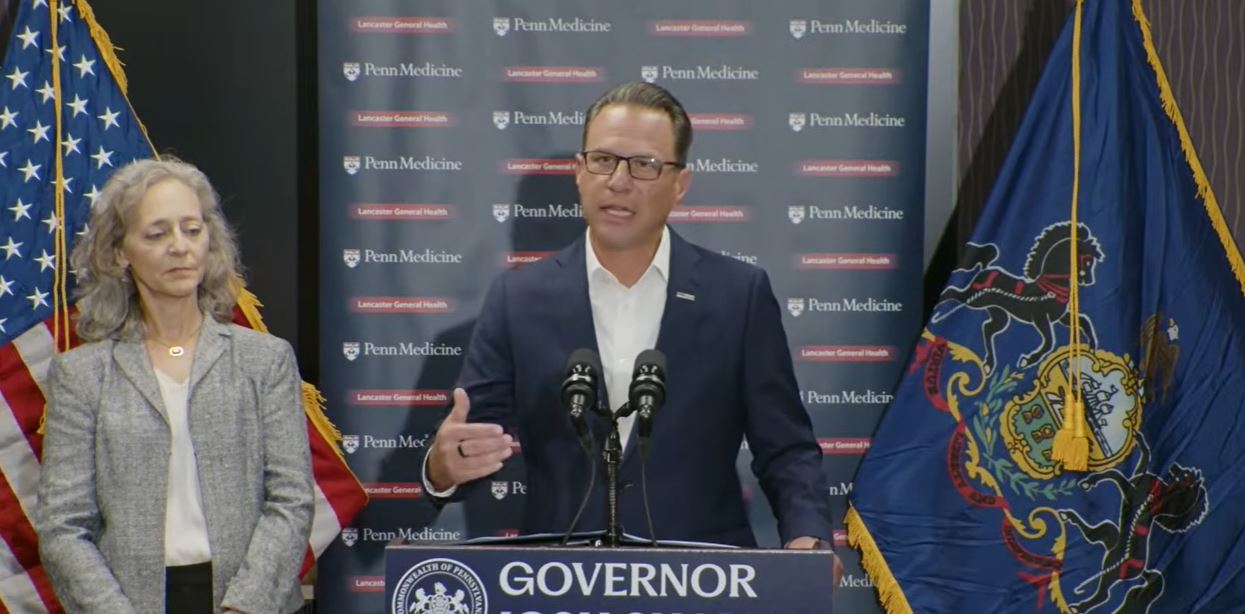
Gov. Shapiro announces Pennsylvania’s first two measles-related deaths in 35 years at Penn Medicine Lancaster General Hospital on August 25, 2026.
Credit: Gov. Josh Shapiro’s office
When Lucy was born in May, the county had no more than a dozen cases. Since then, it’s become the epicenter of the largest measles outbreak the United States has seen this century. This year, more than a third of Pennsylvania’s 1,317 cases, or 467 infections, have been reported there. The entire state reported just 16 cases in all of 2025, according to the US Centers for Disease Control and Prevention (CDC).
Widely regarded as the most contagious disease known to humans, measles is particularly harmful to infants, and at least 14,954 Pennsylvania children under the age of 1 year have received an early dose of the measles, mumps, and rubella (MMR) vaccine, according to 2026 data from the Pennsylvania Department of Health (DOH). Infants produce a weaker immune response to the MMR, and DOH says these babies will still need two doses after their first birthday for lifelong protection.
Esch is counting the days until Lucy can get her early dose. The appointment is scheduled for the week after she turns 6 months, which is the absolute earliest the vaccine can be given.
Until then, Esch won’t take Lucy into indoor public spaces, except to church or when picking up her older daughter from preschool.
Timing is everything with MMR
Children typically receive their first MMR dose from 12 through 15 months of age. But babies as young as 6 months are recommended by the DOH to get an early MMR shot—sometimes referred to as a “zero dose”—if they live in an area where there is an active measles outbreak.
The vaccine can’t be given before 6 months, because maternal antibodies infants receive in utero can neutralize the immune response, making the vaccine less effective.
.jpeg)
Laura Esch holds her youngest daughter, Lucy. Her older daughter, Joanna, swings in the background.
Credit: Laura Esch
As a child nears their first birthday, these antibodies wane. As a result, the MMR vaccine becomes more effective, as shown in a 2019 meta-analysis in The Lancet. Researchers at the Netherlands’ Centre for Infectious Disease Control found that, when given before 9 months, the vaccine is safe and well tolerated in infants, but it’s just 58% protective against measles. That increases to 83% among babies who are 9 months or older.
“The potential for a lower immune response has to be balanced against the benefit of protecting a young infant during a period when they are at high risk of measles infection and its complications,” said lead author Laura Nic Lochlain, PhD, now a technical officer for the World Health Organization’s (WHO’s) Essential Programme on Immunization.
In addition to the MMR vaccine being less protective when given earlier, some worry that a zero dose might blunt the effectiveness of later doses. For example, another 2019 Lancet study by the same team of Dutch researchers found that a zero dose leads to lower antibody levels after subsequent MMR doses, but this doesn’t automatically translate into lower vaccine effectiveness.
Still, because research on the zero dose is limited, pediatricians won’t give it “willy-nilly,” said Sean O’Leary, MD, a pediatric infectious disease physician at the University of Colorado Anschutz School of Medicine.
The potential for a lower immune response has to be balanced against the benefit of protecting a young infant.
However, in areas with measles transmission, or for international travel, infectious disease physicians, including O’Leary, widely agree that infants should get a zero dose at 6 months.
Even if a baby becomes infected, the vaccination likely prevents severe illness. That includes subacute sclerosing panencephalitis (SSPE), a rare but horrific neurologic complication of measles that’s always fatal: Data suggest SSPE is more common if the patient is under 12 months when infected.
While most people make full recoveries, one to three of every 1,000 children who become infected with measles will likely die from respiratory and neurologic complications, according to the CDC. Other long-term complications include intellectual disabilities, deafness, blindness, and chronic lung damage.
Maternal antibodies may wane sooner than expected
Further complicating these medical decisions, research presented today at the Infectious Diseases Society of America annual meeting (IDWeek) in Washington, DC, finds that, by 6 months, most US babies lack protective levels of measles antibodies.
These data, which have yet to be peer-reviewed, suggest that infants may be vulnerable to measles earlier than currently assumed.
The findings raise questions about whether national public health guidance for the measles vaccine should be updated, said lead author Buddy Creech, MD, MPH, director of the Vanderbilt Vaccine Research Program at Vanderbilt University Medical Center.
It felt like the COVID-19 pandemic all over again, Esch told CIDRAP News. Only this time she was a mom.
One strategy would be to change the MMR schedule so that the first dose is given once an infant reaches the age of 9 or 10 months, which aligns with the WHO recommendation for countries where measles is common. Creech said this would shorten the period when a baby is unprotected but allow time for maternal antibodies to wane.
Pediatricians may still recommend a zero dose for younger babies, depending on local epidemiology.
Changing epidemiology presents new challenges
US parents haven’t had to worry much about measles in a generation. The virus was declared eliminated in the country in 2000 because of widespread MMR uptake. At that time, the country’s collective immunity was about 92% to 94%, which is high enough to protect people, including babies, from measles if they are unable to get the vaccine.
The measles vaccine has been so successful, Creech said, that Americans today have lower antibody levels than they did 50 or 60 years ago. When measles circulated widely, people’s immune systems were periodically stimulated, or boosted, by encountering the virus from time to time.
As a result, he said it’s plausible that babies born today have lower levels of maternal antibodies and are at risk for contracting measles sooner than was the case when their parents or grandparents were infants.
atlantic-kid / iStock
As vaccine skepticism continues to drive MMR rates down, places like Lancaster County, as well as parts of Utah, South Carolina, and Texas, have turned into tinderboxes for measles, leaving babies extremely vulnerable.
That her daughter is at risk because other people choose not to vaccinate their children angers Esch. On the rare occasion she’s with Lucy in a crowded public space, like inside a tent at an outdoor community festival, she feels anxious and wary of others.
“I’m kind of trying to assess people’s vaccine status just by, like, a stereotype, which is not great,” she admitted.
But right now, Esch doesn’t have a lot of options to keep her baby safe.