
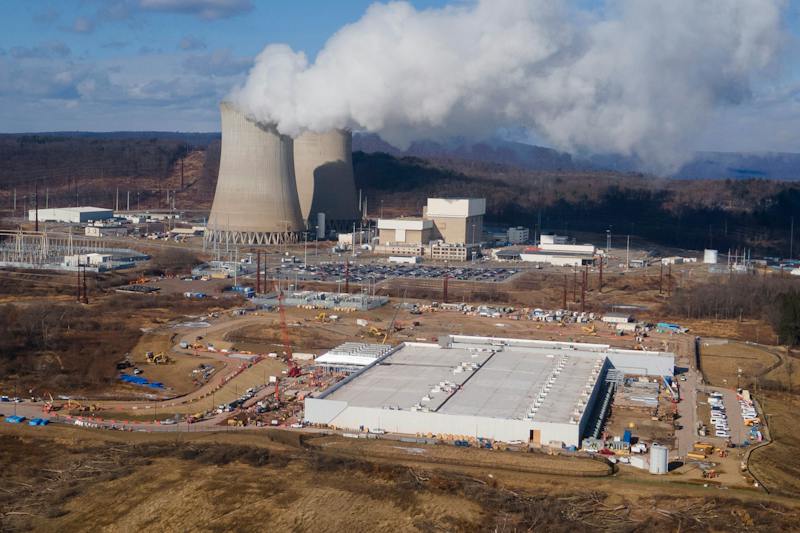
In the battleground state of Pennsylvania, data centers have become a kitchen-table issue.
This September, nearly two-thirds of likely Pennsylvania voters told The New York Times they either strongly or somewhat oppose the construction of data centers to support artificial intelligence. For Pennsylvania Gov. Josh Shapiro, who is seeking reelection in November, the subject has become unavoidable.
After proudly announcing Amazon’s $20 billion data center investment in the Commonwealth in June 2025, the governor signed an executive order in August restricting further data center development across the state and requiring local approval for new installations. The reversal, according to his press release, was informed by “many residents who have expressed their concerns to him directly, and to many more who have shared feedback.”
Neither political party has “really figured out how to respond to the challenge” of rising voter discontent over the issue, according to Matthew Levendusky, a professor of political science and communications. Levendusky expects the pressure to keep building into the 2028 presidential race.
“Data center construction has become a bipartisan issue,” Parrish Bergquist, an assistant professor of political science, said. Any electoral effect, she added, might be “an anti-incumbent effect rather than a partisan effect.”
Get the DP delivered straight to your inbox.
“This is why you see Shapiro coming out against them, because if people are mad about these things, they will vote against whatever incumbent they view as being responsible for building them,” Bergquist added. “At the city council, town council level, I think that could have implications on both parties.”
Bergquist thinks the debate over data center construction is largely driven by concerns from residents.
“People don’t like the disruption associated with construction, or they don’t like noise or disruption to their sense of place,” she said in an interview. “People are like, ‘this isn’t a thing that’s going to benefit us,’” Bergquist said. “Why does it need to be built here?”
Levendusky — who is also the Stephen and Mary Baran Chair of the Institutions of Democracy division — said that media coverage of data centers and AI as a whole has generally “been framed in a way that generates a sense of grievance.”
On one hand, he explained, voters are told the rise of AI will reduce the value of higher education, eliminate white-collar jobs, and might even wipe out humanity. The data centers that power that very technology, he continued, “raise utility bills, pollute, and reduce the quality of life for neighbors.”
“Who benefits?” Levendusky continued. “Mostly a few large companies and their billionaire founders. So, you have highly concentrated benefits and much more broadly dispersed costs — a recipe for people to feel aggrieved.”
John Quigley, a senior fellow at the Kleinman Center for Energy Policy, said that while corporations have made “promises about the economic benefits of data centers,” those claims “don’t withstand scrutiny.” While data centers create temporary jobs during construction, he said they “hardly employ anybody” once fully operational.
According to Levendusky, companies need to “figure out how to structure the benefits of these centers” so that they “outweigh the costs for communities.”
State Sen. Anthony Williams (D-8), whose district includes parts of Penn, said he has heard pronounced concerns from constituents regarding larger data centers. Despite that public opposition, he said the facilities did “meet a need that the public may have.”
“There’s a lot of ads and literature that’s been generated about who supports a data center, who does not, what data centers would do to a community,” Williams explained. “The actual substantive portion related to policy and bills – I don’t think we’ve spent much time on that at all.”
Instead, Williams said that on a statewide level, discussions of data centers and AI were more “political fodder” than substantive policymaking conversations.
These concerns could be amplified by a lack of regulation, according to Quigley, who explained that, so far, the data centers proposed in Pennsylvania largely rely on diesel backup generation.
“A data center could be running several hundred generators, which, even with the best available technology, are going to be releasing significant amounts of NOx and particulate matter pollution, to say nothing of carbon dioxide pollution,” Quigley said.
If inhaled, NOx, or nitrogen oxides, can cause respiratory harm — and even lead to the development of asthma.
Professor of Earth and Environmental Sciences Michael Mann wrote in a statement that data centers are “massive sinks of energy and water” that “produce substantial waste and pollution.”
Mann, who is also the director of the Penn Center for Science, Sustainability, and the Media, said the environmental impact of data centers had previously been mitigated by using renewable energy. The Trump administration, though, has moved to have data centers run on natural gas, which Mann argued adds to “carbon emissions when we need to be rapidly decreasing them.”
According to Bergquist, there has not been a concurrent push for the development of renewable energy sources to support the centers.
“We have to figure out how to be able to build clean and renewable energy capacity and distribution in ways that are just and fair and not environmentally detrimental, but that don’t delay things for longer than they need to be delayed,” she explained.
Despite rising calls for a pause on construction, Pennsylvania does not currently have a data center moratorium. Philadelphia already houses eight data centers, though none are the hyperscale developments needed for AI.
A Planning Commission meeting in July raised the possibility of constructing such data centers on two sites — the Bellwether District in South Philadelphia and a city-owned plot near the Northeast Philadelphia Airport — but no specific proposals have been made. New York has had a moratorium in place since July, and several other states have proposed similar legislation.
“This is a transformational technology, and no one knows how to respond to it,” Levendusky concluded. “This will continue to unsettle politics.”
Una Cutrone, Aadit Garg, and Cynthia Nga contributed reporting.
Senior reporter Lavanya Mani covers legal affairs and can be reached at mani@thedp.com. At Penn, she studies comparative literature. Follow her on X @LavanyaMani_.