
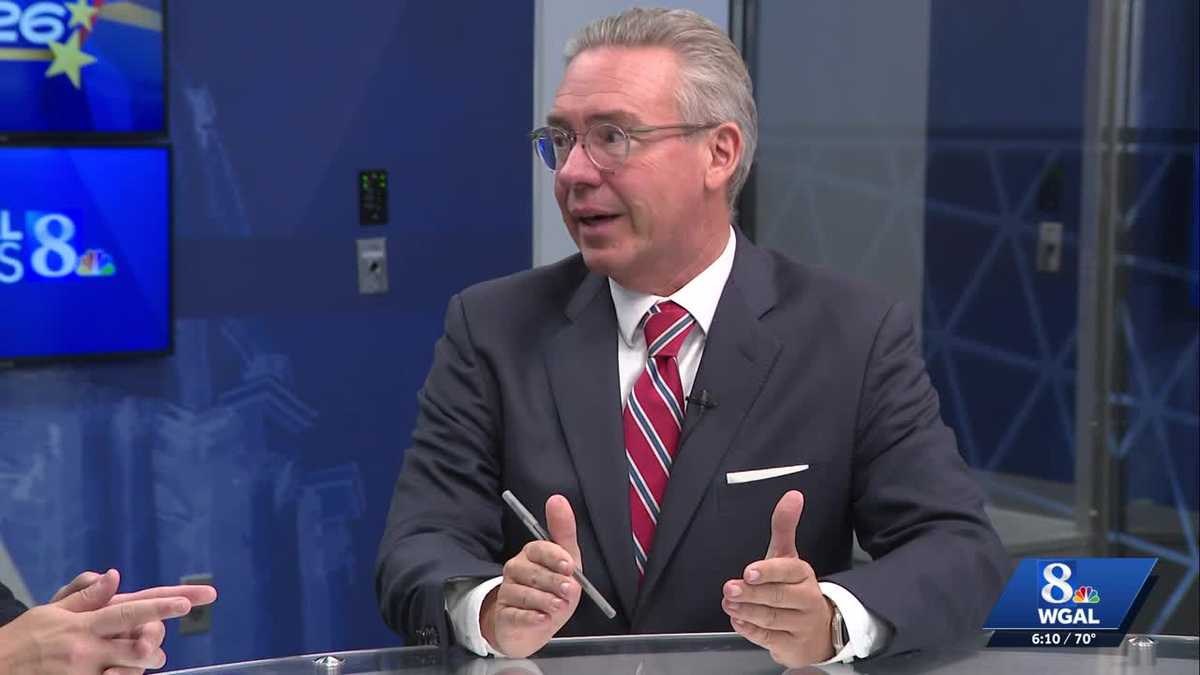
News 8 spoke with Pennsylvania’s top elections official ahead of the midterm elections.
 HARRISBURG, Pa. —
Pennsylvania’s top election official is urging voters to trust the state’s voting system as counties prepare for the Nov. 3 midterm election, while emphasizing that allegations of fraud should be investigated carefully without preventing eligible voters from casting ballots.
Secretary of the Commonwealth Al Schmidt said Pennsylvania’s use of paper ballots, post-election audits and voter identification procedures helps ensure accurate results for ballots cast by mail and in person.
“I think it’s very natural to have questions. Elections have changed so much in the past several years, but they’ve changed for the better in Pennsylvania,” Schmidt said. “Every voter votes by a paper ballot. There’s a paper record of every vote that’s cast, and that’s used in audits after every election.”
Pennsylvania does not generally require voters to present identification each time they vote at a polling place. Voters must provide identification the first time they vote in a precinct, and applicants for mail-in or absentee ballots generally must submit proof of identification each time they request one.
“The first time you vote, whether by mail or at a polling place, you are providing identification,” Schmidt said. “It’s just that if you vote at that same polling place in the elections after that, you no longer have to provide ID again.”
His comments come after federal prosecutors announced charges against nine Pennsylvania residents accused of voting illegally despite not being U.S. citizens. The alleged voting occurred in previous federal elections, including the 2022 and 2024 general elections. The charges are allegations, and the defendants have not been convicted.
Schmidt said any illegal ballot is a serious matter but maintained that such cases are rare. He warned against adopting policies that could prevent eligible voters from participating in an effort to stop isolated violations.
“You don’t want a single vote to be counted that shouldn’t be counted,” Schmidt said. “And you don’t want a single person who’s eligible to be prevented from voting as a result of an election integrity system that is done in a way that disenfranchises eligible voters.”
Such cases require “constant vigilance” and thorough investigations to determine whether allegations are accurate, he said.
Asked whether concerns about voter fraud are justified or overblown, Schmidt said election officials should take a measured, evidence-based approach.
“It’s not really a question of overblown or not,” he said. “It’s a question of being rational, thoughtful and methodical in identifying these sorts of cases and not listening every time someone cries wolf, because that happens far too often.”
Schmidt said unsupported accusations can themselves damage public confidence in elections. People who believe wrongdoing occurred can present evidence in court, he said, where claims can be evaluated under established legal standards.
“I can’t think of anything that undermines election integrity like people constantly saying there’s fraud here and fraud there,” he said.
Federal election monitors expected
The U.S. Justice Department has also notified Pennsylvania that federal election monitors are expected in Allegheny, Lehigh, Luzerne and Philadelphia counties on Election Day. Schmidt said state officials are reviewing what access the monitors may legally have while voting is underway and plan to coordinate with affected counties.
“It really comes down to what level of access they can have, or what level of access they’re permitted to have, on Election Day while voting is taking place,” Schmidt said.
The Justice Department’s Civil Rights Division routinely monitors elections in selected jurisdictions to assess compliance with federal voting-rights laws. The planned deployment comes under President Donald Trump’s administration amid heightened scrutiny of Pennsylvania’s election procedures.
Schmidt said preparations for Election Day are a year-round effort. County election workers are readying poll books, processing voter registration applications and preparing mail-ballot materials.
“It’s not something where people are working two days a year,” he said. “They’re working all year long to make sure those days are successful.”
State officials remain in regular contact with counties to ensure they have the staffing, equipment and other resources needed, Schmidt said.
“We are in contact with them throughout the year in the lead-up to Election Day to make sure that everyone is prepared and that everybody has what they need,” he said.
Mail-in ballot deadlines approaching
Registered Pennsylvania voters have until 5 p.m. Tuesday, Oct. 27, to apply for a mail-in or absentee ballot. Completed ballots must be received by the voter’s county election office by 8 p.m. on Election Day, Nov. 3. A postmark alone is not sufficient.
Schmidt advised voters not to wait until the final days before the election to return their ballots through the U.S. Postal Service.
“There is no hard-and-fast date by which you should no longer put it in the mail, but you have to be reasonable in allowing for some number of days for that ballot to be returned,” he said.
Voters returning ballots late in the week before Election Day should consider delivering them to their county election office or an authorized drop box, if their county provides one, Schmidt said. He specifically cautioned against mailing a ballot on the Saturday or Monday immediately before Election Day.
In most circumstances, Pennsylvania voters must return their own ballots. Limited exceptions exist for voters with disabilities who formally designate someone to deliver a ballot and for certain emergency situations.
Schmidt also addressed two completed ballots that were mistakenly returned as undeliverable by the Postal Service.
“A couple is the right way to describe it, because it was, in fact, two ballots that we’re aware of that were returned as undeliverable,” he said.
The state contacted the Postal Service, which initially attributed the problem to human error in processing the envelopes, Schmidt said.
“We have no reason to think it’s in any way systematic,” he said, adding that voters should remain confident in using the mail if they allow enough delivery time.
Pennsylvania voters can also apply for and complete a mail ballot in one visit at their county election office through the Oct. 27 application deadline. Polls will be open from 7 a.m. to 8 p.m. Nov. 3.