
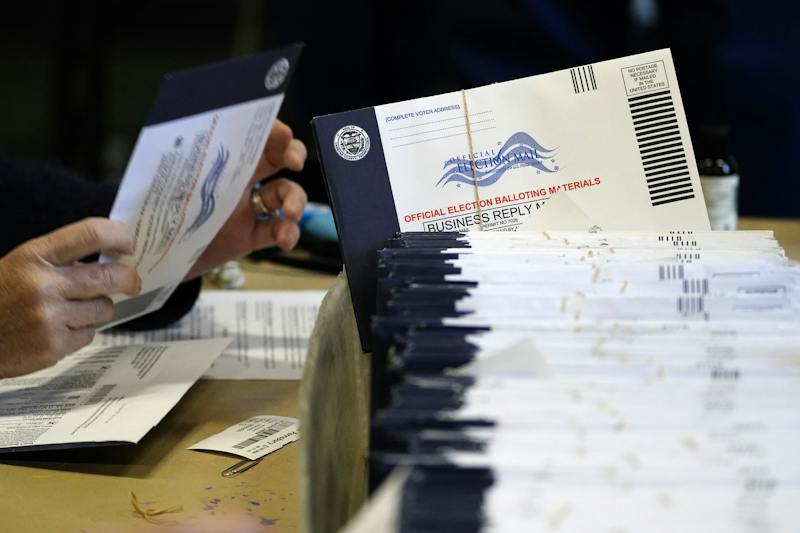
President Donald Trump’s legal battle over mail-in voting is unlikely to affect how Penn students vote in November, but it could shape how future elections are conducted, election experts told The Daily Pennsylvanian.
Trump signed an executive order on March 31 seeking to change how federal elections and mail-in ballots are administered. The order, which would impose new requirements for envelope markings, barcodes, and ballot distribution, faces legal challenges over its expansion of presidential authority over elections.
According to Political Science professor Marc Meredith, mail-in balloting “should run as it normally does” during the 2026 midterm elections.
The executive order — titled “Ensuring Citizenship Verification and Integrity in Federal Elections” — directed the postmaster general of the United States Postal Service to initiate the rule-making process within 60 days.
“The question is: Has Congress sufficiently given the Postal Service authority to be the place where a rule like this would develop?” Meredith, whose research focuses on the political economy of American elections, said in an interview. “I think courts will also be weighing — even if it has been given this authority — whether it’s using that authority in a way that would significantly inhibit people’s ability to vote.”
Get the DP delivered straight to your inbox.
On Aug. 11, a federal judge blocked USPS from implementing the executive order’s provisions on mail-in ballots. Nearly two weeks later, the Supreme Court intervened and concluded that the lower court had acted prematurely because USPS had not yet issued a final rule.
By Aug. 21, the rulemaking process was complete, and opponents of the order secured a new preliminary injunction — which the Supreme Court left in place after finding that the federal government “is unlikely to succeed on the merits of its challenge.”
“Inevitably, I think this rule is headed for a full-on trial after the election,” Meredith predicted. “We’re almost certainly going to end back at the Supreme Court at some point.”
He described mail-in voting as a “good option for people who need to use it,” particularly for students who vote in a state other than Pennsylvania.
“I do think that if you have the capacity to vote in person, it’s probably going to be a better experience than mail voting,” Meredith said. “In part, I think it adds a little bit more of a social element to the process of voting, and there is always a small chance that something will go wrong with a mail-in ballot.”
Political Science professor and elections analyst Daniel Hopkins highlighted that “this is not the sort of thing you want to procrastinate on.”
“There is real value in returning these and not even waiting until anywhere close to the deadlines,” he said. “At times, the state may say that you can send it any time until a certain point, but if the postal service is unable to deliver within that time frame, then you still may risk being disenfranchised.”
Trump — who graduated from the Wharton School in 1968 — has urged his supporters to vote by mail despite making claims that the system perpetuated fraud. Hopkins hypothesized that this was because mail-in voting is historically used by Democrats in larger numbers.
“One of the challenges is that when one party disproportionately relies on one method of voting, then there are at least incentives for the other party to make that method of voting harder,” he said.
In Pennsylvania, applications for mail-in ballots — which may be requested by any voter without an excuse — must be submitted by 5 p.m. on Oct. 27.
Staff reporters Ayesha Faruki, Emily Kohler, Meredith Rinaldi, and Nandita Shetty contributed reporting.
Staff reporter Cathy Sui covers politics and can be reached at sui@thedp.com. At Penn, she studies finance and statistics.