
Dan Stein’s passion for
mitzvot, the Hebrew word for charitable acts and good deeds, was fueled by what literally ran through his veins and kept his heart beating.
The salesman and former substitute teacher, one of 11 Jewish worshippers murdered in a Pittsburgh synagogue eight years ago Tuesday, had a blood type highly sought after by phlebotomists and blood banks: O-positive. That means the red blood cells he donated could be safely used in transfusions for 85% of Americans.
And he took that physiology as a kind of calling.
“Donating blood was really important to my dad,” Dan’s daughter, Leigh Stein, 50, of Squirrel Hill, said after donating blood Sunday as a way of preserving his memory. “When I think of my dad, I think of all the things he did from his heart … and this was one of the many things he did to give back to the community and to strangers.”
Dan Stein, his daughter and others said, was nearly as faithful to regularly donating blood — and encouraging others to do the same — as he was to New Light Congregation. He served as that synagogue’s board president and was attending its Shabbat services when the most lethal act of antisemitic violence in U.S. history unfolded at the corner of Wilkins and Shady avenues on Oct. 27, 2018.
Tuesday marks eight years since a gunman attacked three congregations worshipping inside the Tree of Life-Or L’Simcha synagogue, thrusting Squirrel Hill onto the world’s stage.
But nearly a decade after the shooting and three years since a jury sentenced the gunman to the death penalty, many stress what’s more important than ever is preserving how the 11 fallen worshippers lived — not just mourning the manner in which they died.
For Dan Stein and fellow victim Irv Younger, what mattered was giving blood.
For Richard Gottfried, another of the 11 Jews killed that morning, it was providing free dental care for nearly a decade through the nonprofit group Catholic Charities.
For victims Bernice and Sylvan Simon, it was the spark to preserve family tradition and the unique character of Jewish cemeteries.
On Sunday, more than 200 volunteers honored the memories of those 11 victims in tangible ways. Dozens of volunteers donated blood. Some flocked to Friendship Circle, a nonprofit in the heart of Squirrel Hill’s business district, or tended to an aging Jewish cemetery in the city’s Overbrook neighborhood. And others celebrated Gottfried’s passion project, serving lunch to homeless and at-risk men at a year-round program that the group he supported — Catholic Charities — runs in the city’s Hill District.
Jordan Golin, president and CEO of Jewish Family and Community Services, got a front-row seat to the Day of Service.
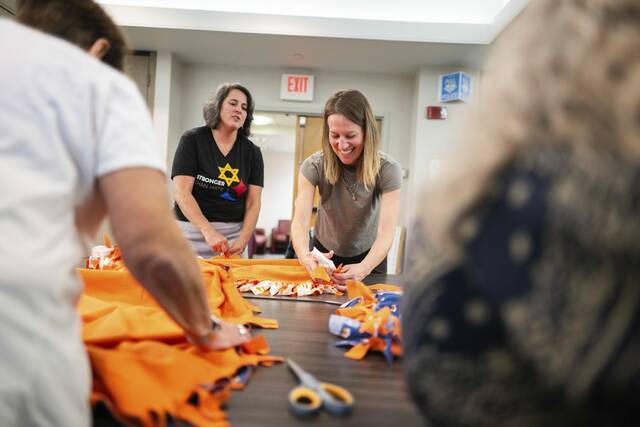
Sporting a cyan “Stronger Than Hate” T-shirt, Golin watched as a sea of volunteers folded colorful cloth into no-sew blankets and personalized care kits inside a JFCS conference room on Squirrel Hill’s Bartlett Street.
“I think these kinds of activities do serve as a way for the community to continue to heal, to continue to grow,” Golin said. “They also help the community to be resilient, to work through things.”
“We do show up for each other,” he added. “We help each other. And when you’re here, you can see that — both directly and indirectly.”
‘Keep their spirit alive’
Sharyn Stein, Dan’s widow, sat at a nondescript table Sunday morning inside a Jewish Community Center auditorium and watched Pittsburghers pay tribute to the man she affectionately called Danny.
Both she and her daughter wore the iconic “Stronger Than Hate” T-shirt — the triad of a Pittsburgh Steelers logo replaced with red, blue and yellow Stars of David.
Stein says watching others perform mitzvot at the blood drive, launched in the wake of the shooting, has been an unexpected source of comfort.
“Over the years, being here, it has helped,” the Squirrel Hill mother and grandmother said. “In the beginning, nothing helped. But now it’s better. I come out and I see the kindness in people. And that’s very helpful to me.”
Alan Mallinger, another Pittsburgher inextricably linked to the synagogue shooting, showed up minutes after the drive opened at 9 a.m. to donate a pint of “power red” — just the red blood cells from the type O-negative blood of a universal donor.
Mallinger’s mother, Rose, was killed in the shooting. She would have been 105 had she made it to Sunday.
“Each year has certainly got a little bit easier,” said Mallinger, 71, of Squirrel Hill, who retired from his post as a JCC administrator five years ago. “But, as we get closer to the day and because of the attention it gets, it certainly brings back that day in my head.”
“Knowing you’re doing something to keep their name alive, it’s meaningful,” he added. “You’ve got to carry that memory forward and keep their spirit alive.”
Turning community trauma to action
Councilwoman Erika Strassburger, who took office representing part of Squirrel Hill in 2018, has measured the months and years since the shooting in a highly human way. The Squirrel Hill politician was pregnant with her son, Evan, on Oct. 27, 2018.
On Sunday, she sat alongside the boy — now a second-grader — in the JFCS conference room and jotted personal notes for care kits. Evan drew what he called “an imaginary smile” on a piece of canary-yellow construction paper.
“It’s hard to fully process trauma as a community until decisions are made — and it feels different now that we’re on the other side of (the trial),” Strassburger said.
Strassburger pointed to people volunteering elbow to elbow in the packed conference room. Some clouds, even unexpected ones, develop silver linings, she said.
Maggie Feinstein, executive director of the 10.27 Healing Partnership, agreed.
“When you face a community trauma, one where you have such loss, you build a narrative around it — and people have found really meaningful ways of integrating the reality of 10/27 into what they do,” Feinstein said.
“The 11 people killed that day, they really lived their lives and they gave so much to the community,” she added. “After this happened, people really stepped forward.”
Changing threat landscape
The days since the synagogue shooting have been plagued by antisemitism — both in Pittsburgh and across the nation.
In 2017, the year before the mass shooting, 27 antisemitic incidents were reported citywide, according to Shawn Brokos, the Jewish Federation of Greater Pittsburgh’s director of community security and a former FBI agent.
By 2021, the total rose to 82.
“The synagogue shooting here in 2018 was a horrific event that was felt by the entire Pittsburgh community, in addition to the Jewish community — and it served to unite different faiths and cultures to say, ‘We’ve got to be stronger than hate,’” Brokos said Monday.
“It exposed something evil,” Brokos said of the tragedy. “And the question was, ‘How can be learn and grow from this?’”
A different date this month triggered even more dramatic spikes in antisemitism.
On Oct. 7, 2023, Hamas terrorists launched a surprise attack on Israel, killing about 1,200 people and taking 251 hostages.
Israel struck back with a relentless assault on Hamas and Gaza, killing and displacing tens of thousands of people, mostly civilians. The Palestinian death toll from the war topped 74,000 last month, according to Gaza’s Health Ministry.
The reports of antisemitism surged.
Last year, 312 antisemitic incidents — a single-year record for the region — were reported to the Jewish Federation of Greater Pittsburgh, Brokos said. This year is keeping pace — 265 antisemitic incidents were reported to the federation through Monday.
Antisemitism is not only a Pittsburgh problem.
The Anti-Defamation League recorded more than 9,300 incidents of antisemitism nationwide in 2024 in its Audit of Antisemitic Incidents, according to its website. That was up from 912 a decade earlier.
“The threat landscape has changed dramatically since Oct. 7, 2023, when white supremacists colluded with nation-state actors, and Jews and Israel became targets for both,” Brokos said. “And, yes, we’ve seen that spike nationally and locally.”
Others also have seen a tide of antisemitism and anti-Zionism.
“It’s had a large and chillling effect on speech — especially in terms of many of the events conducted by Jews and by synagogues,” attorney Jon Pushinsky said Monday.
Pushinsky, a Highland Park man who led courses at the University of Pittsburgh on First Amendment issues, has attended services for more than 30 years at Dor Hadash — one of three congregations attacked inside the Tree of Life-Or L’Simcha synagogue in 2018. He stressed that he does not speak for the congregation.
“People are afraid to advertise events,” he said. “They’re afraid of who might show up.”
“No one,” added attorney Jean Clickner, Pushinsky’s wife, “is safe to go into a house of worship without there being guards.”
Pennsylvania has provided $35 million in grants to buttress security at nonprofits and houses of worship since 2019. Nearly 70% of the grants announced this year in Allegheny County went to Jewish, Israeli or related groups.
About 65% of all faith-based hate crimes in 2025 involved Jews, FBI data showed.
‘It’s the least I can do’
Rabbi Andy Shugerman had a simple answer when asked why he was donating blood in a JCC auditorium Sunday.
“It’s the least I can do,” Shugerman, 48, of Squirrel Hill, said.
Shugerman — like Dan Stein and Irving Younger, the shooting victims to whom he paid tribute Sunday — regularly goes under the needle to donate at PNC Park blood drives. Though he grew up a Baltimore Orioles fan in the Washington, D.C., area, he admits the free Pirates tickets don’t hurt.
“Is this a mitzvah?” a Trib reporter asked him.
“Oh, absolutely,” he responded.
For Shugerman, Sunday’s mitzvot called to mind the 2,000-year-old rabbinical phrase that’s part of the foundaton of Jewish law: Pikuach nefesh — the idea that “saving a life” supersedes all other commandments.
Then, he added in Hebrew, Ve’asita hayashar vehatov be’einei Adonai. That translates roughly to: “And you shall do the right and the good in the eyes of the Lord.”
“You don’t need to look much further than the Hebrew to do what is upright and good,” Shugerman said. “This is about doing something that costs us nothing but saves a life. And I can’t think of anything more upright and good than that.”
Before leaving, Shugerman turned to Sharyn Stein, Dan’s widow. She was seated nearby, watching her husband’s memory thrive as volunteers donated blood.
“I wish it were under different circumstances,” Shugerman told her. “But I’m happy to see you here.”