
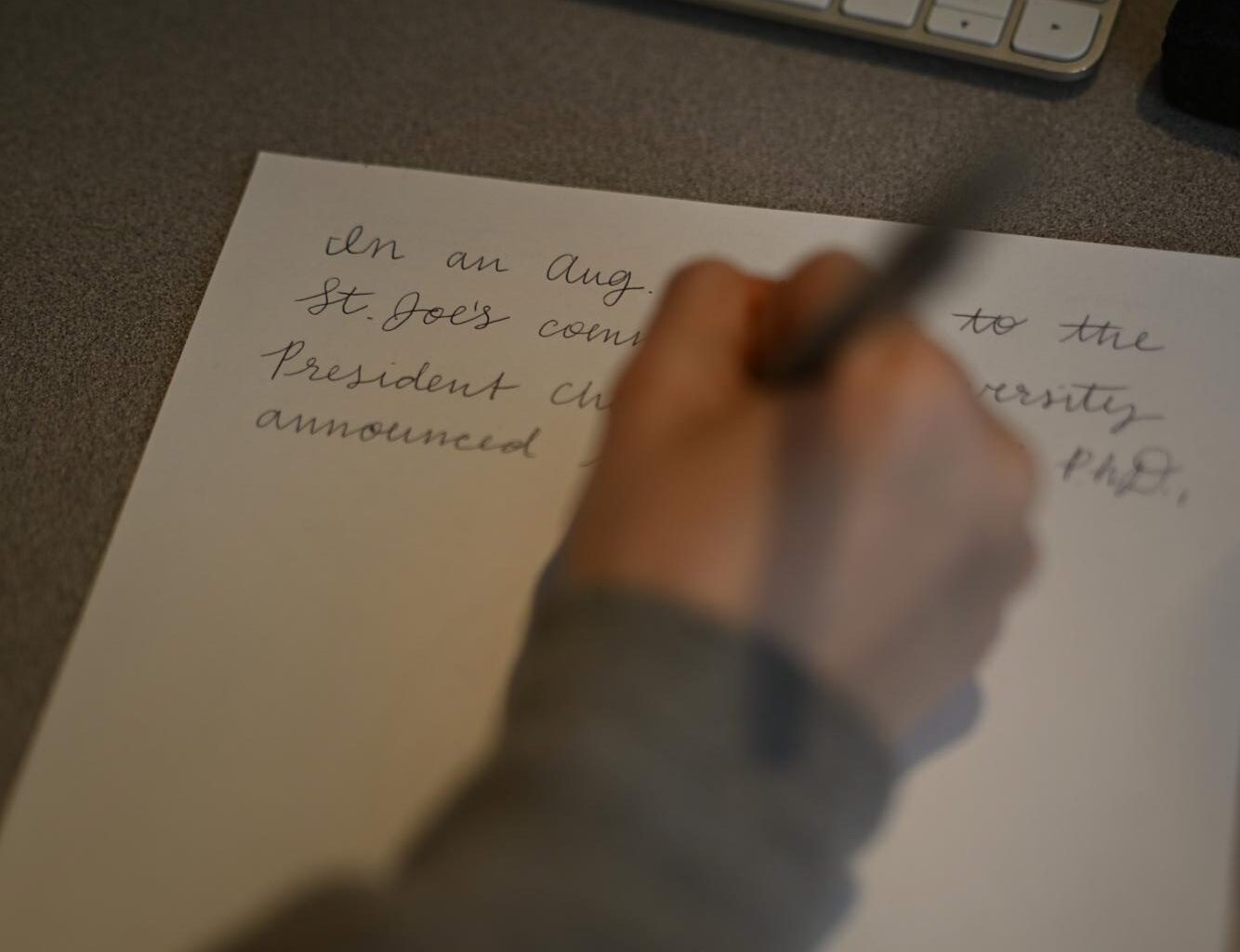
Cursive handwriting is returning to Pennsylvania classrooms, bringing back a skill that some St. Joe’s students rarely use and raising questions about the place handwriting holds in an increasingly digital education system.
Gov. Josh Shapiro signed Act 2 of 2026 in February, requiring Pennsylvania public and private schools to include printing, joined italics and cursive handwriting in writing instruction. The law took effect April 12.
Grace Farrell ’28, a psychology major, is typical of a lot of St. Joe’s students. She said cursive largely disappeared from her life as technology became more prominent in school. Farrell learned cursive in elementary school but stopped using it regularly around her first year of high school.
“I really only use it for my signature,” Farrell said.
The ability not just to write cursive but to read it is important, said Jessica Nagle, Ph.D., clinical assistant professor in the department of teaching, learning and behavioral studies and program director of graduate teacher education.
Nagle said she heard concerns from student teachers that their students, who had not learned cursive, were struggling to read handwritten historical materials.
“It had become problematic for history teachers — high school history teachers — because students were unable to read primary source documents because they did not know how to read cursive,” Nagle said.
Abby Phillips ’27, an elementary and special education double major, said knowing cursive also helps people connect to their own family members.
“Most of our grandparents learned how to write in cursive as their primary form of handwriting,” Phillips said. “Students who cannot read cursive may not be able to understand keepsakes from their older relatives, such as cards or recipes.”
Adding cursive to the curriculum means teachers must find room for it alongside existing instructional requirements. Nagle said early education teachers already face significant demands, particularly in literacy instruction, and cursive should not become the focus of that time.
Phillips, who is currently student teaching at Green Woods Charter School in Roxborough, never learned cursive in school but taught herself in high school. She said she has already started thinking about ways to introduce it in her classroom, like working on it every day in small spurts or introducing letters by the way students learn to move their pencils rather than in alphabetical order.
Belle Politan ’27, an early childhood education major and special education studies minor who is student teaching at Chestnutwold Elementary School in Ardmore this semester, said she has also thought about how she might introduce cursive to students when she has her own classroom, though it depends on the grade she is assigned to teach.
“For kindergarteners and first graders who are just learning how to write letters in print, it may be a bit too overwhelming for them to take on cursive, too,” Politan said. “However, at around second or third grade, I believe students are developmentally ready to start a new skill. I grew up learning and it’s a skill I don’t take for granted.”
Maura Johnson ’29, an elementary education major with a minor in special education studies, learned cursive in second and third grade in Catholic school and continued using it throughout grade school.
Johnson said she was surprised to hear Pennsylvania was bringing cursive back because of how focused schools are on using technology in classrooms.
“I feel like everything now is online, typed and not handwritten as much,” Johnson said.
Despite that shift, Johnson said cursive remains worthwhile for young students.
Nagle said the importance of handwriting became particularly apparent after the covid-19 pandemic. While observing kindergarten and first-grade classrooms, she saw teachers working with children on fundamental skills they had missed while out of preschool during the pandemic, including holding a pencil and basic writing.
“That was a time where technology had completely replaced pencil, and it wasn’t like they were fine without it,” Nagle said. “They still had to learn those skills.”
The return of cursive is also raising questions about how much technology belongs in classrooms. Nagle said educators and parents are increasingly reconsidering the balance between screens and traditional classroom activities.
“I think there’s a major push for that pen-to-paper, that human interaction, away from technology,” Nagle said. “Those skills that encourage writing on paper are still really critical to be teaching.”
For Johnson, handwriting remains valuable even as technology continues to shape how students learn.
“Handwriting is so important for everyone,” Johnson said. “I mean, it’s never going to go out of style.”