
This article was originally published by Pittsburgh City Paper, the city’s weekly alternative for news and arts coverage.
On a misty Pittsburgh September afternoon, the parking lots, labs, and common areas of ALCOSAN are as bustling and full of life as a sunny day in the Strip. Parents help toddlers navigate a water table full of magnetic fish. Families enjoy a free boxed lunch with friends and neighbors. A raucous bingo tent booms with laughter as visitors to the Allegheny County Sanitary Authority learn about where each flush goes on a massive countywide map.
While public utilities and municipal authorities are vital to public life, most Pittsburghers don’t spend too much time thinking about the water that comes out of our taps, the electricity in our wires, and what goes down the drain. For several hours on a busy Saturday each year, the team at ALCOSAN works hard to change that — but it’s more than just that one day. It’s part of a year-round community education effort that helps local residents understand all of the work that goes into maintaining the county’s population while keeping its waterways as clean as possible.
Spreading the water treatment gospel
While it may be true that most of us don’t think about what we flush or pour down our drains, water treatment is actually a crucial part of any city’s functioning. Dealing with 1.3 million residents and their poop is a big job. Given Pittsburgh’s unique position at the confluence of three rivers, that role becomes even more vital. That’s why ALCOSAN has developed a robust system for interacting with all of the residents who funnel liquids to their Northside facility.
Amanda Mueller, ALCOSAN’s Public Information Officer, says their team’s main goal is to make hidden work visible.
“If we are doing our job, 90 percent of the time you don’t know we are there,” she says. “A lot of the programs are ‘outreach’ programs. The average person doesn’t necessarily have a front-row seat for this type of work.”
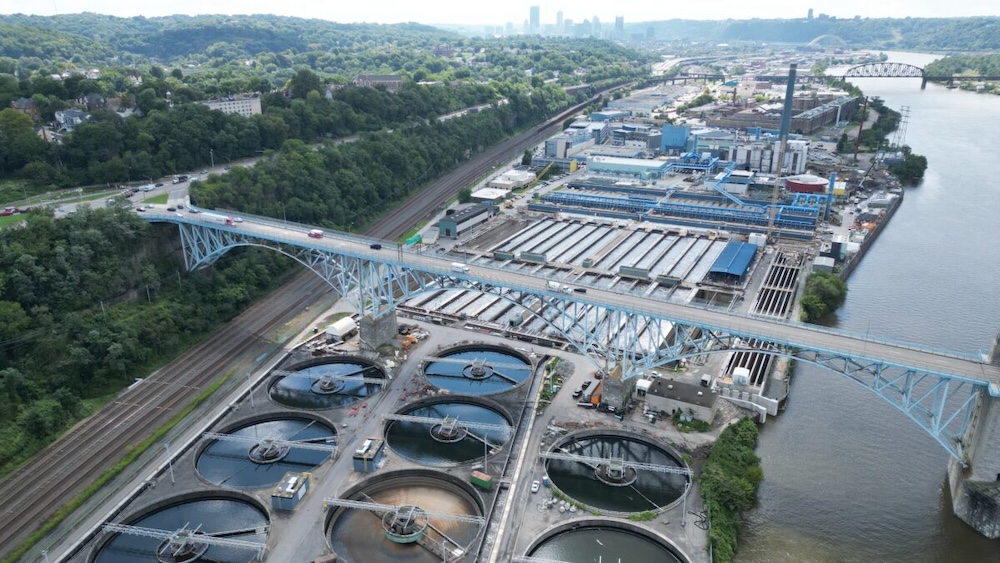
 A view of ALCOSAN next to the Ohio River Credit: Robert Strovers, Wiki Commons.
ALCOSAN not only opens its doors for the open house and other science days throughout the year — they send representatives out into the communities, too. This allows for young county residents to see a future career in STEM at the plant, which employs everyone from those with high school diplomas to doctorates.
“Being able to grow up and see people who are in the industry actually helps us train up the next generation of water and wastewater treatment workers,” says Erica LaMar Motley, Director of Scholastic Outreach and Education at the plant. “Having the kids come down to open house, run around with hard hats with our ALCOSAN name on it … It tells them that this is a place where they can come and work.” She hopes that kids remember that they were welcomed since the time they were preschoolers as they begin thinking about future careers. ‘They’ve welcomed me from the time I was a preschooler.’”
 Visitors line up for the ALCOSAN Open House on Sept. 19, 2026. Credit: Meg St-Esprit.
It’s an all-hands-on-deck situation at the open house, according to Darnetta Craig, who is the lead engineer in regional conveyance — which is a fancy way of saying she’s an incredibly smart person who helps keep the county’s sewer lines working, getting wastewater from our neighborhoods to the treatment plant.
“Strengthening relationships is our goal,” says Craig. “We’re very intentional about outreach because we need it to move our program along.”
That’s true in her daily role, but it’s just as true the day the plant opens its doors to the community.
At the open house, Craig moves the program along by calling bingo — with an educational bent. As bingo combinations are called, Craig and her team use the numbers and letters to highlight sewer connections on a map of the county. At one point, dozens of folks were shouting, “Turtle Crick!” in unison as they followed the flush. It feels like one of those iconic yinzer moments kids will remember when they are grown.
Slime and social media
That work hits the road all around the county, inspiring future scientists and just doing the hard work of educating the general public about how water treatment works. There is an actual online game that lets residents follow the flush; there’s a mobile van. There’s even a mascot named Frankie the Fish.
Erin Thompson, Youth Services Coordinator at Andrew Bayne Memorial Library in Bellevue, has utilized mobile ALCOSAN programming for several years. She loves how the teams make complex (and seemingly boring) topics accessible and fun.
“I’ve had them bring marble runs for preschoolers who then realize that sewer systems are built much like marble runs,” she shares. At another event, kids and their grownups made slime — a common activity. At this event, though, ALCOSAN educators used a fun activity as a bridge into learning.
 Frankie the Fish poses with other ALCOSAN mascots on Sept. 19, 2026. Credit: Meg St-Esprit.
“Slime-making wasn’t just about making slime, but about what a polymer is and why we care about it,” says Thompson. “Kids and families were engaged the entire time, which doesn’t always happen with programs. Their education team is top-notch, and I will always request them to come visit the library.”
ALCOSAN also seeks to take its education digital. Geneva Kenney, the team’s Social Media Specialist, is the brains behind the often-hiliarious-but-always-informative social media accounts. “The work we do is so hidden, but the humor is often the doorway to get to the end goal, which is public education,” says Kenney.
Kenney cites an example from this summer, which featured a great deal of wild weather.
“We had a big storm, and I said to everybody, ‘We got to gather round now. It’s time to talk.’ I wanted people to understand at that moment, we are there with you guys. We understand it, we see all of it, we are experiencing it—and we are operating it.”
Kenney says she sees this as an opportunity to use a real event to educate about the important work ALCOSAN is doing. “I hope the jokes are funny, but if in six months people really have an understanding of regional investments and the work we are doing, that’s the payoff in the end.”
Pittsburgh potties
The team’s focus, from flush to fish habitats, is on the future ALCOSAN hopes to create for the region. From future scientists and truck drivers and engineers to the future of the county wastewater infrastructure itself, ALCOSAN is looking forward.
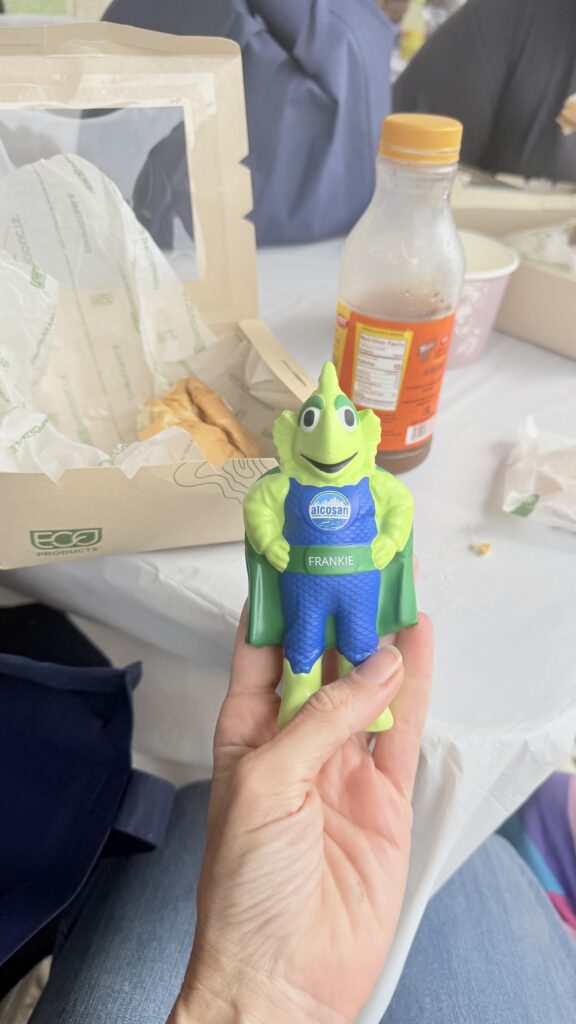 A Frankie the Fish action figure Credit: Meg St-Esprit.
“We have to be mindful that parts of the area’s sewer system are a century old,” says Michelle Buys, Director of Environmental Compliance. She works closely with the education and outreach programs as well. “One hundred years ago, the wastewater system was designed to be flushed with stormwater, and it was sent to the rivers.” Over time, that combined sewer overflow became too much for the old system.
That’s where the Clean Water Plan comes in. ALCOSAN’s new $4.5 billion Ohio River Tunnel project will add 4.9 miles of deep tunnels to capture the mix of sewage and rainwater that can overwhelm local sewers during storms. Instead of spilling into rivers and streams, that wastewater will be routed to the treatment plant.
These big upgrades will require local education as well as support. From the families who get inspired at outreach events to regular residents who learn a bit more about their flush through a Thread or Reel, it’s important for Allegheny County residents to know how essential infrastructure functions work.
Buys says many parents are surprised to see just how involved the process is, and the kids become the gateway to adult curiosity, too: “I see parents lean over to their kids and express their excitement over chemistry. Many parents didn’t realize the amount of scientists, biologists, and chemists at ALCOSAN.”
When it comes to treating the waste from the entire county (and teaching others about it), it takes a unique angle and a bit of an ability to laugh at yourself. Perhaps that’s why ALCOSAN stands out among the regular, everyday authorities that keep Pittsburgh running: The ability to take a dirty and confusing job, use humor as a gateway into the science, and have some fun with it.
 Visitors at an ALCOSAN Open House activity station Credit: Meg St-Esprit.
Motley recalls one particular classroom visit that drives this point home: While standing before a group of fourth-grade students doing a career day presentation, she found herself exclaiming, “I never thought I would fall in love with sewage!”
Motley laughs as she tells the story, but emphasises that the emotions behind it were very real.
“I realized that I just said I loved sewage, like it was my favorite food or a vacation spot. Although it wasn’t the sewage that I loved; it was the treatment process and having an understanding that Clean Water Starts Here.” She says that most people start with the belief that ALCOSAN is the end of the treatment process, but it’s actually the reverse. “It’s the place that ensures the waterways are a place to create memories with family and friends; the aquatic life is able to not just survive, but thrive,” says Motley.
“I guess, if falling in love with sewage is the funniest line, then I hope I have left a splashing impression, and they know just a little more about ALCOSAN.”