
From late September to early October, Jean–Michel Rabaté, a Penn professor of English and comparative literature, was in Paris. It also just so happened that his trip coincided with one of the most critical, highly–anticipated events in fashion all year: Paris Fashion Week.
“It was extraordinary, I have to say … there were shows everywhere, but it was in the street. Everybody was dressed up,” Rabaté says, reminiscing fondly on his time spent in one of (if not the) world’s most renowned fashion capitals.
“In the morning, afternoon, evening, night, you had groups of people dressed in a very extravagant way, taking selfies of being filmed by everybody else and so on … ,” he notes, culminating with a Saturday Pride parade.
But alongside a bursting fashion scene, a tense political landscape fraught with unrest was also on display. Noting heavy police presence during his stay, Rabaté observed a “weird combination of politics and fashion” that exists both on and off the runway.
As multiple news outlets report, weeks of student–led demonstrations have ballooned into a series of protests across France. However, such political tensions have long been brewing. The New York Times emphasizes how “the phenomenon has been building for years, with the perceived failure of liberal democracy to make good on its promises of a better future, especially for the young and the salaried working class.”
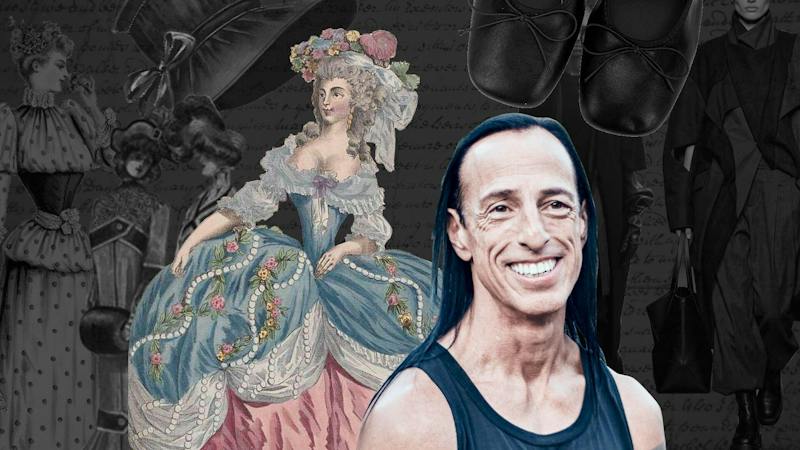
These complex yet intrinsically linked relationships between fashion and the everyday, fashion and the political, and fashion and the modern that Rabaté witnessed unfold firsthand in Paris are exactly what he hopes his students will grapple with through his ENGL 1071 course. Titled “Fashion and Modernity: From Marie Antoinette to Rick Owens,” the class has been taking place during the fall 2026 semester through Penn’s English Department.
According to the Penn English website, the course sets out to “study the emergence of the concept of the ‘new’ as a term understood as ‘new fashion.’” In other words, “What is the ‘fashion of the new,’ and how is the concept linked with the material production of fashion?” the course description thoughtfully poses.
“[What] I am not doing is fashion in all countries [or] fashion in all periods. I am focusing on a certain concept of fashion that is European in a way and American, and also now international, and it starts with the nineteenth century by coincidence,” Rabaté explains.
Referencing Emile Zola’s fashion book which translates to the English title The Ladies’ Delight, he further clarifies that the focus of his course takes a distinct approach: “ … it’s more a philosophical and literary concept of fashion as a certain way of talking about modernity.”
The concept for the course dates all the way back to the 1960s when Rabaté was still a student in France. In charge of a film club in Paris, Rabaté explains that, five years later in 1973, they made the decision to screen documentaries made in May of 1968.
“And when we saw those films, what struck us was how much fashion had changed in five years, so it was really a discovery that what had been [the] result of students’ rebellion had also brought about a new type of fashion, and so that was one thing that was always in my memory. It’s kind of [a] notion of fashion in an extended sense, not just clothes, but also the way we behave,” Rabaté says.
He was also influenced by French Poet Mallarmé, whom he both worked on and published about. Particularly, Rabaté was fascinated by La Derniere Mode, the name of a year–long project in which Mallarmé created his own fashion publication.
More recently, Rabaté notes that over a decade ago, “there was a show in Paris that then went to the Met, called Impressionism, Modernism, and Fashion, and so that’s when I decided to do the class,” he explains. “It gave me enough ideas to think.”
When Rabaté first taught the course, things looked somewhat different. The course content was far more focused on French 19th–century culture as it relates to themes of modernity and invention, drawing from pivotal thinkers such as Walter Benjamin and Theodor Adorno. Now, Rabaté has made some adjustments.
“What I have decided to do is to extend a little bit the historical period, so we begin with the French Revolution and Marie Antoinette and the idea of fashion—even before Marie Antoinette—as a tool of power for the king in Versailles, and how fashion was connected with a very strict code called etiquette, as a way of creating surveillance and forcing the noble families to ruin themselves, and I am now moving much more into contemporary stuff, ending with Rick Owens and many contemporary designers. So broader vision and optic,” Rabaté explains.
Although his course begins with the French Revolution and Marie Antoinette, it takes a series of turns through time. Supplemented by a carefully selected list of readings from the likes of Charles Baudelaire and Mallarmé in addition to the course text Fashion Theory: A Reader by Malcolm Barnard, alongside several films, the course stitches together a wide variety of 20th and contemporary 21st century designers including Elsa Schiaparelli, Martin Margiela, and Virgil Abloh. At the end of the course, students complete a portfolio in which they are tasked with selecting a designer, finding a theme, and illustrating it.
When it came to the selection of which designers to hone in on, Rabaté notes that, in the past, he has worked with fashion curator and historian Valerie Steele, director of The Museum at the Fashion Institute of Technology. Rabaté cites Steele’s Fashion Theory: The Journal of Dress, Body, & Culture, as many of the works featured designers are ones that strongly resonated with him, including Comme de Garçons, Yves Saint Laurent, and Thierry Mugler. He also recalls a show in Paris called “Temple of Love” that inspired his decisions.
So how exactly does Rabaté begin to draw connections between, for instance, the Rococo–movement–inspired, lavish 18th century style of Marie Antoinette with her luxurious, frilly gowns and the edgy, “goth” aesthetic of Rick Owens, with his asymmetrical necklines and high–top leather geobasket sneakers?
“One question that I have always wanted my students to work on is this idea: What is a revolution in fashion?” Rabaté poses.
Juxtaposing fashion with the political, the modern, and the everyday allows for thoughtful interrogation when it comes to style and dress: “Was punk a revolutionary movement? Was it anti–fashion simply or a new fashion? Isn’t it always recuperated by fashion?” he muses.
Mentioning the work of philosopher Walter Benjamin, he also notes that the cyclical nature of fashion anchors the course. “ … It’s the eternal return of the new. See, the new returns all the time. So that is a paradox, of course. What does it mean? The new returns,” Rabaté says. Trends and styles that were once outdated always seem to find their way back into the public consciousness, complicating our perceptions of the old and the contemporary.
“You know, when you deal with fashion, you pose many, many questions that one could ask about the arts [or] history of the arts. But it’s also connected with everyday life.”
To the extent of Rabaté’s knowledge, he hasn’t encountered many other fashion–based courses here at Penn, so he appreciates the English Department’s flexibility when it comes to course teachings. Sometimes Rabaté is interested in film and theory, or other times it might be classical literature.
“But fashion, I think, is a good way of combining a certain philosophical, literary, and I would say artistic knowledge, because it’s art in a sense,” he says.
For Penn students that are interested in bringing fashion into their academic coursework, perhaps Rabaté’s course can open up opportunities and conversations for more fashion–oriented classes in the future. In spring 2027, Penn is slated to offer a few more fashion–related courses for students to enroll in, including Dress and Fashion in Africa, Modern Italian Culture: Italian Fashion, and a Critical Writing Seminar in Toxic Fashion.
Looking back at the history of his own class, Rabaté recalled the very first iteration he taught. Going over a text by Roland Barthes about fashion, signs, and language, he remembers how one student who had to present opted not to say anything at all.
“She came and she said, ‘Read me,’ and almost everybody in the class could see what she was wearing and why and how connected they were,” Rabaté says. “And so this is what I expect: [it] is not so much more knowledge about literature [or] philosophy on fashion, but an awareness of how fashion permeates everything in our lives.”