
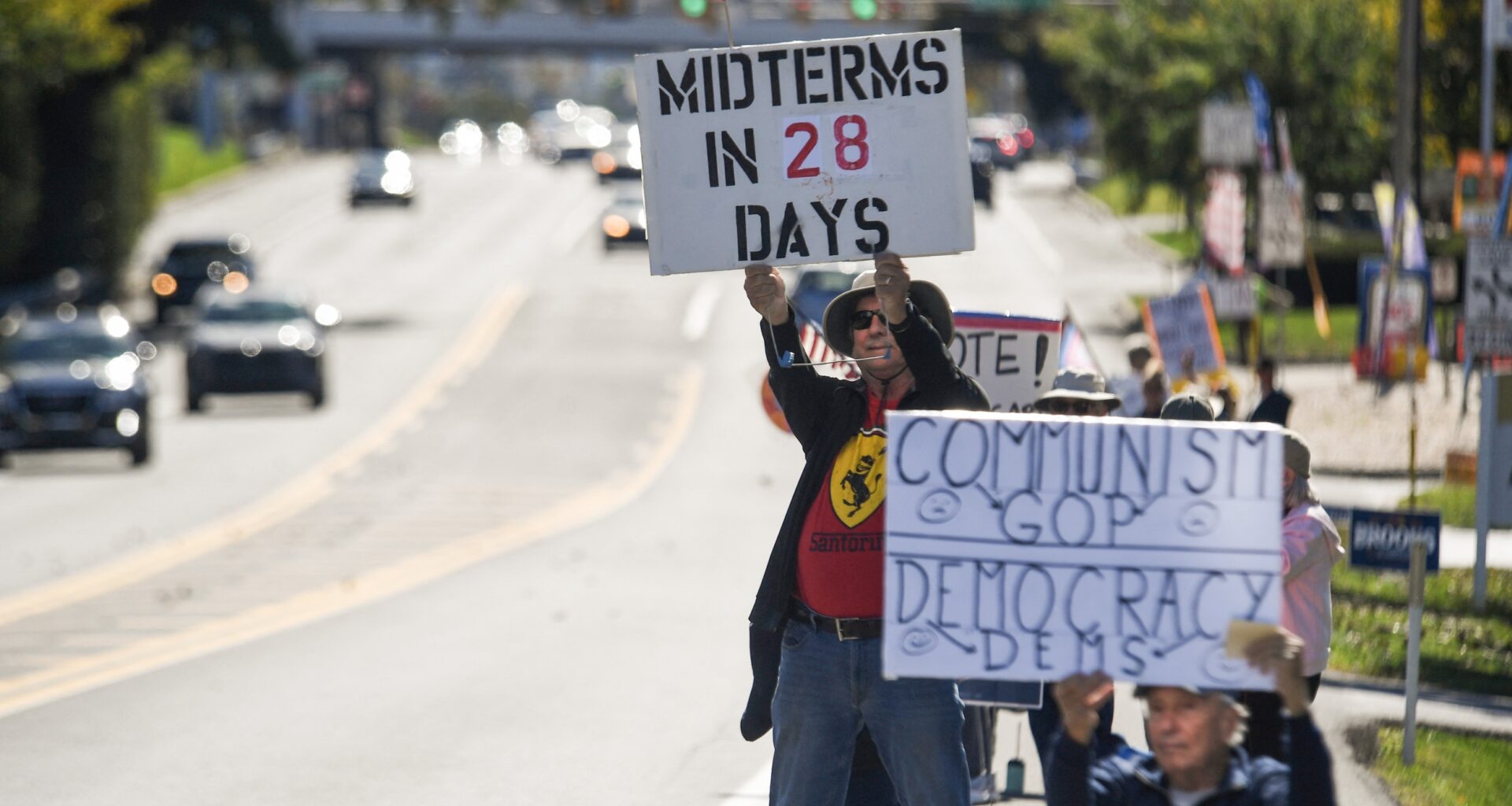
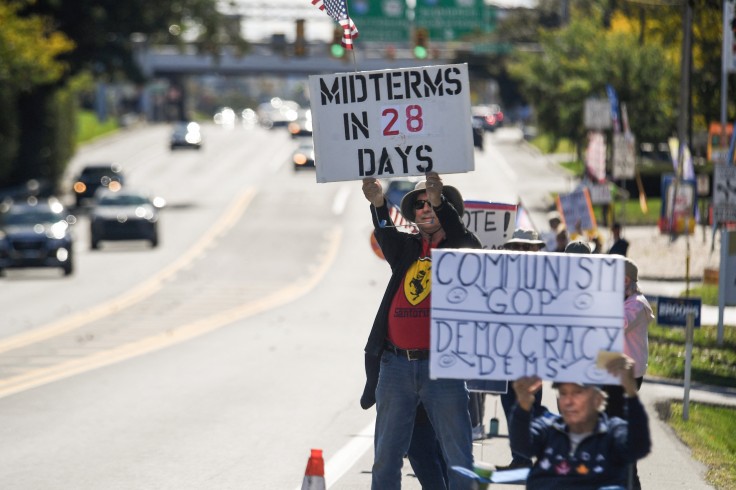
Demonstrators hold signs along a road near the office of US Representative Ryan McKenzie, Republican from Pennsylvania, in Allentown, Pennsylvania on October 5, 2026. Every Monday, dozens of residents line a boulevard in this industrial Pennsylvania city to silently protest against President Donald Trump. The group – mostly middle-aged retirees – has been gathering every week on this street since Trump returned to power in early 2025, near the unassuming offices of Ryan Mackenzie, a Republican member of Congress who narrowly won election representing the Allentown area in 2024. They hope Mackenzie will be swept out of office in a Democratic wave in the November 3 elections that many see as a referendum on Trump, whose national approval ratings have fallen into the mid-30s.
Photo by Matthew Hatcher / AFP via Getty Images
The BriefingAllentown, the population center of Pennsylvania’s 7th Congressional District, is a majority-Latino city where roughly 56 percent of residents identify as Hispanic or Latino, placing it at the geographic heart of the most closely watched House race of the 2026 cycle.Latinos account for roughly 23 percent of the total population in PA-7, a share large enough to determine the outcome between Republican Rep. Ryan Mackenzie and Democratic challenger Bob Brooks in a district decided by a single percentage point two years ago.A new NBC News/Telemundo national poll of Latino registered voters finds only 20 percent approve of President Trump’s handling of the cost of living, while 78 percent disapprove — numbers that are reverberating through morning radio in the Lehigh Valley.A Question, an Open Phone Line, and an Earful
Victor Martinez turned it into a challenge. From his fourth-floor studio in downtown Allentown — hardwood floors, a view of an old stone church, and a control board he works like a conductor mid-performance — he put a single question to the thousands of Spanish-speaking listeners tuned in each morning to La Mega 101.7: name one positive thing about President Donald Trump.
What rolled in was not a list of achievements. A trucker called to share what he described as a silver lining to surging diesel prices — he was anticipating an unplanned vacation because he could no longer afford to top off his rig. A second caller said flatly that he had no intention of voting this November, and left it at that.
At the halfway point of Trump’s second term, Martinez said the mood he hears on air mirrors what he was picking up two years ago — frustration over fuel costs, grocery bills, and an economy that neither administration has managed to tame in the eyes of his callers. “It’s the economy, stupid. That’s what it is. I mean, things have gotten so bad,” he told the Associated Press. “People didn’t think Biden did a good job. Everything was expensive and now it’s worse.”
A Decade on Air, a Community Tuned In
Martinez has been at the microphone in the Lehigh Valley for nearly ten years. Over that stretch, the Latino share of the area’s population has moved from roughly one in five residents to approaching one in four. The politics hour he added to the show during the final stretch of Trump’s first term has since grown into the program’s most-listened-to segment — part call-in therapy, part civic forum — where callers have aired their fears about the January 6 attack, their frustration with inflation under Biden, and their anxieties about the current moment in equal measure.
The studio sits inside Pennsylvania’s 7th Congressional District, and the race unfolding around it has drawn national attention as one of the contests most likely to determine which party controls the House of Representatives after November 3.
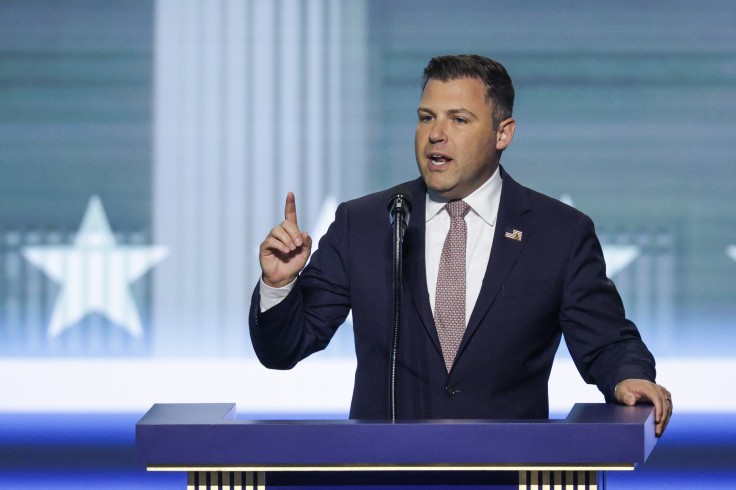
DALLAS, TEXAS – SEPTEMBER 10: U.S. Rep. Ryan Mackenzie (R-PA) speaks on stage on the second day of the 2026 Republican National Convention at the American Airlines Center on September 10, 2026 in Dallas, Texas. U.S. President Donald Trump is headlining the Republican National Committee’s first-ever midterm convention as he aims to highlight his administration’s achievements and rally support for GOP candidates just two months before the upcoming elections being held on November 3.
Photo by Alex Wong/Getty Images
The Race at the Center of the Map
Freshman Republican Rep. Ryan Mackenzie, who defeated then-Rep. Susan Wild by just over one percentage point in 2024, now faces Democratic challenger Bob Brooks — a retired Bethlehem firefighter who spent two decades on the job before rising to lead the Pennsylvania Professional Fire Fighters Association. Brooks has anchored his Latino outreach around the nickname “Bombero Bob” — Spanish for firefighter — stopping by a Mexican restaurant and a barbershop with a Dominican flag hanging inside to carry the message to voters directly. Mackenzie, meanwhile, opened a district office in downtown Allentown with Spanish-speaking staff and unveiled a Latinos for Mackenzie coalition over the summer.
A Morning Call analysis of 2024 Lehigh County precinct data established that movement in majority-Latino Allentown neighborhoods was decisive in Mackenzie’s original narrow win. Holding or reversing those numbers — in a city where economic anxiety has not receded — is now the defining test of his campaign.
Republicans Buy the Airtime, But the Callers Don’t Care
Both campaigns have purchased advertising time on La Mega 101.7, giving each party a line directly into the community. The calls coming into the show, however, are not receptive to the messaging. When Martinez invited listeners to cite something positive about the president’s record, one caller brought up the $5,000 payout Trump has claimed voters would receive if Republicans retain Congress — and Martinez let a laugh track run over the air in response.
Jackie Rivera, vice chair of Lehigh County Republicans, did not shy away from the economic tension. “We’re not pretending everything is great right now,” she said. “You have to be honest with them so that they can believe in you and actually trust in what you’re stating to them.”
Allentown’s Democratic Mayor Matt Tuerk offered a less diplomatic read of the moment. “People on the street were like, ‘Yeah, but my monthly childcare bill is higher and then my monthly mortgage, the price of groceries is ridiculously high,'” he said. “That’s the same story that you hear right now. There’s been no improvement.”
The Voices Neither Campaign Is Ready to Answer
The phone calls reaching Martinez’s studio are not the voices that campaign messaging was designed to address. Listener Claudia Parrales-DeLeon said the show gives people a chance to hear what others are living through, even when what they hear is hard. “I don’t know if it makes people less afraid, as much as it makes people more informed,” she said. She recalled a day when a caller’s account of losing his job, failing to find another, and not knowing where his children’s next meal was coming from moved her to tears while listening.
Alberto Pena has co-run a Dominican restaurant in Allentown with his wife for close to two decades. He voted for Trump two years ago in the hope that prices would ease after the inflation of the Biden years. Today, he and his wife are still “living day by day,” and he is leaning toward Brooks in November. “This is not what we expected,” he said. “The economy is completely on the ground.”
The Crossover Voice Neither Party Can Control
Martinez is openly backing Brooks this cycle. But his political history does not fit the partisan profile either campaign would draw. He supported Marco Rubio and Jeb Bush in Republican primaries and pushed back against Biden’s decision to run for a second term, arguing he was too old. That crossover credibility is what makes his audience difficult for either side to write off — and difficult to lock down.
Stephanie Valencia, co-founder of Equis Research, a Latino political polling organization, has observed that “Democrats lost a thread with Latinos over the last couple of election cycles,” while cautioning that Republican inroads from 2024 are far from permanent.
When a caller told Martinez he had given up on the whole exercise of voting, Martinez did not simply sympathize. “I understand that feeling of frustration,” he said on air, “but not doing nothing is not the answer.”
Whether that conviction travels from the radio into the ballot box — in a district where a few hundred votes in the right precincts could shift control of an entire chamber — is the question that will be answered on the morning of November 4, when the calls stop and the votes are counted.
© {{Year}} Latin Times. All rights reserved. Do not reproduce without permission.