
Tuesday was Veterans Day and across the region and the country ceremonies rightly honored the service and sacrifices of our men and women in uniform and the families who serve and sacrifice in everyday ways that get less public attention and appreciation.
For veterans and their families, every day is Veterans Day.
Monday marked the 250th birthday of the Marine Corps, which is a year older than the nation itself. I marked the anniversary with Marine veteran Dana Nelson and Donna, his wife of 23 years. We met for coffee and a briefing on Dana’s search for a kidney donor. He was gravely wounded in the first Gulf War and didn’t know it until decades later.
Toxic smoke from “burn pits” ruined Dana’s lungs. A transplant saved his life but ruined his kidneys. Almost 35 years after he came home from war, this Marine is still fighting for his life.
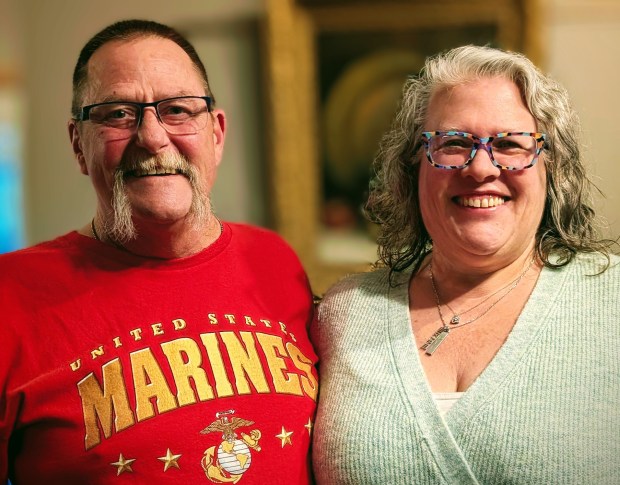 Disabled Marine Dana Nelson’s service in the first Gulf War cost him both lungs. Now he needs a kidney transplant. He and his wife, Donna, are seeking a living donor to save Dana’s life. (CHRIS KELLY / STAFF PHOTO)
“The Seabees did a good job setting it up, but it was very primitive,” Dana said of the base in Bahrain, where he served as an aviation/hydraulics mechanic. Burn pits blazed around his living quarters. Dana and his fellow Marines were breathing poison 24 hours a day.
“You didn’t really think about it,” he said. He felt no immediate effects and left the Marine Corps in 1991 for a civilian career repairing helicopters in Washington state. By 2019, he needed a double lung transplant. Miraculously, Dana was put on the transplant list in just 12 days. Two days later, he received his Gift of Life at the Hospital of the University of Pennsylvania in Philadelphia.
Dana successfully navigated the COVID pandemic, but in 2022, his body began to reject his donated lungs. The medicine used to fight the rejection ruined his kidneys. Dana kept the lungs, but also the dialysis treatments. DOVE, a nonprofit that works to secure living kidney donations for veterans, is leading the charge to get Dana a transplant. Living-donor kidneys last longer. The average wait-time for deceased-donor kidneys is five to eight years.
Dana’s first application for disability benefits was denied, but his second quickly resulted in a 100% disability classification. Dana, 60, and Donna, 57, said the Veterans Administration has made sure he gets any treatment he needs.
This wasn’t always the standard. In 2022, I reported the story of Dalton native Scott Laird, a major in the Pennsylvania Army National Guard and Bronze Star recipient who died of colon cancer in 2021. He was 40 and left behind a wife and two young sons. A VA oncologist connected Scott’s cancer to toxic exposure from burn pits, but the government denied his claim that his illness was service-related.
A year after Scott’s death, the Honoring our PACT Act was signed into law by President Joe Biden, who believed his son Beau’s fatal brain cancer was connected to toxic exposure from burn pits.
“Burn pits” is an absurdly understated description. In March 2004, Times-Tribune Photo Director Mike Mullen and I were embedded with the Scranton-based 2nd Battalion, 103rd Armor of the Pennsylvania Army National Guard. We spent 31 days in Kuwait and Iraq telling the stories of local soldiers at war and breathing the same fetid air.
Some “pits” were the size of football fields, filled with trash, plastic, construction rubble, ruined vehicles and human waste. They were doused in jet fuel and torched, fouling the air for miles around. “Burn pits” were also used in Afghanistan, but until I met Dana I had no idea they were standard in the Gulf War, too.
How Dana met Donna is a love story worthy of a Hollywood “rom-com.” They connected on aol.com in the days of dial-up internet. Dana was living in Washington state. Donna was teaching at the dePaul School in her native Scranton. He was intrigued by her screenname: “SheReadsalot.” Their correspondence graduated from emails to phone calls and Dana eventually invited Donna to visit him in Seattle.
Donna had reservations about flying 2,300 miles to visit a guy she met on the internet, but when she saw a delivery truck with “Washington” on the side, she decided to go.
“That was my sign,” she said.
Dana was a goner from the get-go.
“I met her and I said, ‘That’s it. I’m moving to Scranton,’” he said.
“So you were actually ‘Sleepless in Seattle?’” I asked.
“Absolutely,” Dana replied with a broad grin.
Dana took a job at Lockheed Martin and they made a home in Scranton with Chessie, a Lab mix, and Benny, a pugnacious pug. It’s a good life, punctuated by four-hour dialysis treatments three times a week. Dana is in end-stage kidney failure. Without a transplant their good life together will end sooner.
“It’s every day,” Donna said. “You have to schedule everything around dialysis and doctor appointments and being there for him.” She said her employer has been “wonderful” in giving her time and support and family has rallied to make sure she and Dana have the help they need.
“It really does take a village,” Donna said.
Dana has a daughter, son-in-law and three grandchildren in Washington and other family in California, Kentucky, New Hampshire and Idaho. The pandemic postponed a planned trip to visit far-flung relatives, including some Dana hasn’t seen in more than a decade. A transplant is the ticket to making the trip a reality. More importantly, it’s the key to keeping Dana and Donna’s rom-com rolling.
Before parting ways on the 250th birthday of the Marine Corps., I asked Dana a question I’ve posed to dozens of veterans whose health was ruined as a result of their service.
“Do you ever regret serving?” I asked.
“Never,” he said.
I get the same answer every time.
To help Dana, visit dovetransplant.org or call 551-233-1611 for information.
CHRIS KELLY, the Times-Tribune columnist, salutes all who serve, including their families. Organ donors, too. Contact the writer: ckelly@scrantontimes.com; @cjkink on X; Chris Kelly, The Times-Tribune on Facebook; and @chriskellyink on Bluesky.